Full Article
about Torreblacos
Small settlement near Calatañazor
Hide article Read full article
A village that feels almost missed
Some places give the impression you were never quite meant to arrive. Torreblacos, in the Tierras del Burgo area of Soria, is one of them. With a population of around thirty people, it sits quietly along a rural road where the journey can feel longer than the destination might suggest.
On an ordinary weekday, the sense of stillness is striking. There may be only a handful of people about, perhaps someone tending plants, a dog watching from a distance, and very little else. The dominant presence is silence, the kind that settles in rather than feeling empty.
Benches facing the open land
One of the first things that stands out in Torreblacos is how the village is arranged in relation to the landscape. The benches are not placed at random. They face outward, towards the fields, as if inviting people to stop and look rather than pass through.
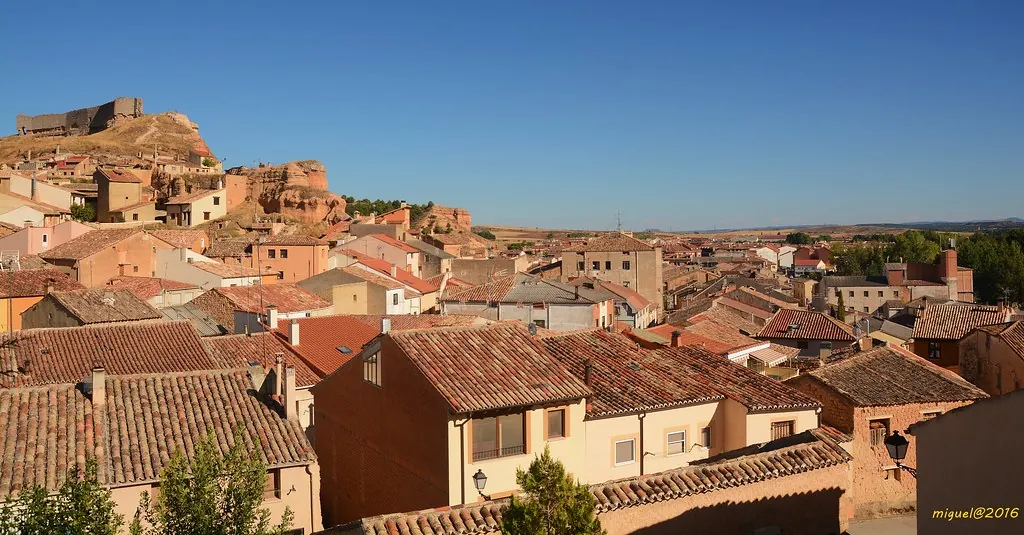
The village rests on a gentle slope. Its stone houses and dark roofs blend into the terrain, almost merging with the earth around them. A short walk is enough to leave the last buildings behind and reach open countryside, where fields stretch out and shift in colour with the seasons.
On clear days, distant sierras frame the horizon. The setting may seem unremarkable on a map, yet standing there brings a strong sense of space that is typical of Soria. There is a wide sky, very little noise, and roads where minutes can pass without seeing another vehicle.
At the centre of Torreblacos stands the church of San Andrés. It is generally dated to the 16th century, although like many rural churches it has been altered over time. The exterior is simple, built in stone with a solid presence. Its heavy door opens slowly, with the kind of sound that suggests long familiarity and repetition.
Depopulation without needing numbers
There is no need for statistics to understand what has happened in places like Torreblacos. It becomes clear just by walking through the streets.
Closed windows, large doors that are no longer opened every day, and vegetable plots that are still maintained but by fewer hands than before all tell part of the story. Even so, the village does not feel completely abandoned. It feels paused, as if waiting.
Conversations with residents often turn to comparisons with earlier decades. There was a time when there was a school, when daily life brought more movement, and when local celebrations filled the streets with cars and people. Today, the rhythm is quieter and more measured.
Life has not disappeared entirely. Some houses reopen in summer. Families return at weekends. There are those who keep hold of a family home even if they no longer live there permanently. The village shifts between stillness and brief periods of activity, depending on the time of year.
Walking without watching the clock
The surroundings of Torreblacos are shaped by long-used dirt tracks and agricultural paths that connect one area to another. They are not signposted routes in the style of a natural park, but they are easy enough to follow for anyone who enjoys walking without too much structure.
Within minutes of leaving the village, the landscape opens into fields and low vegetation. In spring, the change is noticeable. Fresh grass appears, wildflowers begin to dot the ground, and there is a distinct scent of damp earth after several days of rain.
This is not a place of dramatic peaks or striking viewpoints. The appeal lies elsewhere. Walks here tend to be long and unhurried. Along the way, there might be a tractor passing, a flock grazing in the distance, or simply the wind moving across the crops.
Time feels less important in this setting. The paths invite wandering rather than destination-focused walking.
Food that belongs to the table, not the camera
Torreblacos does not have restaurants or terraces where visitors can sit and order from a menu. In villages of this size, meals are usually taken at home.
When people gather, the food reflects the traditions of this part of Soria. Dishes are based on what has long been cooked here: lamb, slow stews prepared over time, proper bread, and products from the winter pig slaughter. Migas are also common, cooked in a large pan and eaten slowly, with conversation taking priority over anything else.
If visitors happen to fall into a conversation with locals and are invited into a kitchen, something that is not unusual in small villages, the pace of these meals becomes clear. The sobremesa, the time spent talking after eating, stretches out without hurry.
When the village fills again
For much of the year, Torreblacos remains very quiet. That changes when local celebrations arrive.
San Blas is one of the key dates in the village calendar. There are also gatherings and romerías in spring, traditional outings or pilgrimages that bring together residents and people returning from nearby towns and cities. During these days, the streets fill with voices, parked cars appear where there are usually none, and long tables are set up for shared meals.
Summer nights bring another shift. Many people return to family homes, and the atmosphere changes for a few hours at a time. Music can be heard, chairs are taken out into the street, and the village briefly takes on a different rhythm.
It does not become busy in the usual sense. Instead, the life that is scattered throughout the rest of the year gathers together.
Taking the time to understand it
Torreblacos is not a place that works well as a quick stop. Arriving, taking a photo and leaving means missing much of what defines it.
Spending a little time makes a difference. Walking through the streets, sitting on one of the benches that face the fields, and waiting a while allows the place to reveal itself more naturally. In villages this small, it is common for someone to pass by sooner or later.
What stands out is not a single landmark or attraction, but a way of being. Torreblacos offers space, quiet, and a slower rhythm that is increasingly rare. It asks for time rather than attention, and gives back a sense of calm that does not need explanation.