Full Article
about Valdenebro
A farming village ringed by juniper and pine woods.
Hide article Read full article
A village that appears without warning
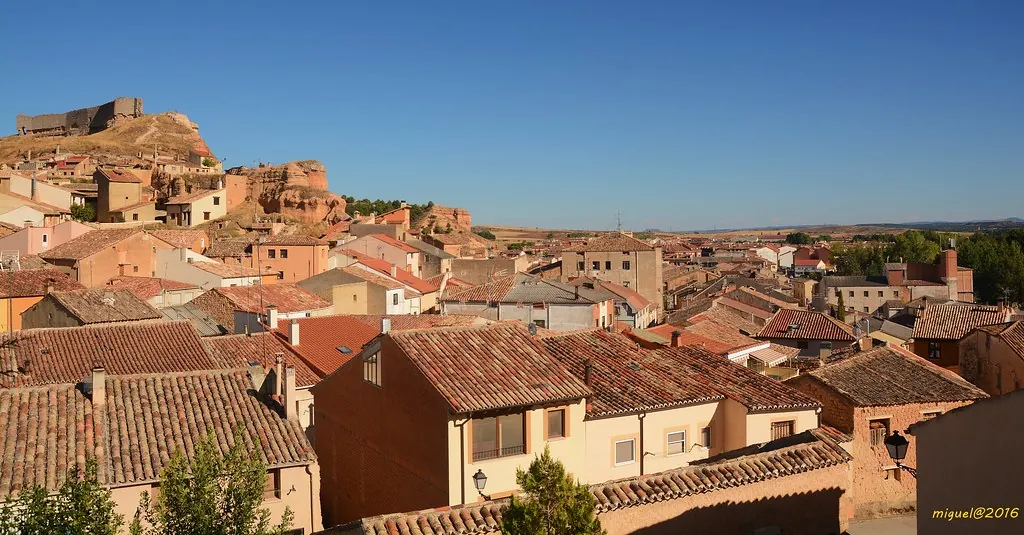
Early in the morning, the dominant sound is the wind moving through the fields. Nothing else. The approach to Valdenebro runs between stretches of cereal crops in every direction, and as the sun rises, a flat light settles over stone and adobe façades. The village comes into view without announcement, gathered on a small rise in the Tierras del Burgo area of Castilla y León. Around eighty people live here, and daily life follows the rhythm of the seasons more than the clock.
There is no sense of rush. The surroundings are open, the horizon wide, and the silence is part of what defines the place. Valdenebro does not present itself as a destination packed with attractions. It is somewhere to observe how life still unfolds in much of inland Castile, where conversations stretch into the evening and the wind continues its steady passage across the plateau.
Streets gathered around San Juan Bautista
The village can be crossed in a matter of minutes, though it rewards a slower pace. Streets are narrow, lined with stone walls that hold onto coolness even in the height of summer. Some houses still display carved coats of arms above their doors, while wooden gates have darkened with age.
At the centre stands the church of San Juan Bautista. Its solid tower is visible from the surrounding fields and acts as a point of reference when arriving along the agricultural tracks. Like many rural churches, the building reflects changes over time. Older sections sit alongside later repairs, all within a restrained Castilian style that avoids excess decoration.
The layout of Valdenebro is simple. A handful of streets cluster around the church, with no clear separation between living space and the agricultural landscape beyond. Step beyond the last houses and the countryside begins almost immediately.
Walking out into open land
Dirt tracks extend from the edge of the village in all directions. These are working routes used by locals to reach their plots, wide and generally flat, making them easy to follow on foot or by bicycle. Anyone heading out should carry water, as shade is scarce for several kilometres.
The landscape is defined by its openness. Wheat and barley dominate in spring and summer, while autumn brings stubble and ochre tones. Scattered junipers, enebros in Spanish, punctuate the fields. On damp days they release a resinous scent that lingers in the air.
On clear days, other small villages can be seen on nearby rises. Their church towers rise above the rooftops, echoing the same pattern as Valdenebro. The sense of distance is constant, yet nothing feels entirely isolated.
Spring is often the most rewarding time to walk here. The green of the fields lasts only a few weeks, and poppies begin to dot the edges of the tracks. By high summer, the sun is intense and the land becomes noticeably drier. The same routes remain, but the experience shifts with the season.
Watching birds in the cereal plains
The surroundings of Valdenebro form part of a typical cereal-growing plain, known in Spain as campiña cerealista. These landscapes are closely tied to birdlife that thrives in open farmland.
Set out early and it is common to see partridges crossing the tracks. Larks are a constant presence, their song carrying high above as they spiral upwards. Birds of prey also appear, gliding over the crops in search of movement below.
There are no designated observation points or marked routes for birdwatching. The usual approach is simple: stop along a track, remain still, and watch with binoculars. Patience matters, as does respect for the environment. Keeping to the paths avoids disturbing cultivated areas and the wildlife that depends on them.
Winter cooking and sheep-based produce
The local cuisine reflects a region shaped by long winters. Sheep farming plays a central role, and this is evident in the food. Cured cheeses, hearty stews and roasted dishes are typical, traditionally prepared in wood-fired ovens in family homes.
Seasonal ingredients also make an appearance. In autumn, especially when the weather is damp, mushrooms can be found in the surrounding countryside. Locals who go out to gather them know the terrain well. Without experience, caution is important, as mistakes in identifying wild mushrooms are more common than they might seem.
Food here is not elaborate. It is practical, filling and closely tied to what the land provides at different times of year.
When the village fills with people
The most important celebrations revolve around San Juan Bautista, the village’s patron saint. During these days, people who live elsewhere return, and the atmosphere changes noticeably. There is a procession, gatherings in the square and shared meals among neighbours.
Summer brings other simple activities, often organised by those who come back for the holidays. For a short time, Valdenebro regains a sense of bustle that recalls earlier decades, when more people lived here year-round.
Outside these periods, quiet returns quickly. The contrast is part of the village’s character.
Choosing the moment to come
For those seeking silence, any time outside August maintains the calm of a small rural community. In summer, it is best to walk early in the morning or later in the evening. Around midday, the sun is strong and there is little shade along the tracks.
Valdenebro does not revolve around a packed schedule of activities. It offers something simpler: open fields, short streets, unhurried conversations at dusk, and the steady sound of wind moving across the Castilian plateau.