Full Article
about Villanueva de Gormaz
Tiny village in a vineyard and riverside area
Hide article Read full article
A village shaped by the Duero frontier
Villanueva de Gormaz sits close to one of the defining landmarks of the Duero valley: the fortress of Gormaz. In the 10th and 11th centuries this area marked the frontier between al-Ándalus and the Christian kingdoms. The vast castle overlooking the river controlled movement through the region and gave the surrounding landscape its strategic importance.
Many of the settlements seen today took shape later, as the territory was reorganised and repopulated around this stretch of the Duero. Villanueva de Gormaz belongs to that network of small villages tied to the agricultural life of the Soria plateau. Its story is less about monuments and more about continuity, shaped by land use and long-term rural rhythms.
The village lies within the Tierras del Burgo, on a high plain close to a thousand metres above sea level. The setting matches much of inland Soria: wide cereal fields, patches of holm oak, and low scrub adapted to long, dry winters. Depopulation has had a strong impact here, reducing the number of permanent residents. Some houses now stand empty or show clear signs of abandonment, a familiar sight in very small villages across the province.
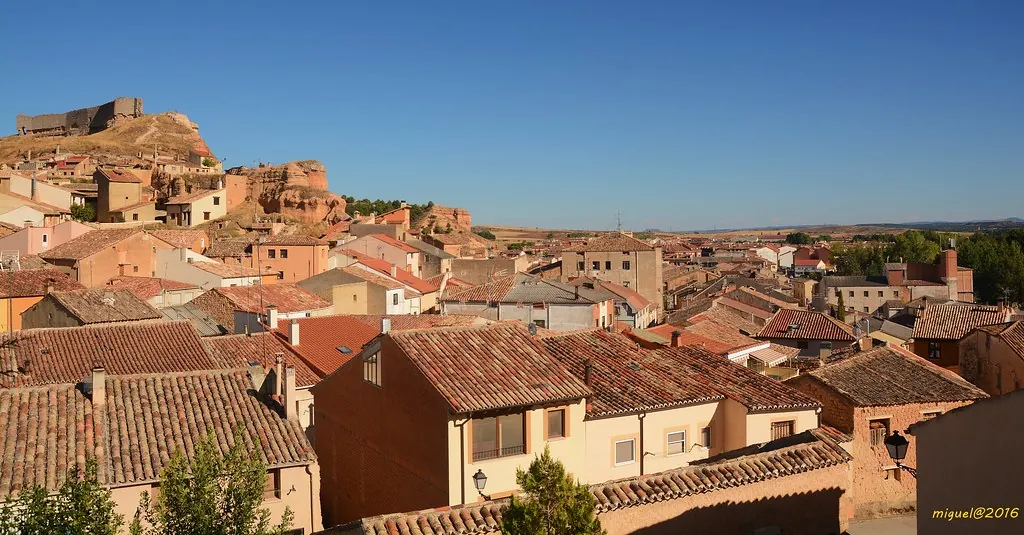
Even so, Villanueva de Gormaz retains the structure of a traditional agricultural settlement. Stone dominates walls and boundary enclosures, with wood used for doors and beams. Decoration is minimal. Buildings follow a practical logic, offering protection from the cold while making efficient use of local materials.
Architecture and village layout
The housing stock includes several masonry dwellings with thick walls and small openings. This type of construction appears throughout Soria in villages that expanded between the 18th and 19th centuries, when the local economy relied heavily on cereal farming and livestock.
Large gateways hint at that agricultural past, built to allow carts to pass through and to store tools and harvests. The emphasis is always on function. Materials are used in their simplest form, without ornament beyond what is strictly necessary.
At the centre of the village stands the parish church. It is not a large building, yet it defines the layout of the main square. In this part of Spain, many parish churches were built over earlier structures or altered several times during the Early Modern period. Rural communities maintained them with their own resources, adapting the building as needs changed.
Inside, these churches often contain simple altarpieces and devotional objects. Their interest lies less in artistic refinement and more in what they reveal about everyday religious life. They reflect how the building was used by local people rather than serving as a showcase of grand design.
The square and surrounding streets follow a straightforward plan. Streets are short, with a practical layout. Buildings stand close together, offering shelter from the wind. There are no large open spaces beyond those required for daily tasks.
Paths, fields and open horizons
Tracks leading out of Villanueva de Gormaz connect to farmland and to old livestock routes. These paths form part of a historic network linked to transhumance, the seasonal movement of animals between grazing areas. For centuries, this system shaped the economy across much of Soria.
The terrain is gently undulating rather than rugged. From certain points, there are wide views across the surrounding countryside, where the horizon often appears clear and uninterrupted. The sense of openness defines the landscape as much as any built feature.
Birds of prey are a regular presence in the sky, using thermal currents that rise above the fields. Their movement adds a slow, continuous rhythm to an otherwise still environment.
Traditions that follow the seasons
With so few permanent residents, the festive calendar is concentrated in the summer months. At that time, families with ties to the village return, and religious celebrations regain their role in community life. During the winter, these events would draw very little attendance.
Many rural customs have shifted from necessity to memory or occasional practice. The slaughter of the pig, once central to winter life in villages across the region, still takes place in some households. It now functions more as a family gathering than as an essential source of food.
These traditions reflect a way of life that has largely receded but has not entirely disappeared. They continue in quieter forms, adapted to a smaller population and different circumstances.
Understanding Villanueva de Gormaz in context
Villanueva de Gormaz can be explored quickly, yet its meaning becomes clearer when seen in relation to its surroundings. A short distance away stands the castle of Gormaz, a 10th-century caliphal fortress that was once among the largest in western Europe. It gives historical depth to the area and helps explain why settlements developed here.
Nearby is El Burgo de Osma, a former episcopal seat and the historic centre of the region. Its role contrasts with the smaller villages, which depended more directly on agriculture and local networks.
The interest of Villanueva de Gormaz lies in that relationship with the land. It forms part of a wider pattern of villages that grew under the influence of the Duero and its historic routes. Walking through its streets shows how life was organised in these parts before rural depopulation changed the landscape.