Full Article
about El Barraco
Municipality in the Alberche Valley, ringed by reservoirs and pine forests; birthplace of famous cyclists and a recreation area.
Hide article Read full article
A valley with a long memory
El Barraco appears in documents as far back as the 12th century, under a name very close to “del Berraco”. The term is usually linked to the verracos vetones, those granite animal sculptures scattered across much of the province of Ávila. They marked livestock territories long before Roman times, and still form part of the region’s identity today.
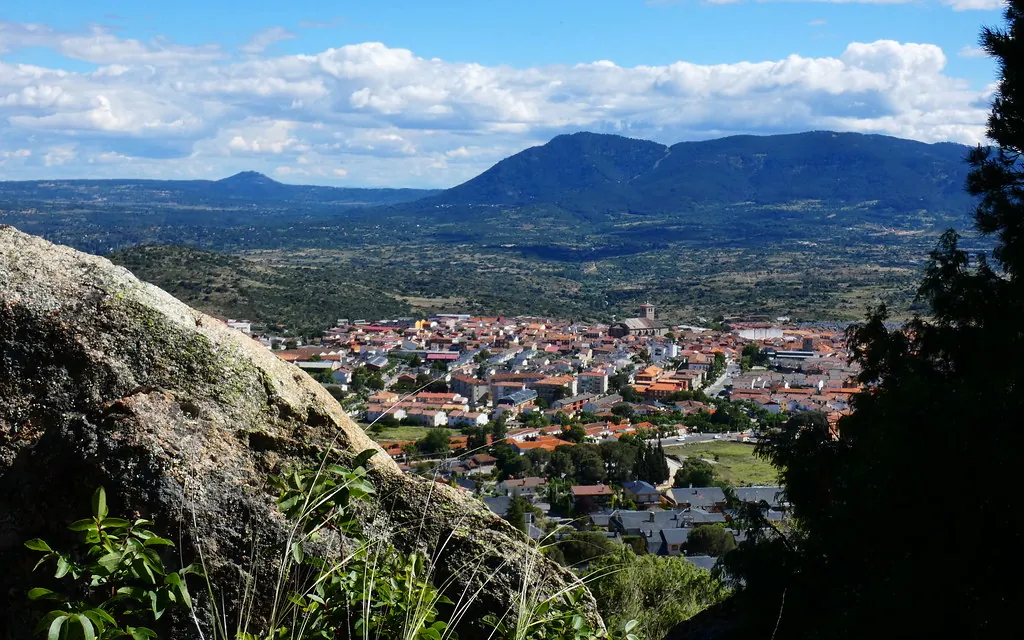
The setting helps explain that continuity. The Alberche valley opens out between the Sierra de la Paramera and the first rises of the Gredos mountains. For centuries, this was a natural corridor. People and herds moved through on foot, following routes shaped by the land itself. Modern roads now reach the village easily, but many of those routes still echo that older geography.
From feudal control to a second-home village
At the end of the 14th century, El Barraco came under the control of Fernán Pérez de Ayala, granted by King Henry III. Like many places across the Castilian plateau, this feudal arrangement shaped daily life for generations. Taxes, justice and parts of the town’s development were tied to that relationship.
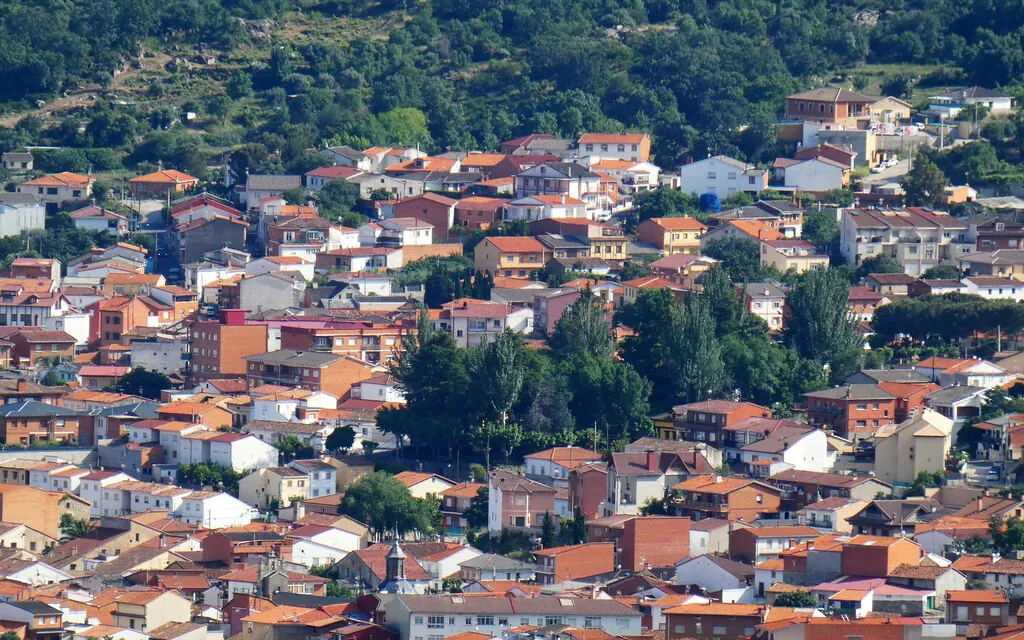
Traces of that past remain in the old centre. Short streets climb towards the church, lined with houses built from local stone. The current Casa Consistorial, documented since the 16th century though altered over time, still displays a coat of arms linked to the Ayala family on its façade. It is not an imposing building, but it gives a clear sense of that earlier period.
The 20th century brought change. For several decades, the leather industry played an important role in the local economy and supported many families. Some related activity continues today, though in a more scattered form. At the same time, the nearby Burguillo reservoir and the relative proximity to Madrid encouraged the growth of housing developments and villas on the surrounding slopes. El Barraco shifted from being purely agricultural to a place where weekends and summers became part of its rhythm.
A landscape shaped by cycling and forest
Cycling is one of the first things mentioned in connection with El Barraco. Several well-known riders in Spanish cycling came from here, including Carlos Sastre, Ángel Arroyo and José María Jiménez, known as “El Chava”. The terrain explains why. Roads in the area rise steadily into the surrounding mountains, offering long climbs that attract both professionals and amateurs.
The route towards the Paramera and those leading to the Puerto de Mijares are part of that cycling landscape. At weekends, it is common to see groups of riders gathering in the square before heading out towards the hills.
Beyond the roads, the natural surroundings shape many visits. The nearby Valle de Iruelas, a protected natural reserve, combines extensive pine forests with oak and chestnut trees in the damper areas. Marked footpaths run through the woodland and lead to viewpoints overlooking the Burguillo reservoir. On clear days, much of the Alberche valley stretches into view from these higher points.
The Ermita de la Piedad and local traditions
At one edge of the town stands the Ermita de la Piedad. It is a small building, usually dated to the 16th century, though later additions have altered its appearance. Its size and decoration are modest, yet it remains closely tied to local life.
One custom linked to the chapel is the ringing of its bell at certain times of day. Older residents often say the tradition has simply continued over time, without a clearly remembered origin. Like many long-standing practices, its meaning has faded while the habit itself endures.
The main festivities in El Barraco take place in September, centred on the Cristo de Gracia. During those days, the square fills with religious events and band music. Processions follow routes that have barely changed over the decades. It is also a time when many people who have moved away return to the village.
Exploring at an unhurried pace
El Barraco lies in the Alberche valley, in the southern part of the province of Ávila. The N‑502 connects it with the provincial capital and with routes heading into the Gredos mountains. From Madrid, the journey usually follows the A‑5 and regional roads descending towards the Burguillo reservoir.
The reservoir itself sits just a few minutes from the town. Its shores include areas where people come to swim when water levels allow. In summer, mornings tend to be quieter, as the reservoir is one of the more accessible spots from Madrid and becomes busier at weekends.
Within the town, everything can be explored on foot without rushing. The Iglesia de la Asunción, the Ermita de la Piedad and nearby viewpoints help make sense of the landscape. From these points, the valley opens towards the water of the reservoir, while the first mountains of Gredos rise in the distance.
Those interested in traditional architecture can look closely at the stone houses in the old centre. Some still incorporate former animal enclosures into their structure, a reminder of the livestock-based economy that sustained El Barraco for centuries.