Full Article
about Santa Cruz del Valle
Known as the Balcony of Gredos; a picturesque village with a mild climate.
Hide article Read full article
A village shaped by silence
By mid-morning in Santa Cruz del Valle, silence tends to linger until something small interrupts it. A shutter swings open with a sharp sound, or footsteps echo briefly along the pavement. Light arrives cleanly from the southern slopes of the Sierra de Gredos, settling over façades of stone and wood. In autumn, the air often carries the smell of damp chestnuts and freshly lit fires. With fewer than three hundred residents, the village is defined as much by what is absent as by what happens.
There is no sense of urgency here. The pace feels set by habit rather than by schedule, and the atmosphere is one of continuity. Even simple movements, a door opening, someone crossing a street, seem more noticeable against the quiet.
Stone houses and unhurried streets
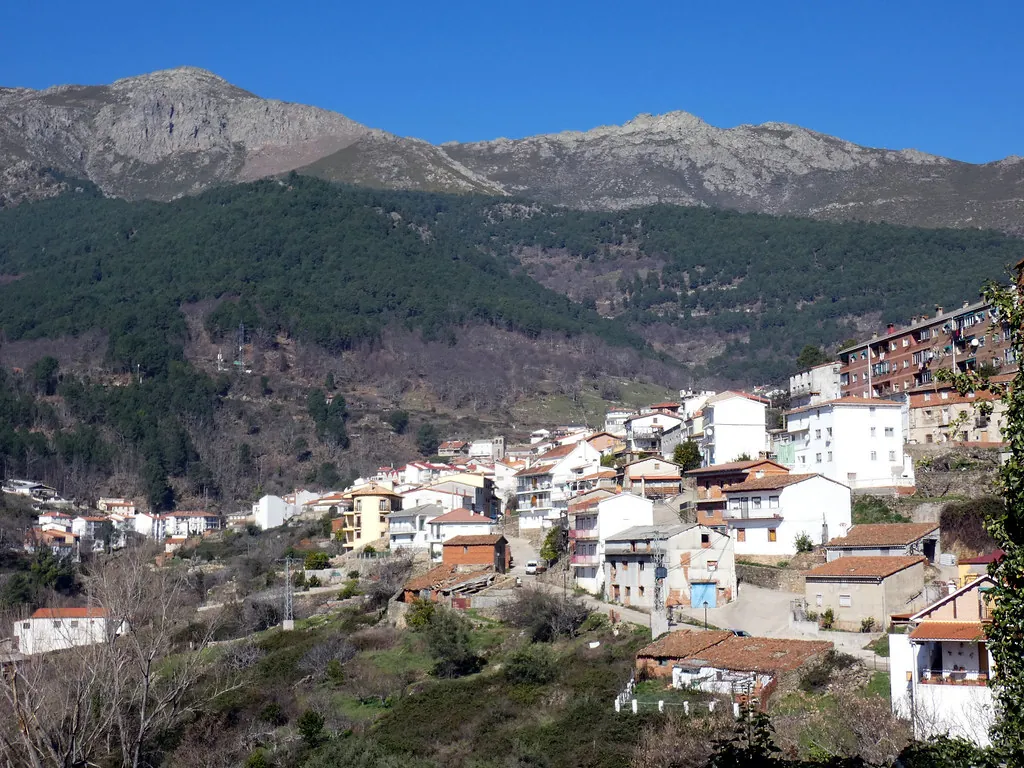
The houses cluster along short streets that rise and fall with the shape of the valley. Thick stone walls and reddish roof tiles are typical, with wide doorways where tools might be resting against the wall or stacks of firewood prepared for winter. It is common to come across people stopping for a conversation in the middle of the street. Cars move slowly, or remain parked at the edge of the village.
The architecture still reflects much of its earlier form. Local stone, wood darkened over time, and small balconies give the place a consistent look, even if not every building is old. The overall impression makes more sense when walking without a plan, letting the streets lead naturally towards the edges of the village.
Those edges matter. As the streets thin out, the sense of enclosure fades and the valley begins to open up. There is no need for signs or marked viewpoints. Simply following the slope or the line of a street is enough to arrive at a wider view.
Facing the Sierra de Gredos
The village centre revolves around the parish church, a simple structure built in granite. It does not dominate through ornament but through its position and material, blending into the same landscape that surrounds it. From nearby streets, when the sky is clear, the peaks of the Sierra de Gredos come into view. In winter, they are often covered in snow for weeks at a time.
Late afternoon tends to be the moment when the setting reveals itself most clearly. Light moves down through the valley and the mountains shift in colour, from pale grey to a deeper blue. The change is gradual but noticeable, and it does not require any particular effort to observe. Standing at any point where the village meets the open valley of the Tiétar is enough.
This relationship between village and landscape feels constant. The mountains are not distant decoration but part of the daily horizon, visible from ordinary streets and corners.
Water, rock and simple bathing spots
From within Santa Cruz del Valle, the sound of water can sometimes be heard in the background. Streams, known locally as gargantas, descend from the Sierra de Gredos, running between rounded granite boulders. Along their course, they form natural pools where, in summer, both residents and visitors occasionally bathe, even though the water remains quite cold.
These are not developed bathing areas. There are no large facilities or structured spaces, just straightforward spots shaped by the flow of water and stone. Care is needed, particularly after heavy rain. Rocks can become slippery, and water levels may change quickly.
During July and August, timing makes a difference. Early in the day tends to be quieter, while by midday some pools can become more crowded than the space comfortably allows. Even then, the experience remains simple, tied closely to the natural surroundings rather than any form of organisation.
Paths leading outwards
Several walking routes begin directly from the last houses of the village. Some lead into chestnut groves, where the ground is covered with dry leaves for much of the year. Others climb gradually towards the higher slopes of the Sierra.
Conditions vary depending on the season. After storms or forestry work, paths may be partially blocked by fallen branches or become harder to follow. For longer walks, it is sensible to ask locally about the current state of the routes.
In autumn, the surrounding woods attract people searching for mushrooms. Varieties such as boletus and níscalos appear when the season has been wet. Gathering them requires knowledge and care, and also respect for the environment. Here, the forest is not just a place for leisure. It continues to serve as a working landscape and a route of passage for those who live in the valley.
The paths reflect that dual role. They are used for walking, but also for everyday movement tied to the land, which shapes how they are maintained and understood.
Seasons and timing
Spring and autumn are often the most balanced times to visit. Temperatures are mild, and the valley either turns a vivid green or shifts into tones of ochre. Summer brings stronger heat to the Tiétar valley, although the streams provide some relief during the middle of the day.
August weekends can feel different. The village becomes noticeably busier, and the calm that defines it during the week fades for a few hours. As evening approaches, that change gradually recedes and the usual rhythm returns.
Santa Cruz del Valle does not depend on a list of attractions or a structured itinerary. Its character lies in its pace, its materials, and its setting at the edge of the Sierra de Gredos. Time passes quietly here, marked by light, weather and small daily movements rather than by events.