Full Article
about San Justo de la Vega
At the gates of Astorga; a mandatory stop on the Camino de Santiago with the famous Crucero de Santo Toribio.
Hide article Read full article
Between the Tuerto River and Astorga
Five kilometres from Astorga, in the comarca known as the Vega del Tuerto, lies San Justo de la Vega. Its proximity to the former Maragato capital explains much of its story. These are farming lands shaped by the River Tuerto, and the village grew as agricultural support for the surrounding area. With around 1,750 inhabitants and set at roughly 850 metres above sea level, it retains the structure of a Leonese rural settlement where the countryside still carries real weight in daily life.
The Camino de Santiago also passes through the municipality on its way to Astorga. For centuries, pilgrims have crossed these fields before entering the city. Even so, San Justo tends to function more as a place people move through rather than somewhere they stay for long. That role has helped preserve a steady, unhurried rhythm, with little orientation towards tourism.
Parish Church and Village Streets
The main landmark in the centre is the parish church. It probably dates back to the 16th century, although it has undergone later alterations. Inside, there is a simple Baroque altarpiece. It speaks more of the devotion of a local community than of grand artistic ambition. The church stands in a central position, as is common in agricultural villages across this part of León.
A walk through the streets reveals different layers of time. Stone and adobe houses remain, some with agricultural outbuildings such as corrals and barns, along with small courtyards. Alongside them are homes renovated in recent decades. The result is not a uniform historic quarter, but a place that shows how rural life in the comarca has evolved.
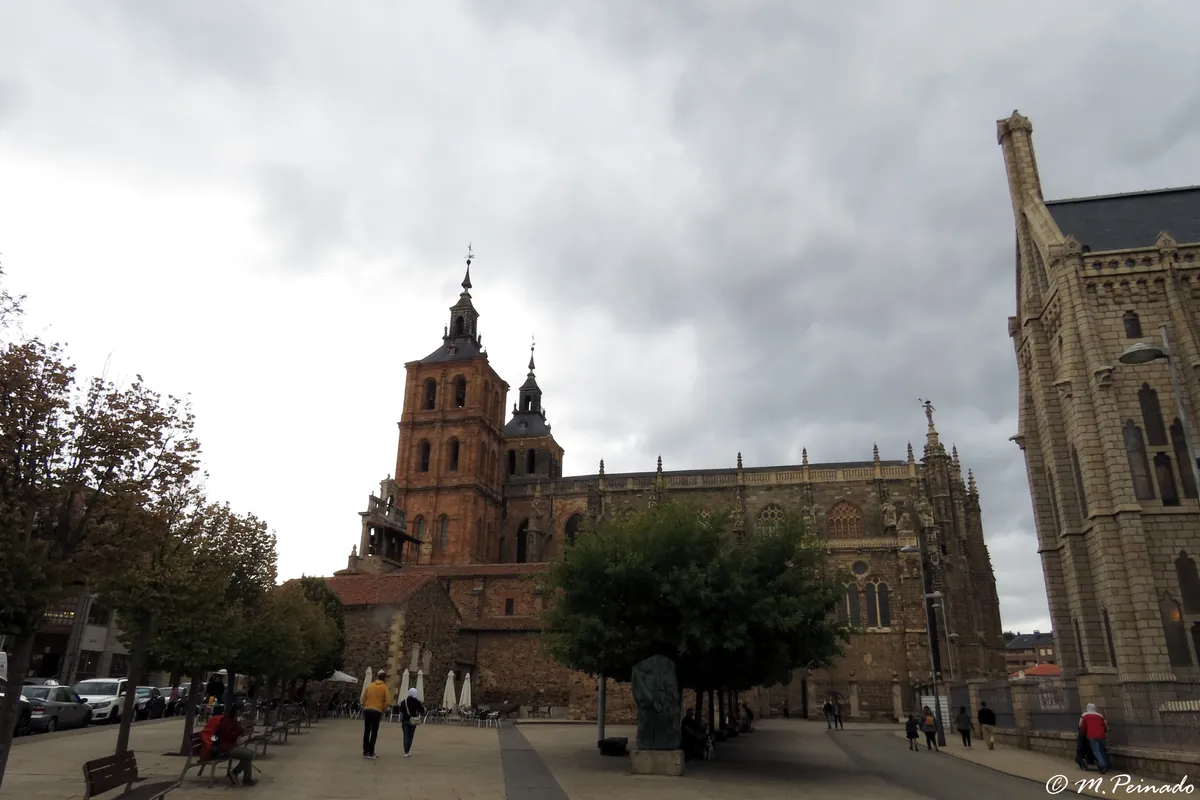
Astorga is only a few minutes away by car and helps to frame the wider context. Several historic landmarks are concentrated there: the cathedral, the episcopal palace designed by Gaudí, and Roman remains that recall the importance of ancient Asturica Augusta. Visiting Astorga makes it easier to understand the historical background against which villages like San Justo developed.
On the banks of the River Tuerto, kitchen gardens, service tracks and poplar plantations are still part of the landscape. These scenes are closely tied to traditional irrigation systems in the Leonese riverside plain. Walking along these paths shows how the river organises the territory more decisively than any single monument.
Flat Land and Rural Routes
The terrain around San Justo de la Vega is largely flat, which makes it easy to explore on foot or by bicycle. Many routes are in fact agricultural tracks that link plots of land, irrigation channels and small bridges over the Tuerto. They are not usually signposted as formal hiking trails, so it is sensible to use a map or a mobile phone for orientation.
The Camino de Santiago crosses this area in the direction of Astorga. Here the landscape differs from mountain sections of the route. Long straight stretches, open fields and dirt tracks define this stage. It is a part of the pilgrimage that remains closely connected to the agricultural world of the province.
Local cooking reflects Leonese tradition. Dishes are hearty and designed for long working days in the fields. Cocido maragato, served first with the meats, is one of the most recognisable specialities of the wider area. Trout soup and products from the traditional pig slaughter also form part of the culinary repertoire. Being so close to Astorga means easy access to its best-known sweets, including mantecadas.
Secondary roads link San Justo with nearby villages in the vega such as Celada and Nistal, allowing for short drives through the plain. After periods of rain, some agricultural tracks can become muddy or deeply rutted. This is fairly typical in a landscape devoted to cultivation.
Festivities and Everyday Life
Patron saint festivities usually take place at the end of August. During those days, the population temporarily increases as residents return from other cities. Religious events are organised alongside open-air dances and community activities, similar to celebrations in other villages along the Tuerto riverside.
For the rest of the year, life proceeds calmly. Local shops, agricultural work and the daily movement to and from Astorga set the pace of a municipality still closely tied to its immediate surroundings. San Justo de la Vega is not designed for major sightseeing trips. It offers instead a way to understand how villages in the Leonese plain function, shaped by the river, by farming and by their relationship with a nearby historic city.
In this corner of Castilla Leon, the appeal lies less in headline monuments and more in continuity. The parish church anchors the centre. The River Tuerto structures the fields and gardens. The Camino de Santiago traces a line through the municipality, linking it to a wider European route. Together, these elements define a village that remains grounded in its agricultural setting, just a short distance from Astorga yet firmly rooted in its own landscape.