Full Article
about Colera
Quiet coastal village north of Cap de Creus; pebble beaches and family atmosphere.
Hide article Read full article
A Different Pace on the Northern Costa Brava
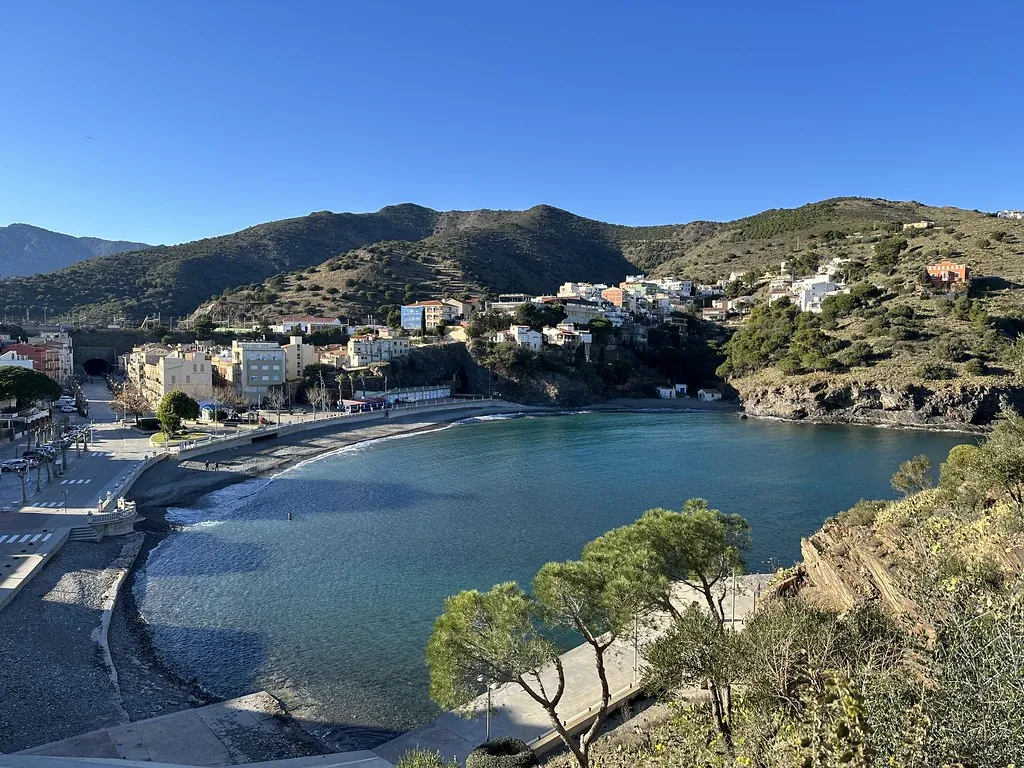
There are coastal towns where everything seems arranged for a quick stop: park, take a photo, move on. Tourism in Colera heads in the opposite direction. Set at the northern tip of the Costa Brava, almost touching the French border, this small town sits where the mountains slide down towards the Mediterranean.
Around five hundred people live here. That small population shapes the atmosphere. Even in summer, the mood is more about residents with family homes and visitors from nearby towns than large waves of tourists. Anyone familiar with other parts of the Girona coastline in August will notice the contrast straight away.
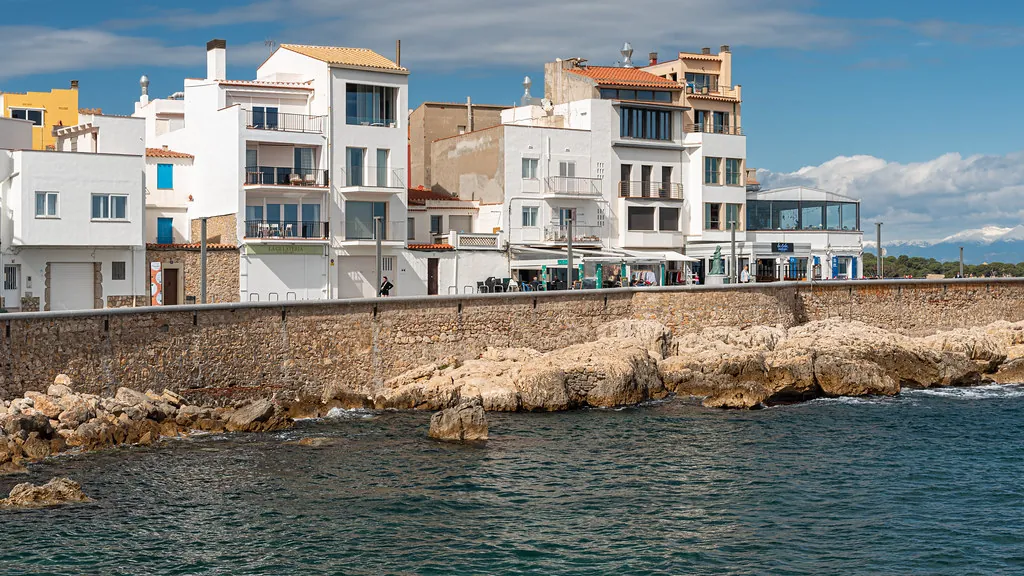
Colera does not try to impress. It feels practical and unvarnished: houses close to the sea, small boats, a functional beach, dry hills rising behind. The interest lies less in decorative façades and more in the surrounding landscape. This is a stretch of coast where the terrain sets the tone.
What to See in Colera, Without Overthinking It
Above the town stands the castle of Molinàs, positioned on a hill that reveals the curve of the bay below. Its origins are usually placed in the early modern period, when a series of defensive structures were built along this part of the coast to keep watch over the sea. Today the remains are weathered and fragmentary, yet the walk up is short and the view makes the effort worthwhile. From the top, it becomes clear how the coastline grows increasingly rugged in the direction of Cap de Creus.
Further out lies the monastery of Sant Miquel de Colera. A few walls and structural remains survive. Tradition places its foundation in the Middle Ages, and it once belonged to a Benedictine community. What stands today is not a restored complex prepared for long visits. It is more a trace, a reminder of how long people have moved through these hills and made use of this territory.
Then there is the sea, which ultimately dictates the rhythm of life here. The beach of Colera combines sand with coarse shingle and, when the wind allows, the water is often clear. It is not a long sweep of fine sand. Entry into the water is over rounded stones, and sturdy footwear for swimming can make things more comfortable.
Move a little further and smaller coves appear. Garbet, to the south, is often quieter early in the day. To the north, the shoreline becomes rockier, with small inlets where posidonia sometimes gathers along the shore. These seagrass deposits are not the polished image of a travel brochure, yet they form part of the Mediterranean ecosystem and belong naturally to this coast.
Walking Between Sea and Hills
This stretch of the Alt Empordà sits between open sea and the first ridges of Cap de Creus. Walking here means accepting climbs and descents. These are not level seaside promenades. Paths can be stony, slopes are frequent, and certain sections are exposed to the wind.
The Camí de Ronda between Colera and Portbou follows an old route once used to watch over the coastline. In places the path runs close to the cliffs, with open views across the Mediterranean accompanying the entire walk. Carrying water and taking a steady pace is sensible, particularly when the sun is strong.
In the nearby hills, bunkers and defensive positions from the Spanish Civil War remain scattered among low vegetation and rock. They appear unexpectedly while walking, a reminder that this border area has long held strategic importance. The presence of these structures adds another layer to the landscape, connecting natural scenery with more recent history.
Clear Water and Simple Pleasures
When the sea is calm, visibility in the water is often good. Beneath the surface there are rocky seabeds where marine life moves through cracks and crevices. Many people are content to swim near the rocks with a mask and snorkel. There is no need for elaborate equipment to spot fish weaving between stones.
The day often ends in a straightforward way: sitting near the port and eating fish. In Colera, the relationship with the sea remains direct. Mediterranean produce, cooking rooted in the Empordà tradition and the atmosphere of a small town define the experience. There is little ceremony involved, just the sense that what arrives on the plate has travelled a short distance.
Understanding Colera
Colera works best when it is not overloaded with plans. Arrive, take a walk, swim, perhaps cover a stretch of the Camí de Ronda, and eat with a view of the water. The scale of the place means that in a few hours it is possible to see most of it.
The impression it leaves, however, is not really about ticking off monuments. The castle of Molinàs and the monastery of Sant Miquel de Colera add context, and the remnants of bunkers hint at more recent chapters, yet the lasting memory tends to be simpler. It is about a piece of the Costa Brava that still retains much of its character.
In a region where parts of the coastline have long been shaped by seasonal pressure, that continuity stands out. Colera remains a town that follows its own rhythm, defined by the sea, the wind and the dry slopes behind it. For travellers willing to slow down rather than collect highlights, that is more than enough.