Full Article
about El Pla del Penedès
Small municipality surrounded by vineyards with a tradition of vine nurseries.
Hide article Read full article
In the agricultural heart of Alt Penedès
Tourism in El Pla del Penedès begins with a simple fact: this is the agricultural heart of the Alt Penedès. It is a flat landscape shaped over centuries by vineyard work, where the rhythm of daily life still follows the cycle of the vine. With just under 1,400 inhabitants, the municipality retains a clearly rural character. The grape harvest, winter pruning and vine treatments continue to organise much of the local calendar.
The village stands at around 216 metres above sea level, in an open stretch of inland Penedès. The Garraf and Foix mountain ranges appear faintly on the horizon, some distance away. Barcelona is not far by road, yet the atmosphere feels very different. Scattered masías, agricultural tracks and long runs of vineyard parcels define the surroundings. Wine, particularly the grapes destined for cava production, explains much of what you see across the plain.
This is not a place shaped by monumental architecture or dramatic scenery. Its identity is tied to cultivation, to a working landscape that changes with the seasons and to a community that remains closely connected to the land.
A village shaped by agriculture
The layout of El Pla del Penedès follows a pattern common to many farming villages in the comarca. Short streets, a straightforward design and a central square where daily life gathers form the core. It is not a historic centre built to impress, but a functional space that has grown around agricultural activity.
The parish church of Santa María occupies the most visible point in the centre. Its origins date back to the 16th century, although the building has undergone several later alterations. The bell tower defines the village skyline when arriving by road and remains its main visual reference point. The church is of interest less for artistic value than for what it has represented over the centuries. For a long time it was the setting not only for religious services but also for aspects of community organisation.
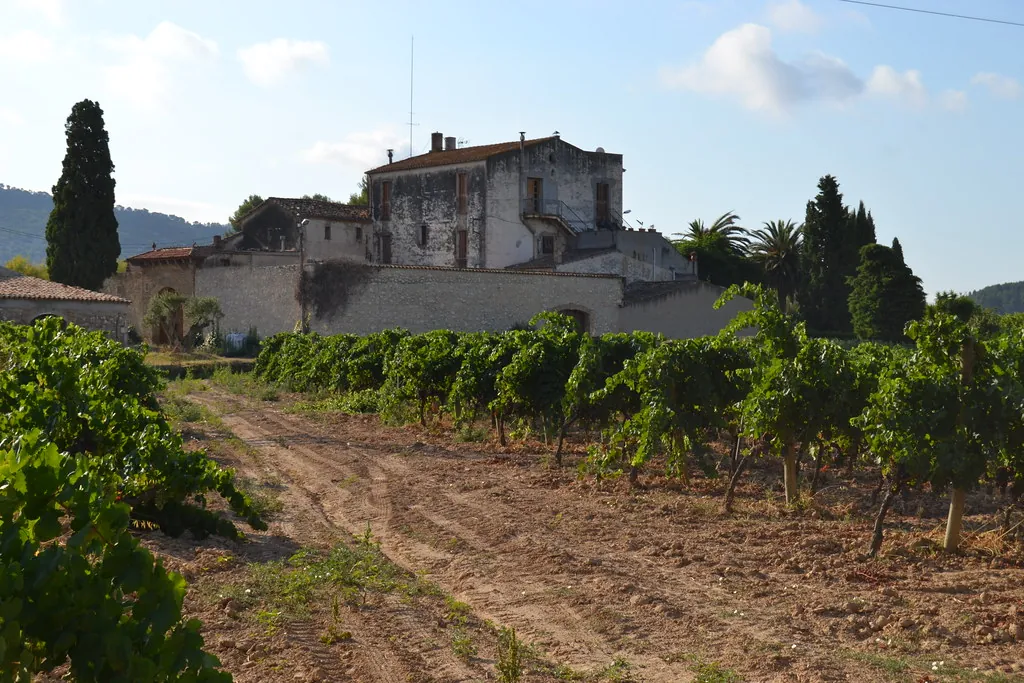
Beyond the urban centre, several traditional Penedès masías stand among the fields. Built in stone and topped with tiled roofs, some have a history stretching back centuries. Many are still linked to agricultural holdings or used as private homes. They are generally private property, so they are usually seen from the rural tracks that cross the vineyards rather than visited from within.
The inland Penedès landscape
The surroundings of El Pla del Penedès are defined above all by vineyards. Parcels extend across gentle undulations, linked by dirt tracks that connect fields, wineries and masías. There are no major changes in elevation, which reinforces the sense of an open plain typical of this part of the comarca.
The appearance of the territory shifts noticeably through the year. In autumn, when vine leaves turn red and yellow, the agricultural mosaic becomes more pronounced. Rows and plots stand out clearly against the soft contours of the land. In winter the vines are bare, and fog often settles on cold mornings. The landscape feels more austere at that time, yet the structure of the parcels and the network of old agricultural paths can be seen with greater clarity.
Agriculture remains the economic engine of the municipality. A large share of the grape production ends up in wineries across the comarca that are linked to the production of cava and Penedès wines. The connection between field and cellar is direct and visible, even if much of the winemaking takes place beyond the village itself.
Along the vineyard tracks
The area around El Pla del Penedès is well suited to unhurried walks or cycle rides. These are not mountain routes but agricultural tracks that pass through vineyards and link different parts of the municipal area.
The routes are straightforward, with no major technical difficulties. They offer a way to understand how the Penedès landscape is organised: clearly defined plots, small rises in the terrain and isolated masías between cultivated fields. It is worth bearing in mind that these tracks are also working routes. At certain times of year tractors and other agricultural vehicles pass frequently, especially during periods of intense activity in the vineyards.
On clear days, from slightly higher points, it is possible to make out the line of nearby mountain ranges closing the horizon of the Alt Penedès. Even from a modest elevation, the sense of space is evident, shaped more by cultivation than by dramatic natural features.
Wine as part of everyday life
Wine culture is deeply present in El Pla del Penedès. Within the municipality and in the surrounding area there are several family-run wineries that work with grapes from their own vineyards. Some organise pre-arranged visits, explaining the process of making wine or cava and showing their facilities.
The focus varies from one project to another. Some visits are more technical in tone, others more introductory. In most cases it is necessary to arrange the visit in advance, as many of these wineries primarily function as agricultural businesses rather than as full-time tourist attractions.
The prominence of cava is no coincidence. The grapes grown here form part of the wider Penedès production linked to this sparkling wine, which has become one of the region’s best-known products. Even without entering a winery, the connection between landscape and bottle is clear. The rows of vines that stretch across the plain are the starting point for a process that continues elsewhere in the comarca.
Festive dates in the village calendar
The celebrations of El Pla del Penedès follow the pattern common to many municipalities in inland Penedès. The Festa Major, the main annual festival, usually takes place at the end of August. It combines religious events with popular activities and music in the square, bringing together residents of different generations.
September coincides with the grape harvest. Work in the fields intensifies and there is constant movement in the vineyards. During these days, some local activities revolve around wine and the gathering of grapes, reflecting the central role of the harvest in the village’s life.
Throughout the year other traditional celebrations are also maintained, such as the verbena de Sant Joan. As in much of Catalonia, this midsummer festival marks the eve of 24 June and is typically associated with community gatherings and festive traditions.
El Pla del Penedès does not present itself as a destination of grand landmarks or dramatic contrasts. Its appeal lies in continuity: a cultivated plain, a village structured around agriculture and a calendar guided by the vine. For those interested in understanding how wine country functions beyond the cellar door, this small municipality in Alt Penedès offers a clear and unembellished view of rural Catalonia.