Full Article
about Font-rubí
Penedès balcony overlooking vineyards and a well-kept natural setting
Hide article Read full article
A Landscape Shaped by Vines
Early in the morning, when the air is still cool and the leaves on the vines barely move, the tracks around Font-rubí are almost silent. Now and then a distant car passes, or a farmhouse door shuts with a dry thud. Tourism in Font-rubí has little to do with coaches or crowded streets. Life here revolves around the vineyards of the Alt Penedès and the unhurried rhythm of agricultural work.
On clear days, from one of the dirt tracks that climb between the hills, the serrated outline of Montserrat appears on the horizon. Far beyond that, a thin blue strip usually marks the Mediterranean. It is a wide, open landscape, defined by gentle slopes and long views rather than monuments or busy squares.
Font-rubí has around 1,400 inhabitants. The municipality is made up of small clusters of houses and scattered masías, traditional rural farmhouses, set among the vines. There is no large historic centre and no network of streets designed for hours of wandering. What there is, instead, is territory: rolling hills covered in vines, agricultural tracks and stone houses that have been facing the same scenery for decades, sometimes centuries.
Around Sant Miquel
The church of Sant Miquel serves as the main point of reference. Its origins are Romanesque, although what stands today reflects later alterations. It is not a monumental church. Rather, it fulfils the familiar role seen in many small Catalan villages: a bell tower visible from a distance and a square that, depending on the time of day, may be completely empty.
The houses nearby are simple in style, with thick walls, wide doorways once designed for carts and roofs covered in curved tiles. On weekdays there is little movement. Late in the morning, the square can be almost deserted, perhaps with the sound of a conversation drifting out of an open window.
This small nucleus does not function as a conventional town centre with shops and steady foot traffic. It feels more like a reference point within a much wider rural setting. From here, roads and tracks lead quickly back into the vineyards.
Tracks Between Masías
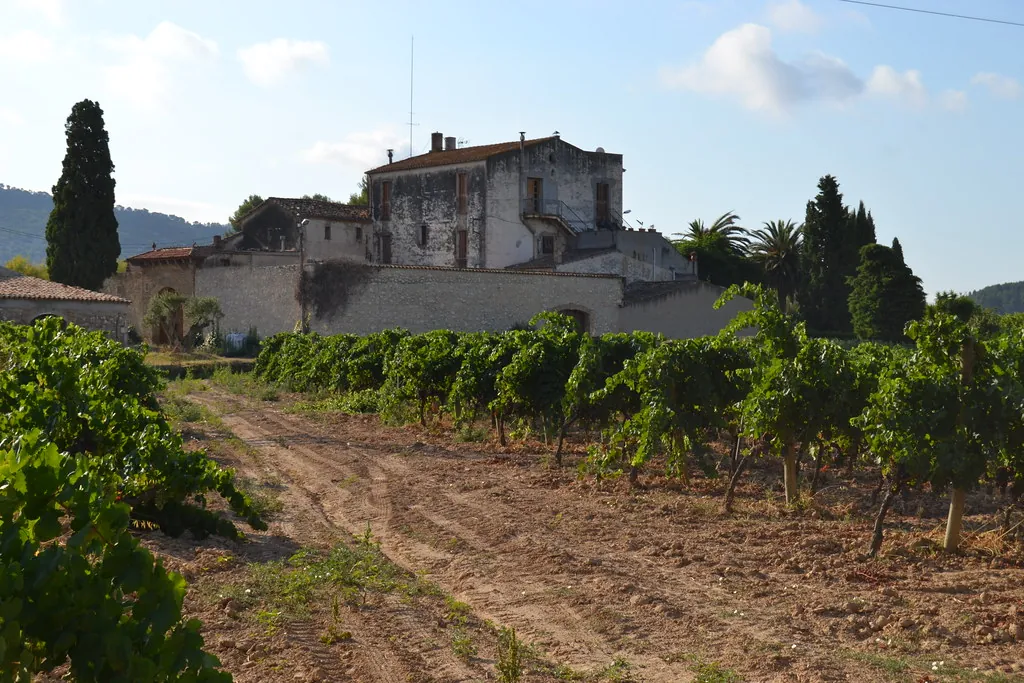
The landscape of Font-rubí is that of the Penedès wine region at its most tranquil. Rows of vines run up and down the hills in clean, ordered lines that change dramatically with the seasons. In spring they are a vivid green. Summer brings drier tones under the strong sun. In autumn, the slopes turn a mix of yellows and reddish shades.
Agricultural tracks thread between the fields and can be explored on foot or by bicycle without too much difficulty. They are not always marked as formal walking routes. Many are used daily for working the vineyards. It is best to move at an easy pace, step aside when a tractor approaches and remember that some paths end at private property.
From time to time a masía appears among the fields. These are large buildings with stone walls and south-facing galleries. Some remain family homes, others are part of active agricultural operations. They are worth observing from the track, but always with respect, as many stand within working estates.
The sense of space is constant. There are no dramatic peaks or deep valleys, just a steady succession of low hills. The visual rhythm of the vines, repeated across slope after slope, gives the area a distinctive identity within Alt Penedès, one of Catalonia’s most active wine-producing regions.
Springs and Echoes of Rural Life
Within the municipal boundaries there are several springs and natural water sources that traditionally supplied nearby houses. Some local routes link a number of these points via tracks and narrow paths. Signage is not always clear, so it is sensible to carry a map or check locally before setting out.
Here and there, partly hidden by vegetation or close to old paths, there are remains of structures once used for storing ice or water. They are not always easy to identify at first glance. When spotted, they offer a glimpse into how resources were managed before electricity and modern refrigeration systems. In a landscape now associated so strongly with wine production, these modest constructions recall a time when survival depended on careful storage and seasonal planning.
The rural character of Font-rubí is not staged or reconstructed. It is embedded in everyday features: working tracks, cultivated slopes and buildings that continue to serve practical purposes.
Wine as the Common Thread
Everything in Font-rubí leads back to the vine. The Alt Penedès is one of the most dynamic wine-growing areas in Catalonia, and that culture is visible on every hillside here. The vineyards are not decorative. They are the economic and social backbone of the municipality.
Several wineries in the area usually organise visits or tastings. During these, they explain how local grape varieties are cultivated and how both still wines and sparkling wines are produced. For visitors unfamiliar with the region, it is worth knowing that Alt Penedès is particularly associated with sparkling wine, alongside a broad range of still styles.
If planning a visit to a winery, booking in advance is the safest approach. During the grape harvest, typically in late summer and early autumn, cellars are busier and may not be able to accommodate unplanned drop-ins. At that time of year, activity in the vineyards intensifies. Tractors move between the rows, crates fill with grapes and, occasionally, a sweet scent of must lingers in the air.
Seasons in Font-rubí
Font-rubí changes noticeably over the course of the year. In spring, the countryside is especially green and the tracks are comfortable for walking. The light is soft, and the vines are in full growth.
Autumn brings the harvest. The atmosphere becomes livelier among the vines, and the work of gathering grapes shapes the daily routine. The colours shift across the hills, and the air sometimes carries the smell of freshly pressed juice.
High summer is a different experience. The sun falls hard on the slopes and there are few shaded stretches along the tracks. Setting out early in the day or waiting until late afternoon makes exploring more comfortable. Practical considerations matter here. Many local roads are narrow, with gentle bends weaving between vineyards. There is no need to rush; few people do.
Font-rubí does not compete with larger destinations. It offers open land, working vineyards and a small community set within one of Catalonia’s key wine regions. For those willing to adapt to its pace, the appeal lies in the quiet continuity of rural life and in the changing colours of the vines across the seasons.