Full Article
about La Granada
Historic Penedès town known for hosting major wine events.
Hide article Read full article
A Hill in the Middle of the Plain
Tourism in La Granada begins with geography. In the middle of the flatlands of Alt Penedès, where the usual pattern is scattered masías set among vineyards, the village appears tightly gathered on a small mound beside the BV‑2127. The houses cluster together, the streets are narrow, and above them rises an elongated silhouette that dominates the whole settlement.
That shape follows an old logic. From this point it was possible to control the passage along one of the historic routes that crossed the comarca towards Vilafranca and Barcelona. In an agricultural and open landscape like this one, any elevation was useful for keeping watch over the movement of people and goods. La Granada grew around that strategic position.
Even today, the setting explains the place. The surrounding terrain is broad and cultivated, with vines stretching out in every direction. The mound on which the village sits is not dramatic, yet in such a flat environment it makes all the difference.
The Castle Built for Watching, Not Living
The castle of La Granada seems to have had a practical purpose from the outset. The oldest sections date from around the 11th and 12th centuries and correspond more to a structure for surveillance than to a noble residence. The nearby road mattered for trade and territorial control, and the tower allowed views across the entire plain of the Penedès.
The building’s shape reinforces that idea. It is long, relatively narrow, with spaces that make more sense for storage or defence than for courtly life. From the hilltop, the choice of site becomes clear. The view stretches across kilometres of vineyards and open fields, a landscape that shifts with the seasons: green in spring, drier towards the end of summer, and golden as the grape harvest approaches.
The complex was modified in the 16th century, at a time when traffic through the area still held importance. Today it belongs to the municipality and is occasionally opened to visitors. What remains are mainly walls, parts of defensive structures, and the reading of the site itself. It feels more like a former control point than a palace.
Land Art Among Working Vines
On the outskirts of the built-up area lies the Vinya de l’Om, a land art intervention created by the artist Josep Almirall‑Llusià. The work was laid out across a plot of vineyard of around one and a half hectares, where chardonnay vines were planted and pruned according to a specific pattern.
At ground level it is difficult to grasp the full design. From above, however, the layout forms the shape of a vine leaf. Walking between the rows, there is nothing obviously unusual at first glance. Only gradually does the broader drawing begin to make sense.
The piece was conceived as a gesture in defence of the agricultural landscape, in an area where industrial estates have steadily gained ground. Despite its artistic dimension, the vineyard remains in production and is harvested like any other plot in the comarca. The artwork does not interrupt the agricultural cycle, it exists within it.
Everyday Life in a Small Municipality
La Granada has just over two thousand inhabitants and a rhythm typical of an agricultural municipality in Alt Penedès. In the main square there are basic services, a bar, a pharmacy and a bakery, and the town hall occupies a 19th‑century house with little ornamentation.
The old quarter is brief. It can be walked at an unhurried pace in about twenty minutes. The streets retain proportions once designed for carts and pack animals, and some façades display coats of arms or reliefs linked to vine growing. These are small details rather than grand monuments: tools carved in stone, family symbols, dates etched into lintels.
The parish church, dedicated to Saint Peter, dates from the 18th century. Its interior was altered after the Spanish Civil War. The current altarpiece is neoclassical and fairly restrained. More interesting than the decoration is its position within the village. The steps in front of the church face the square and function as a meeting point, offering a view of the quiet movement of daily life.
There is nothing monumental about La Granada in the conventional sense. Its character lies in scale and continuity. The village remains compact, surrounded almost immediately by fields. The transition from street to vineyard happens in a matter of metres.
Vines That Are Still Fields
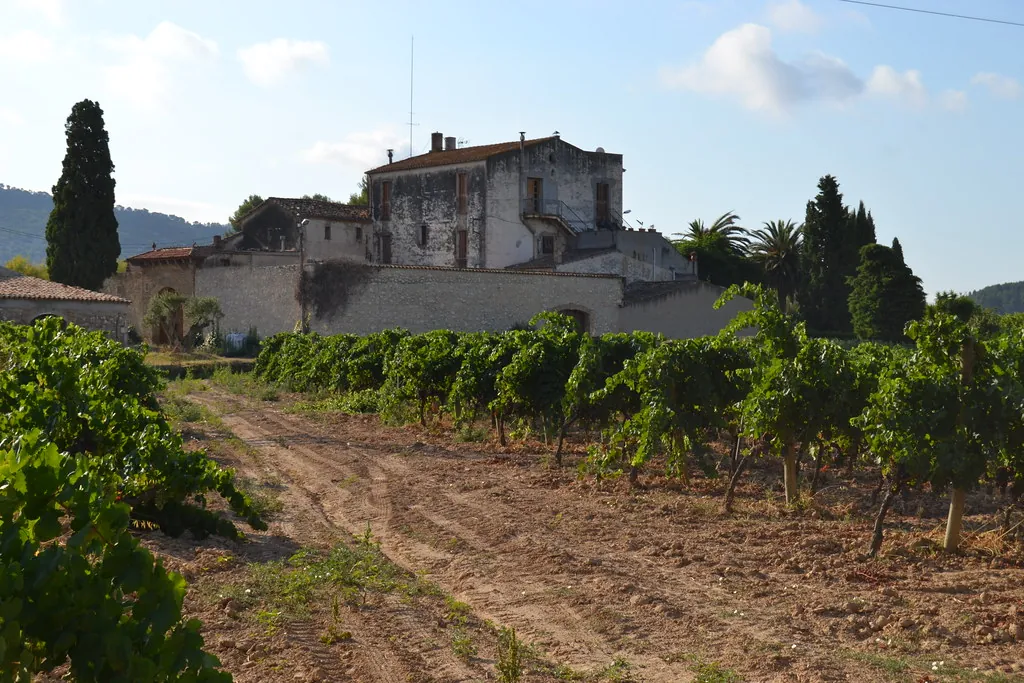
The landscape around La Granada is flat and intensively worked. There are no major hills or natural viewpoints. The vineyards reach almost to the last houses and are separated from the village by dirt tracks used by tractors.
During the grape harvest, known in Catalan as the verema, the pace changes. Work begins early so that the grapes arrive fresh at the wineries in the area. If the weather does not cooperate, the harvest is postponed. Rain or excessive heat can undo a full day’s effort.
There are no marked walking routes as such. Even so, several agricultural tracks connect La Granada with nearby villages such as Sant Cugat Sesgarrigues and el Pla del Penedès. Walking along them gives a clear sense of how a wine‑producing comarca operates in practice: productive plots, machinery, storage buildings and people at work. It is not a staged landscape but a functioning one.
The experience is simple. Wide skies, straight rows of vines, the sound of vehicles in the distance. The interest lies in observing how closely the settlement and the fields remain linked.
When to Go and How to Reach It
La Granada is in Alt Penedès, within reasonable driving distance of Barcelona and with straightforward access from the Vilafranca area. The nearest train station is usually Lavern‑Subirats, several kilometres away, so arriving by car is the most common option.
Autumn is a good time to visit because it coincides with the verema and the landscape changes noticeably in colour and activity. In winter, around January, the village traditionally celebrates Sant Antoni with popular events organised locally, a reminder that agricultural calendars and community life still go hand in hand.
La Granada does not present itself as a destination of grand attractions. Its appeal rests on understanding why it stands where it does, how it grew around a point of control, and how the vineyards that surround it continue to define its present. In a flat stretch of Alt Penedès, a small rise in the land was once enough to shape a settlement. That logic remains visible today.