Full Article
about Les Cabanyes
Small wine-growing municipality in Penedès with a peaceful rural setting.
Hide article Read full article
By mid-morning, when the sun begins to warm the ground and the shadows are still short, the fields around Les Cabanyes carry the scent of grape must and fine road dust. During the grape harvest it is common to pass a tractor moving slowly between rows of vines stacked with crates. The engine noise lingers for a few seconds, then fades back into a quiet broken only by a distant dog or the wind shifting the leaves.
Les Cabanyes sits in the heart of the Alt Penedès, around 250 metres above sea level, very close to Vilafranca del Penedès. The village is small and can be explored quickly. At its centre stands the parish church of Sant Pere, built in pale stone, with a tower visible from the paths that circle the municipality. Around it, short and peaceful streets reveal worn wooden doorways and walls where stone blends with old plaster.
A Small Village in a Sea of Vines
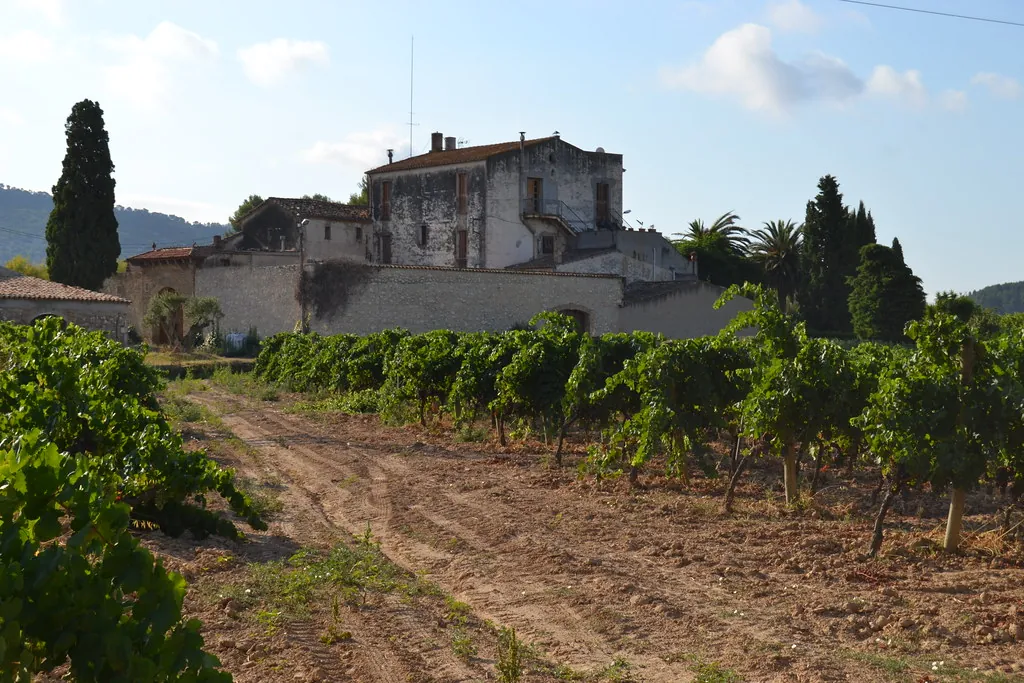
In Les Cabanyes the landscape carries more weight than the village itself. A short walk out of the centre is enough to find yourself surrounded by vineyards stretching in every direction.
Farmhouses, known locally as masías, are scattered among the plots. They are solid buildings with curved roof tiles and thick walls, some still inhabited by families who have worked the same land for generations. They are not generally open to visitors. What can be seen from the road is everyday rural life: storage spaces, tractors parked by the door, dogs dozing in the sun.
The terrain is gentle, without steep slopes, which gives the horizon a sense of openness. On clear days, from slightly elevated tracks, it is possible to make out the low mountain ranges that close off the Penedès towards the Garraf area. The effect is subtle rather than dramatic, a wide agricultural plain framed by distant hills.
Walking and Cycling the Rural Tracks
The surroundings of Les Cabanyes lend themselves well to walking or cycling. Numerous agricultural tracks of gravel or compacted earth connect vineyards, masías and neighbouring villages.
This is not a place of heavily signposted trails or grand viewpoints. The appeal lies in spending time on rural paths, moving between neat rows of vines and noticing how the scenery shifts with the seasons.
In spring the vines burst into a vivid green. By late summer the leaves grow denser and the grapes begin to darken. Autumn brings irregular patches of yellow and red that appear unexpectedly among the rows, breaking up the uniform lines of the fields.
Summer visitors should plan with care. After midday the sun becomes intense and many tracks offer little shade. Early mornings or the final light of the afternoon are more comfortable times to be out on foot or by bicycle, when the air softens and the long shadows stretch across the soil.
The Rhythm of the Grape Harvest
The grape harvest, known in Spanish as la vendimia, usually takes place in September and noticeably alters the atmosphere in the fields. There is more movement along the tracks, tractors coming and going, and people working from the first hours of the morning.
At that time of day the air carries a sweet, slightly sharp smell from freshly cut grapes. It is also when the close link between the local economy and wine becomes most apparent. The Penedès region is internationally known for its wine production, and even in a small municipality like Les Cabanyes that connection shapes daily life.
Within the municipal boundaries there are not many wineries open to the public. Many remain small, family-run operations focused on production rather than tourism. Across the wider Penedès, however, it is common to find producers who organise visits or tastings, usually by prior arrangement. Those interested in exploring the wine culture in more depth often look beyond the village itself while using Les Cabanyes as a quiet base.
Simple Food and Nearby Towns
Les Cabanyes is very peaceful and services are limited. For a broader choice of places to eat, many people head to Vilafranca del Penedès, just a few minutes away by car. As the main town of the Alt Penedès, it provides more options while remaining closely tied to the surrounding vineyards.
The cuisine of the area revolves around what the market gardens produce and the traditional dishes of inland Catalonia. Seasonal vegetables feature strongly, alongside grilled meats, straightforward stews and wine from the Penedès accompanying the meal. The cooking is rooted in the agricultural character of the region, shaped by the same land that supports the vines.
When to Visit
Spring and autumn are generally the most pleasant times to walk the tracks around Les Cabanyes. Temperatures tend to be mild and the landscape shifts noticeably in colour, from the fresh green of new growth to the warmer tones of harvest time.
Summer brings considerable heat during the central hours of the day. Setting out early or waiting for the last light makes a clear difference. As evening approaches, the vineyards cast long shadows over the ground and the air begins to move again, easing the intensity of the sun.
Les Cabanyes does not aim to impress with grand monuments or a packed programme of activities. Its appeal lies elsewhere, in the steady rhythm of agricultural life and the changing patterns of the vines through the year. A short walk from the church of Sant Pere is enough to leave streets behind and step into a landscape that defines the Alt Penedès, where wine remains central and the countryside speaks more loudly than the village itself.