Full Article
about Olesa de Bonesvalls
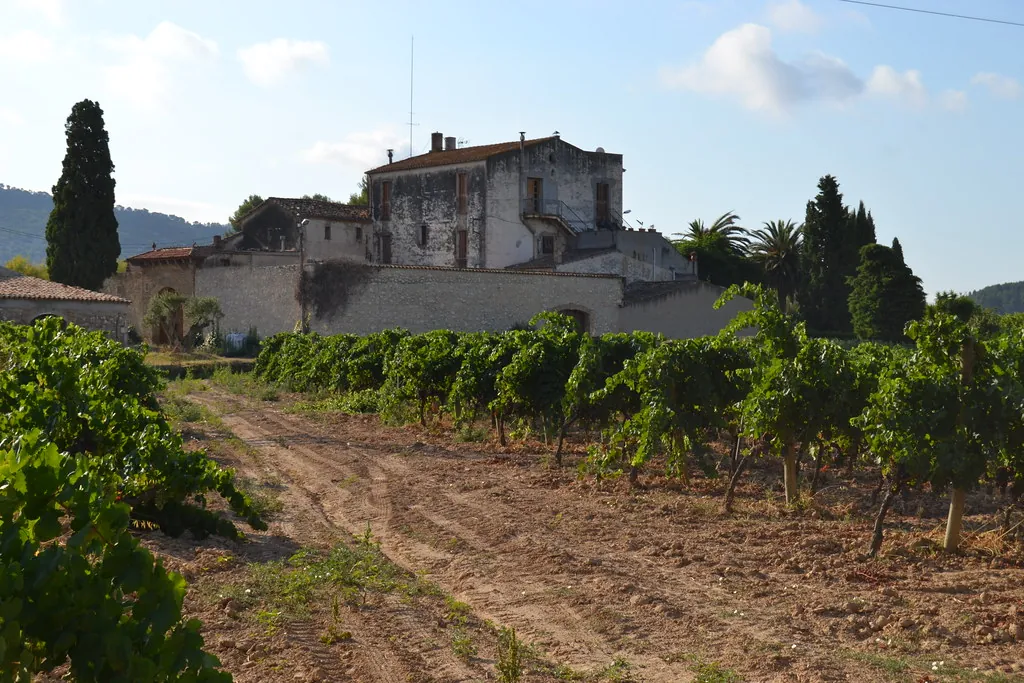
Set in the Garraf massif, it is a karst landscape and natural corridor.
Hide article Read full article
Arriving on a winding road
Anyone heading to Olesa de Bonesvalls should think about the car first. The BV‑2112 road has plenty of bends, and the final stretch runs straight into the Garraf massif. From Barcelona it usually takes less than an hour, though this is not a route for rushing.
Parking works best in the upper part of the village or near the cemetery, if there is space. From there, it is easier to walk down into the centre without dealing with narrow streets. Driving into the middle tends to complicate things more than it helps.
Time of day matters. Early morning or late afternoon feels more comfortable. At midday the sun is direct and there is very little shade.
A small village with a long past
Olesa de Bonesvalls is compact. It does not take long to walk from one end to the other. Stone houses line short streets, and during the week there is a noticeable quiet.
The church of Sant Joan has a medieval appearance. Many sources place it around the 13th century. Its look matches that of a rural parish: thick stone walls, a simple roof, and little decoration. A brief visit is usually enough before moving on.
Nearby stands the old medieval hospital that gave its name to one of the neighbourhoods. What remains today is a historic complex with some restored sections. It is not especially large, though it helps explain the role of this part of the Garraf. For centuries, this was a route linking the Penedès region with Barcelona.
Castle remains above the valley
A short walk from the village leads to the ruins of the castle of the count of Cervelló. Expectations should stay realistic. The site consists mainly of wall remains and little else.
The appeal lies more in the setting than in the structure itself. Views open out over the valley, and it is usually a quiet spot without many visitors. There is no interpretation centre and no organised route through the ruins.
The Arcada del Garraf
The Arcada del Garraf, a natural rock bridge, sits some distance from the village in the direction of Canyelles. Signs along the road point the way, followed by a walk along a track.
It makes sense to visit for anyone interested in the geology of the Garraf. Otherwise, it is simply a rock formation with a large arch. It is an unusual sight, though not something that fills half a day.
Walking into the Garraf
The surroundings are the clearest reason to come to Olesa de Bonesvalls. The Garraf massif begins almost at the edge of the village.
Several long-distance paths pass through here, including the GR‑92, along with many forest tracks. The terrain is dry, with limestone underfoot and low vegetation such as rosemary. Sun exposure is constant, so carrying water is advisable even on mild days.
The area also attracts mountain biking, particularly around the Ordal zone. Routes tend to involve long climbs, loose ground and dust when conditions are dry.
Local festivals
The main village festival usually takes place in August. It includes a correfoc, a traditional Catalan event where participants dressed as devils run through the streets with fireworks, along with other cultural activities and evening music. It has the feel of a local celebration: neighbours out in the streets, long tables, and plenty of noise late into the night.
In the Hospital neighbourhood, autumn sometimes brings its own festivities. These often include a market focused on traditional trades and demonstrations of older forms of work. Attendance comes mainly from people in the surrounding comarca.
A place to pass through, not linger
Olesa de Bonesvalls does not work as a destination packed with sights. It makes more sense as a starting point for exploring the Garraf.
A simple plan fits best. Park at the top, walk down into the centre, take a short look around, then head out into the hills. It is also worth leaving before nightfall if possible. The road out is narrow, and wild boar tend to appear when least expected.