Full Article
about Cava
High-mountain municipality in the Cadí-Moixeró Natural Park; total peace and quiet
Hide article Read full article
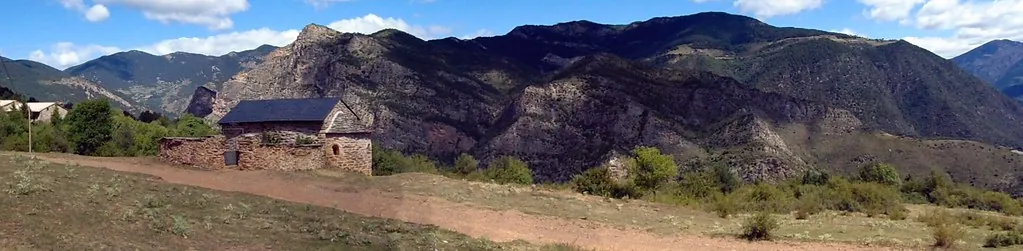
Under the shade of a solitary pine, where the street stops being a street and turns into a dirt track, a stone house faces a horizon of mountains. In Cava, in the comarca of Alt Urgell in Catalonia, silence is not a figure of speech. The wind moves through the pine needles and, from time to time, a branch cracks sharply in the air. With fewer than fifty residents, the village is explored slowly and often without seeing another soul.
Cava sits at around 1,300 metres above sea level. It is a small Pyrenean community with no shops and no signposts designed to guide visitors. Houses are scattered rather than grouped tightly together, linked by cobbled paths and short stretches of earth. The road up is narrow and winding, with sections where patience and careful driving are advisable. That difficulty keeps traffic to a minimum. Most people who arrive are locals, those who have a house here, or walkers who already know exactly where they are headed.
Stone houses and Sant Climent
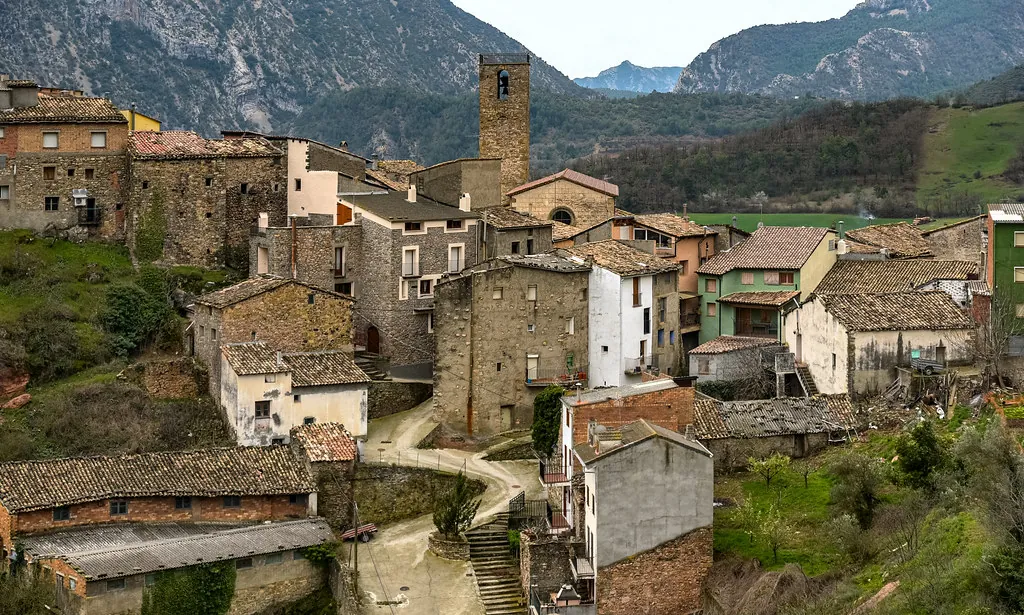
Time has left its mark on many façades. Some homes are still lived in, while others remain closed for much of the year. Even so, there is a clear sense of unity in the architecture. Thick stone walls, dark roofs and small courtyards define the look of the village. In some of those courtyards, logs are stacked in preparation for winter.
The church of Sant Climent stands near the centre of the settlement. It is a modest, sober building in both size and decoration. When it is open, which is not always the case, light filters through small windows and leaves the interior in a cool half-light, even during summer. The worn wooden pews suggest rural celebrations and community gatherings rather than organised tourism.
There are no grand monuments or curated heritage displays. What Cava offers instead is coherence: buildings that belong to the landscape and to the pace of life at this altitude.
Forest, meadows and shifting seasons
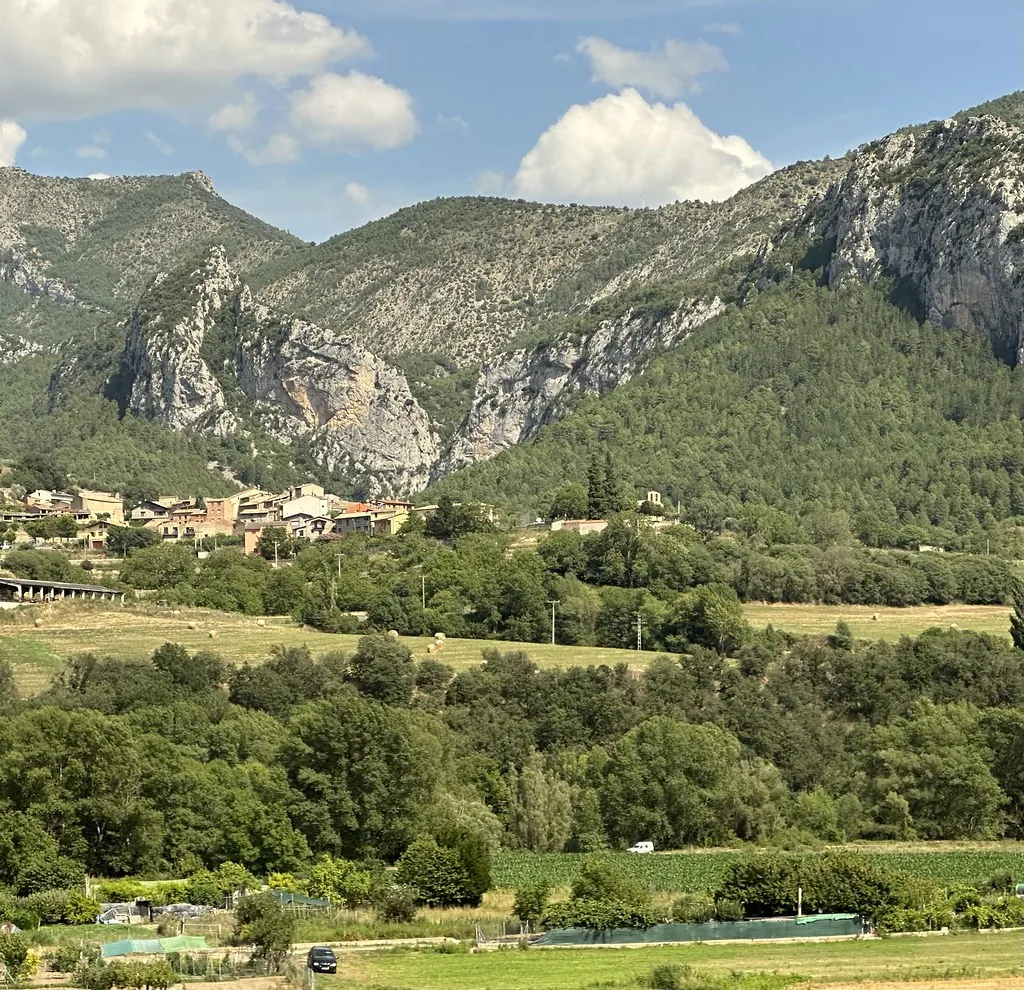
Cava is surrounded by woodland and mountain pasture. Scots pine dominates the slopes, mixed with low shrubs and clearings where small flowers bloom close to the ground in spring. As soon as the sun warms the air, the scent of resin becomes noticeable.
The seasons alter the landscape in distinct ways. Spring brings green, damp meadows. Summer tends to be dry and clear, with days of far-reaching visibility across the mountains. Autumn covers the hillsides in ochre tones and deepens the sense of quiet. Winter frequently brings snow, and with it more challenging access by road.
At night, when the sky is clear, the darkness is almost complete. There are barely any artificial lights nearby, so the stars appear sharply defined if the weather allows. The sense of height and isolation becomes more pronounced after sunset.
Old paths and slow walks
Several old paths lead out from the village into the surrounding countryside. Not all of them are signposted, and some fade gradually into meadow or forest. A map or a downloaded track is advisable for those who plan to explore them. Traditionally, these routes connected fields, bordas (stone agricultural buildings used for storage or livestock) and other small settlements in the area.
A slow walk often reveals signs of wildlife. Footprints mark muddy patches. Droppings from roe deer or wild boar are easy to spot. Birds of prey circle overhead, riding air currents that rise from the valley below. During grazing months, the distant sound of cowbells drifts across the slopes.
There is no marked circuit laid out for visitors, no designated viewpoint with railings. The experience depends largely on time and attention: following a path as it bends between pines, crossing a clearing, stopping to notice how the wind moves through the grass.
Practical considerations
Late spring to early autumn is usually the most straightforward period to visit. Paths are generally dry and access by road is simpler. In winter, snowfall can make certain stretches of the approach road delicate.
Visitors should arrive prepared. There are no shops or tourist services in the village. It is wise to bring what is needed and to download maps before heading up, as mobile coverage can fail in several sections of the route.
Cava does not function as a quick stop or a viewpoint where you pull over, take a photograph and leave. The layout of the village and the absence of facilities make that clear from the outset. This is a place that asks for a pause, even if only a short one.
A small place in the mountains
Cava occupies a high corner of the Alt Urgell where time seems to move differently from the valley below. There is no single landmark that defines it. The memory that tends to linger is more atmospheric than architectural: wind in the pines, the smell of resin in warm weather, the crunch of gravel underfoot.
Its scale shapes the experience. With so few residents, daily life remains discreet. Doors stay closed, courtyards quiet. The church may or may not be open. A walker might pass through the entire village without crossing paths with anyone.
Yet that apparent stillness is not emptiness. It reflects a mountain rhythm tied to seasons, weather and distance. In spring, damp grass and low flowers edge the paths. In summer, visibility stretches across ridgelines. Autumn compresses sound and colour into deeper tones. Winter, when snow arrives, redraws the outlines of roofs and tracks.
Cava does not try to present itself. It simply exists at 1,300 metres, reached by a road that narrows and twists as it climbs. Those who make the journey usually know why they are coming. They come for quiet, for walking, for a glimpse of a Pyrenean settlement that has changed slowly and on its own terms.
In the end, what stays in the mind is not a monument or a checklist. It is the feeling of standing in a high, sparsely populated part of Catalonia, where the wind can be heard clearly among the pines and where the pace of the mountains sets the rhythm of the day.