
Full Article
about Coll de Nargó
Known for its dinosaur sites and the Romanesque church of Sant Climent.
Hide article Read full article
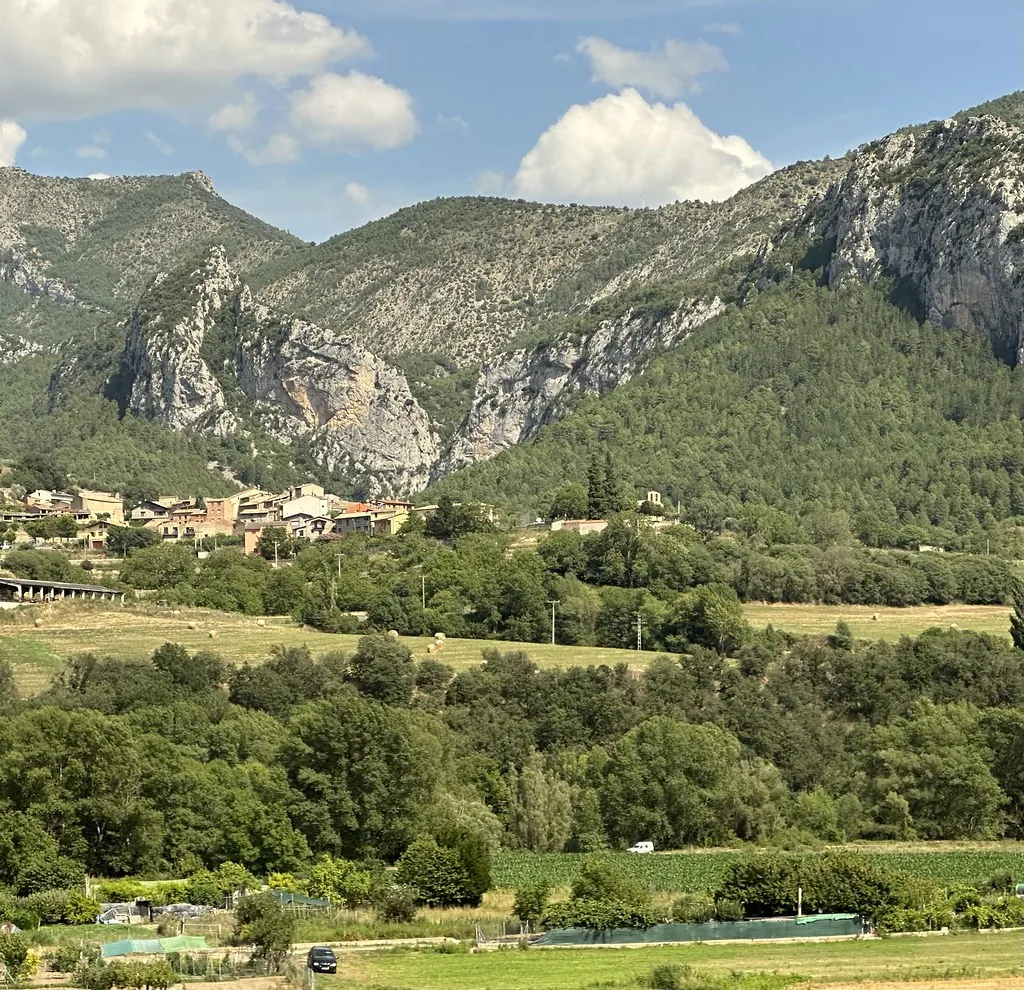
Tourism in Coll de Nargó makes most sense when the land itself is taken into account. The village sits on a promontory in the comarca of Alt Urgell, at around 573 metres above sea level, where the Pre‑Pyrenees begin to rise with clarity. With roughly 585 inhabitants, it retains a small, quiet scale. The old centre gathers around the hilltop, while beyond it lie rocky outcrops, pine woods and agricultural terraces that reflect a life closely tied to the mountains.
The municipality has gained recognition thanks to its palaeontological sites. Some of the most studied dinosaur remains in Catalonia have been found here. Even so, Coll de Nargó continues at the pace of a dispersed agricultural community. There is no sense of a purpose‑built attraction or a village reshaped for visitors.
The municipal area includes several small settlements scattered across ravines and hillsides. The terrain is irregular, with slopes that force roads and paths to follow the natural contours of the land. From higher points, the valley of the Segre River opens out below. Pine and holm oak cover many slopes, and in certain stretches limestone walls stand out clearly against the vegetation.
Here, history and geology coexist without separation. Fossil remains share space with Romanesque churches and a landscape that has been worked for centuries. Nothing feels detached from its setting.
Fossils and Romanesque stone
One of the best‑known sites in Coll de Nargó is the Museo de los Dinosaurios. It presents the discoveries made in the surrounding area, where several excavations have uncovered nests and well‑preserved fossilised eggs. These finds have helped researchers understand the final stages of dinosaurs on the Iberian Peninsula. The museum itself is small and straightforward. Its panels are easy to follow, even without previous knowledge of palaeontology.
The palaeontological sites are not dramatic monuments rising from the ground. They are discreet places within the wider landscape, sometimes difficult to interpret at first glance. Part of the visit involves learning how to read the terrain and understand what occurred here millions of years ago. Access is organised through signposted routes or with specialised guides, who help explain the significance of the remains without separating them from their natural context.
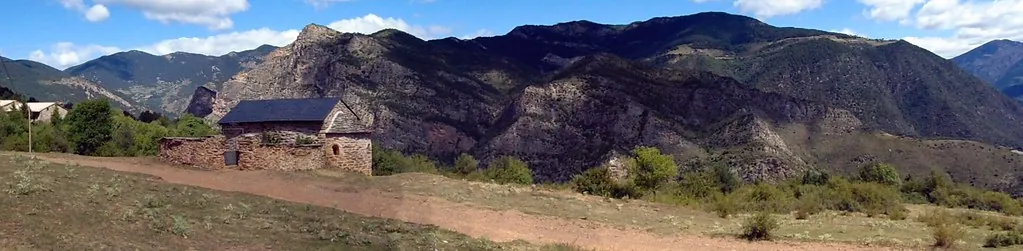
In the old quarter stands the church of Sant Climent. The building dates back to the Romanesque period, although it has been modified over the centuries. Its position overlooks part of the valley, making the link between settlement and landscape immediately clear. From the surroundings of the church, the relationship between the built environment and the terrain becomes evident.
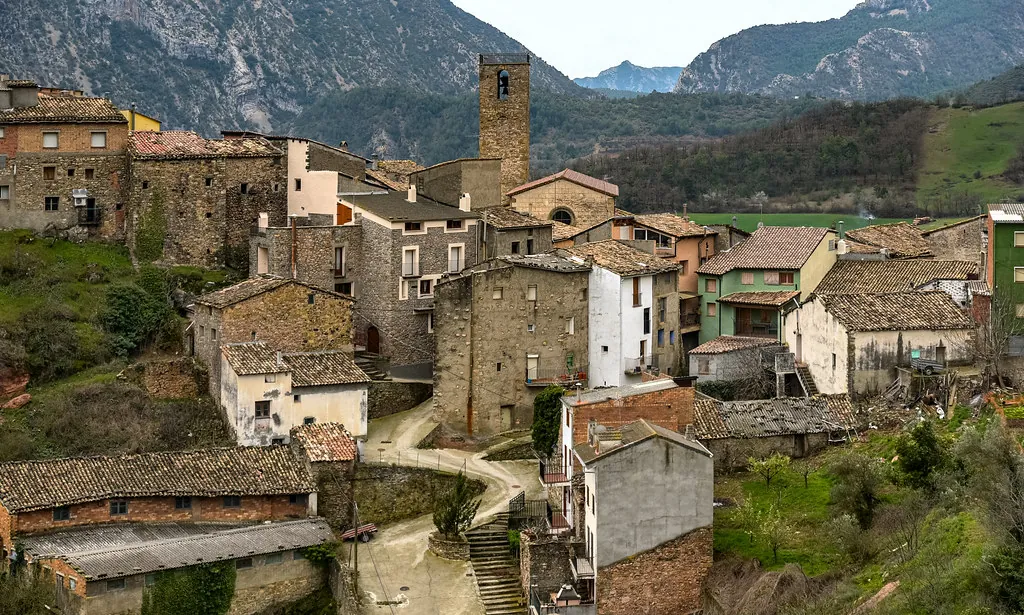
A walk through the centre reveals sober stone houses lining the narrow streets. Some retain older features such as broad doorways or simple wrought‑iron balconies. Others have been refurbished while keeping their original structure. The overall impression is one of continuity rather than display.
It helps to situate Coll de Nargó within its wider setting. Further south lie the reservoir of Sant Llorenç de Montgai and the Montsec mountain range, both in the neighbouring comarca of La Noguera. From certain elevated paths around Coll de Nargó they can be seen in the distance, though they do not form part of the municipality itself.
Walking the slopes of Alt Urgell
Several paths leave directly from the village, heading towards nearby settlements and the slopes of the valley. Many cross areas of holm oak and pine woodland. The terrain rarely stays flat for long, with constant ascents and descents shaped by the Pre‑Pyrenean relief. Most routes are not especially long, yet suitable footwear is advisable due to uneven ground and loose stone.
Some itineraries combine stretches of footpath with points linked to the fossil sites. In certain places, interpretive panels offer context for what can otherwise appear as ordinary rock formations. Old agricultural terraces and remains of rural constructions also appear along the way, reminders of the farming economy that has long structured the area.
Secondary roads in the region attract cyclists exploring the Pre‑Pyrenees. The C‑14 connects Coll de Nargó with other valleys in Alt Urgell. Traffic is generally light, although there are tight bends and narrow sections that require attention. The character of these roads reflects the terrain, winding rather than cutting straight through it.
The Segre valley concentrates much of the outdoor activity in the wider area. Near the reservoirs, fishing and other water‑related pursuits take place. Access and regulations vary, so it is sensible to check conditions in advance, as not every stretch allows approach to the riverbank.
Landscape shaped by time
Coll de Nargó is defined as much by its geology as by its built heritage. The visible limestone formations, the fossil beds and the shifting slopes of the Pre‑Pyrenees form a continuous backdrop to daily life. Agricultural terraces step down the hillsides, evidence of generations who adapted cultivation to the contours of the land.
The dispersed nature of the municipality reinforces this impression. Small clusters of houses appear between ravines and on sun‑facing slopes. Roads follow the shape of the hills rather than imposing a grid. From higher ground, the Segre valley can be seen stretching through the landscape, linking settlements across Alt Urgell.
This is not a place of grand monuments or concentrated attractions. Its interest lies in how different layers overlap: prehistoric remains, medieval architecture and a rural environment still in use. The absence of spectacle is part of its character.
Local flavours of Alt Urgell
The cuisine of Coll de Nargó follows the patterns of Alt Urgell. Local sausages and cheeses are common, along with dishes connected to the traditional pig slaughter, a practice that has long been central to rural households in this part of Catalonia. The food is straightforward and closely linked to the agricultural economy that continues to shape the municipality.
Eating here reflects the same values visible in the landscape and architecture. There is an emphasis on local produce and on recipes that respond to the climate and terrain. The mountains, the river valley and the farmland are present not only in the views but also on the table.
Coll de Nargó offers a way of approaching the Pre‑Pyrenees through terrain rather than spectacle. Its dinosaur sites have drawn scientific attention across Catalonia, yet the village itself remains anchored in its hillside setting above the Segre. Romanesque stone, fossilised nests and wooded slopes coexist within a single, coherent landscape.