Full Article
about Estamariu
Mountain village with a Romanesque gem; views of the Cadí
Hide article Read full article
Morning Light on the Slope
At first light, when the sun barely brushes the peaks that circle the village, the air in Estamariu carries a mix of damp earth and burnt wood. The light slips in at an angle between stone houses and dark roofs, picking out rough textures and grey tones that seem to merge with the mountain itself. Tourism in Estamariu is something very simple: walk slowly and listen. Silence is broken only by the creak of branches in the breeze and the brief call of a blackbird.
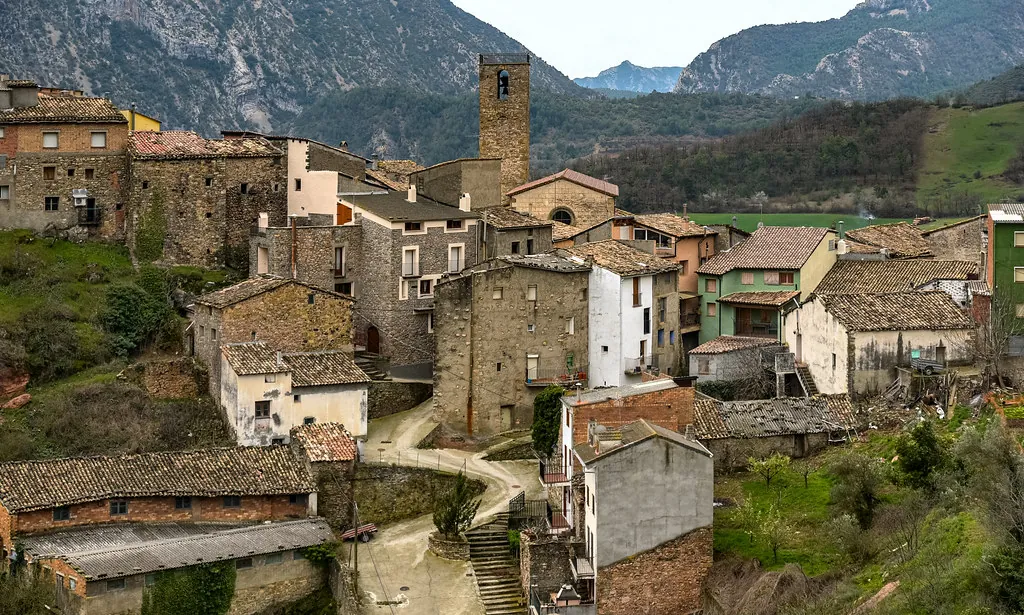
The village stretches along the hillside, its houses fitted to the incline as if they have always belonged there. Stone walls, small windows, doorways slightly askew with age. Many façades still show traces of everyday use: tools hanging in an entrance, neatly stacked firewood by a door, a shutter opening with the dry squeak of old timber. From time to time, the faint sound of cowbells drifts across from the surrounding paths. Livestock still move up and down these routes.
There is no grand spectacle waiting at the end of a street. The appeal lies in the rhythm of the place. A corner opens onto another short climb, a narrow passage leads to a patch of open sky, and the mountain is always close.
Sant Pere, Stone and Shadow
From the small square, a narrow street climbs towards the parish church of Sant Pere. The building has Romanesque origins, although later alterations are visible in parts of the walls. It is solid and unadorned, built of thick stone that shifts in colour as the daylight changes.
On the doorway, capitals with heavily worn decoration can still be made out. Time has softened their lines, leaving just enough detail to hint at their past form. Inside, the light is sparse. Wooden pews bear the marks of years of use, the air holds a cool damp scent, and the altar is restrained in its design.
Sant Pere is not always open. Morning is often the best moment to try, when there may be a little more movement in the village. Even from outside, though, the church shapes the character of Estamariu. Its mass anchors the slope, and its stone echoes the tones of the surrounding houses.
Between Bordas and Meadows
Walking through Estamariu means pausing to look at how things are made. The houses have thick walls and small balconies with old metal railings. On the ground floor, former stables can still be recognised by their sturdy doors, some of which retain marks left by tools.
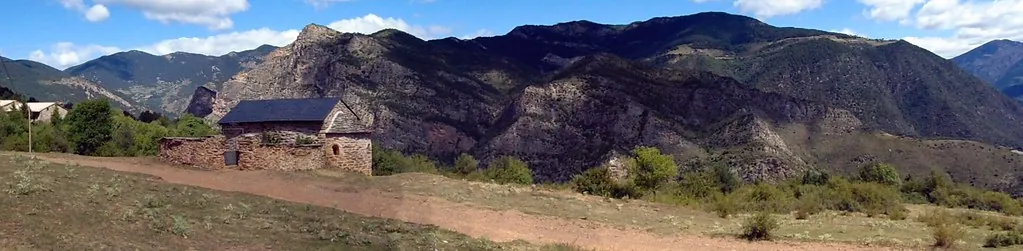
Step just beyond the cluster of houses and paths begin almost immediately. Narrow trails cross woodland and meadows where cows and sheep grazed for decades. Here and there stand bordas, traditional stone agricultural buildings once used to store hay or shelter animals. Some remain in use, others are half-covered by vegetation, their outlines softened by time.
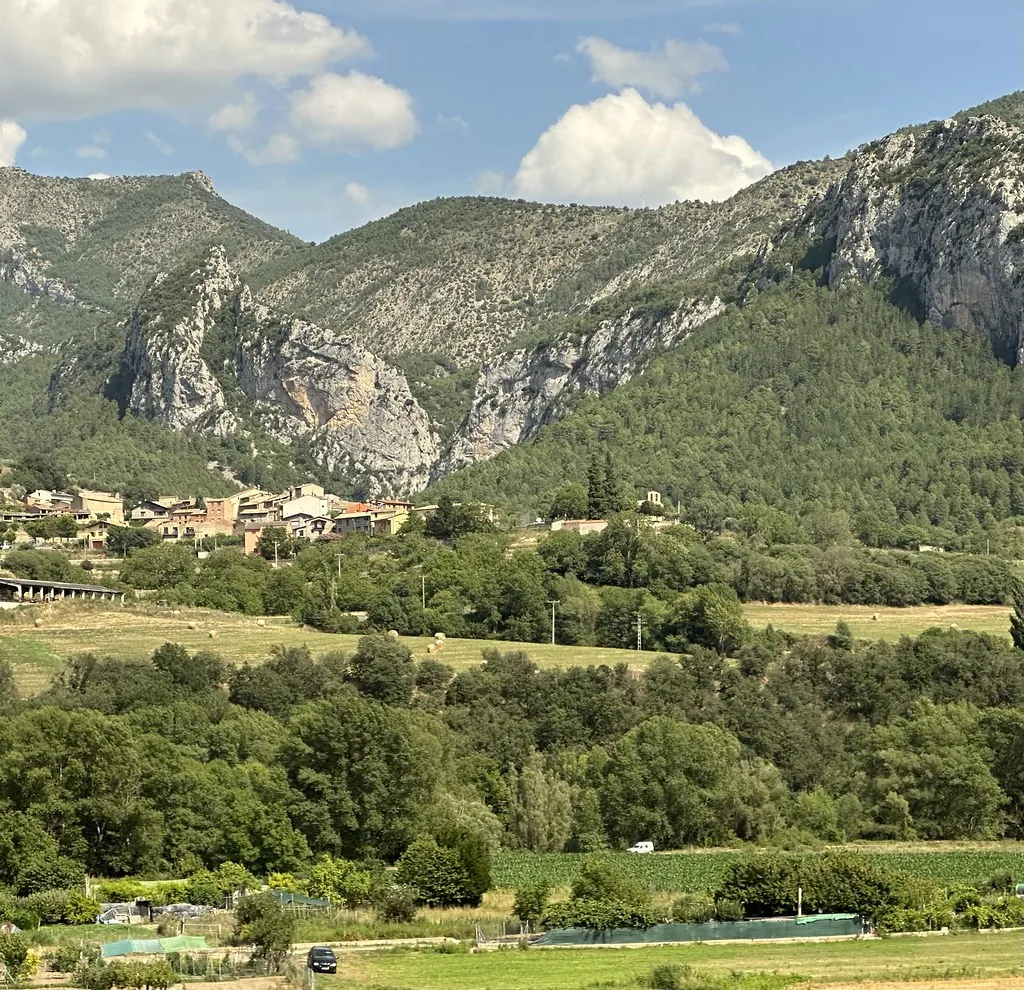
From certain clearings, the view opens towards the Segre valley. The Segre is one of the main rivers of this part of Catalonia, and from above it shapes the landscape in broad lines. Old agricultural terraces can still be seen scoring the hillside, straight lines drawn across the slope that continue to show through the trees. They speak of long periods of cultivation, even if today the forest has reclaimed much of the ground.
The experience here is unhurried. A short walk can become an hour without much distance covered. The interest lies in textures underfoot, the smell of grass or pine, the shifting view between trunks and open patches of sky.
The Landscape Through the Seasons
The hills around Estamariu are covered mainly with pine. In autumn, the ground is layered with dry needles and the air carries the scent of damp resin. Footsteps are muffled, and colours lean towards browns and deep greens.
When colder weather arrives, snowfall still blankets the village in some winters. On those days, Estamariu feels wrapped in a thicker silence than usual. Rooflines soften, paths blur at the edges, and sound travels differently. The same slopes that in summer are dotted with movement become still and pale.
Spring alters the tone completely. Meadows fill with wildflowers and green spreads over areas of bare rock. The contrast between stone walls and fresh growth is sharp at first, then gradually blends as the season settles in. Towards evening, light falls sideways across the village walls, and long shadows stretch over the fields. The change in angle reshapes familiar corners, turning rough surfaces golden before dusk.
Seasonal shifts do not transform Estamariu into a different place. They adjust the colours, the scents and the quality of sound. The structure of the village remains constant: stone, slope, sky.
Before Setting Off
Estamariu is small, and daily life follows that scale. Services are not always open within the village itself, especially outside weekends or the busier months. Anyone planning to stay for a while would do well to bring water or something to eat.
It also helps to arrive early. By midday the light grows harsher, and the quiet moment of morning fades. At that hour, hardly a car passes and the village’s soundtrack is mostly wind moving between the roofs.
There are no elaborate itineraries required here. Estamariu asks for time and attention rather than plans. A slow walk through its sloping streets, a pause outside Sant Pere, a path leading towards the Segre valley: these are enough. The village reveals itself in small details, in the way stone holds light and in the spaces between sounds.