Full Article
about Montferrer i Castellbò
Large municipality that includes the historic Castellbò valley and cross-country ski trails.
Ocultar artículo Leer artículo completo
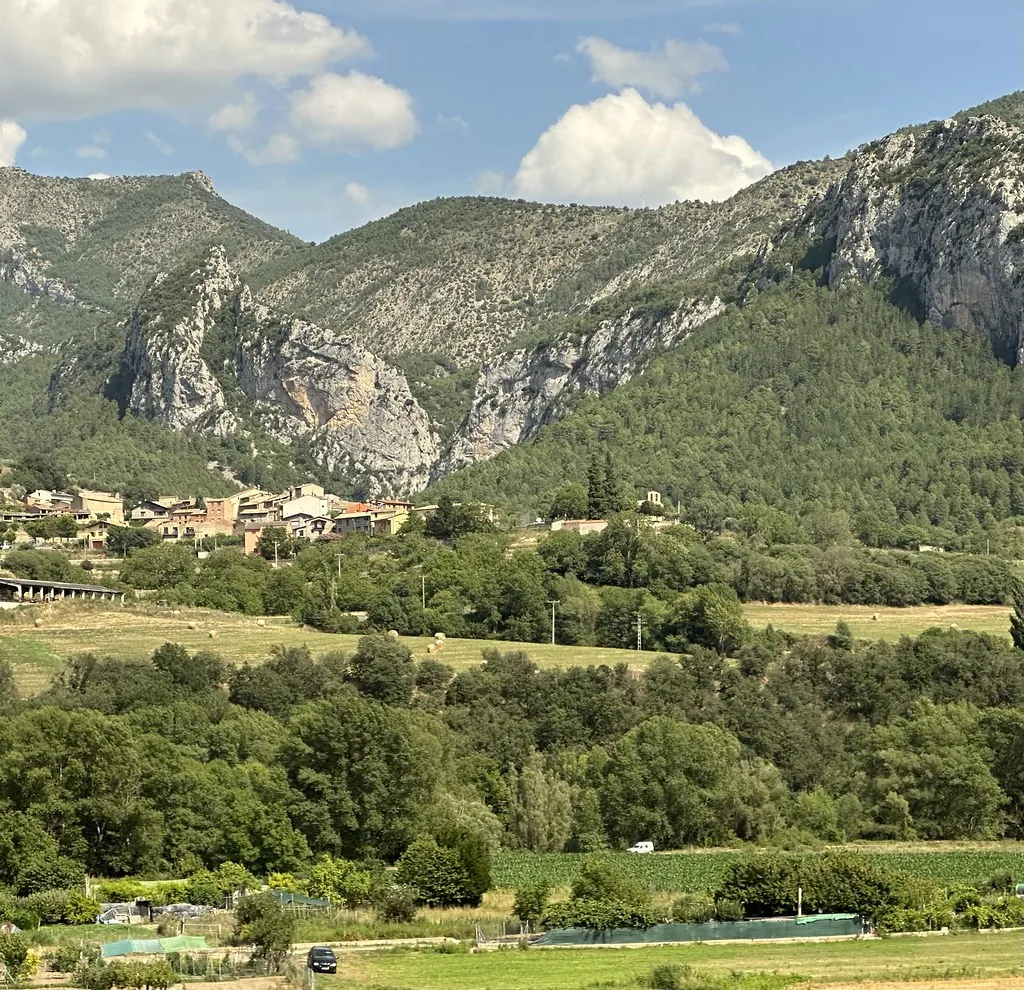
The castle walls appear first. Not grandly, but as a jagged silhouette against cereal-coloured hills, more suggestion than fortress. From the C-14 approaching Montferrer i Castellbò, this 12th-century ruin signals altitude rather than ambition – you're at 730 metres now, where the Segre valley narrows and proper mountains start pushing up from Catalan farmland.
Most visitors race past this junction, hell-bent on Andorra's duty-free petrol twenty minutes farther north. Those who swerve right find a municipality stitched together from two medieval parishes – Montferrer's low hamlets and Castellbò's loftier stone core – plus a scattering of farmsteads that barely register on the map. Total population: 1,093, though you'd need a week and good boots to meet them all.
Stone, Sky and the Smell of Cut Hay
Park by the football pitch in Montferrer; the tarmac stops being generous here. A five-minute shuffle uphill brings you to Sant Bartomeu, the village church whose Romanesque bones poke through later plaster like an old elbow. The bell tolls on the quarter-hour, not for tourists but to remind locals when the co-op shuts. Opposite, Casa Mauri still sells newspapers and tinned sardines; inside, the light is the colour of weak tea and the owner keeps accounts in pencil on a cornflakes box.
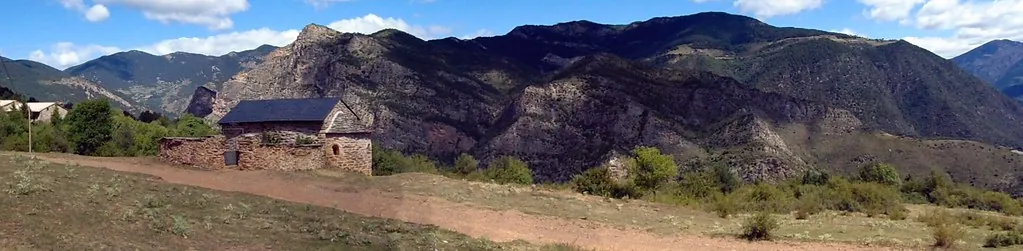
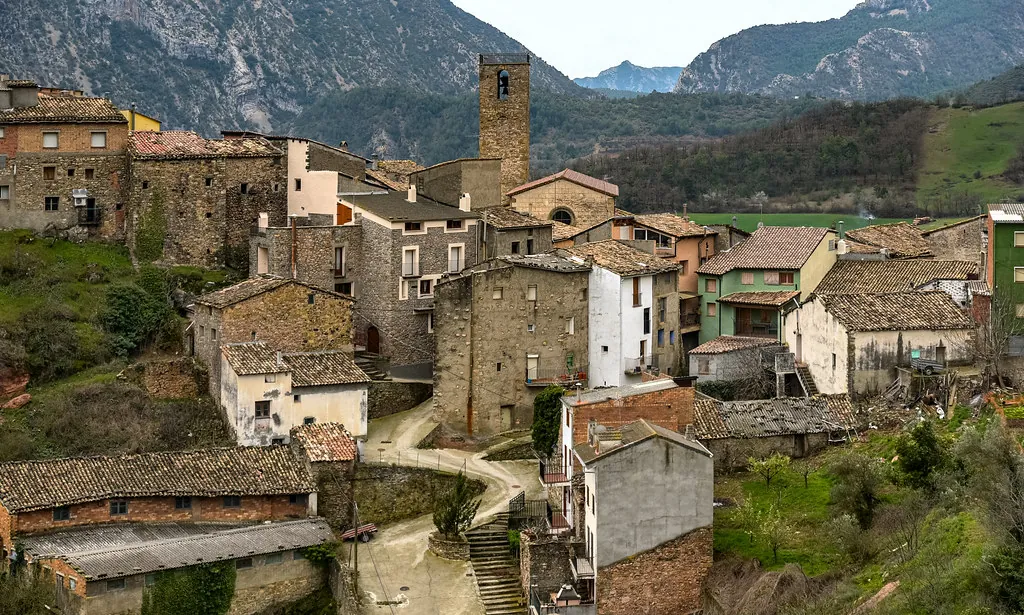
Castellbò itself hangs 150 metres higher. The road corkscrews through almond terraces until houses clamp tight around the lane, forcing drivers to breathe in. At the summit plateau the castle ruin finally reveals its full outline: a broken rectangle of pink limestone, empty windows framing tractor-ploughed strips and, beyond, the first white peaks of the real Pyrenees. Entry is free, though the council has roped off the most suicidal drops. Climb the short ladder to the keep and you'll see why this spot mattered – the Segre valley unrolls like a carpet, the C-14 now a grey thread, La Seu d'Urgell's cathedral tower a chess piece in the distance.
Below the walls, Santa Maria church does quiet service on Sundays. Its south door, carved with a worn lamb and cross, sits unlocked all week; inside, the temperature drops five degrees and swallows nest in the trusses. No gift shop, no QR code, just a printed notice asking visitors not to picnic on the altar steps.
Walking Off the Map
Footpaths here pre-date the OS. Yellow-daubed waymarks lead north-east along the castle ridge towards the hamlet of Aixirivall, twenty minutes away. The track is arrow-straight, sunk between dry-stone walls loud with grasshoppers. Keep going another hour and you drop to the Segre's flood plain, where herons hunt irrigation channels and the river smells of cold stones.
Serious walkers can stitch together a 14-kilometre loop that climbs from 650 m to 1,150 m, crossing oak, then beech, then alpine pasture. The route starts behind the Montferrer bakery (opens 07:00, closes if the baker's mother is ill) and finishes at the same spot, conveniently adjacent to Bar Cal Marçal, where beer arrives at outside tables via a sliding window. Allow four hours, carry water – fountains marked on the ICC map sometimes run dry by August – and expect thigh burn. Mountain bikes are tolerated, though hikers have right of way and cattle don't recognise either.
Winter sharpens everything. Snow can fall from November to March; the castle road is gritted, but the walking track to Aixirivall becomes a toboggan run. Come properly equipped: the nearest outdoor shop is 18 km back in La Seu, and the locals already own all the crampons.
What Passes for Lunch
Don't hunt for Michelin plates. The single restaurant in Castellbò, Ca l'Isern, opens Thursday to Sunday, serves whatever Mercadona delivered that morning, and shuts when the last table finishes. Expect trout from the Segre, rabbit with herbs, and a carafe of Costers del Segre that tastes better than it should. Three courses hover around €18; they haven't heard of contactless payment, so bring notes.
Montferrer has marginally more choice. Bar Cal Marçal does toasted sandwiches the size of house bricks and coffee that makes British petrol-station brew taste like bathwater. Locals breakfast at 10:00 on pa amb tomàquet, jamon and red wine; join them or wait until 13:30 for the lunch menu. Vegetarians get tortilla, salad, and sympathetic shrugs.
Between meals, buy Serrat cheese at the dairy on the BV-4033 (follow the hand-painted sign reading "Format"). It's a raw-cow blue, crumbly and fierce; the farmer wraps it in waxed paper and asks if you're sure about taking it on a hot car journey. He's right – by Perpignan it will smell like rugby socks.
Beds for the Night
El Racó de Cal Maró, a stone cottage on Montferrer's edge, sleeps eight for roughly £190 per night whatever the season. French visitors give it ten out of ten for welcome cake and hospital-grade cleanliness. Interiors are beamed, tiled and mercifully free of taxidermy; the terrace looks across hay meadows to the castle, floodlit until midnight then pitch black. Book through the usual platforms, but note check-in is 17:00–20:00 sharp – after that the owner drives to Lleida and leaves the key under a flowerpot labelled "NOT HERE".
Alternatives cluster 10 km south in La Seu: Hotel Naudi has a pool and spa, plus family rooms from €120, while the youth albergue in nearby Alàs charges €17 for a bunk and won't mind muddy boots. Camping Font Freda, squeezed beside the Segre, opens April–October; river noise drowns the motorway, though mid-summer the site fills with Barcelona teenagers comparing Spotify playlists.
Getting Here, Getting Out
No trains reach this pocket of Catalonia. From the UK, fly to Barcelona, collect a car, and head northwest on the A-2 and C-14 for two and a half hours. Girona is twenty minutes nearer but fewer hire desks. Roads are fast until La Seu; after that, prepare for hairpins and the occasional loose cow.
Buses run twice daily from Barcelona's Estació del Nord to La Seu (Alsa, €24, three hours), then local line 715 climbs to Montferrer. It stops outside the bakery, assuming the driver remembers. Sunday service is mythical.
The Honest Verdict
Montferrer i Castellbò will not change your life. It offers no souvenir tea towels, no zip-wires, no fridge-magnet epiphanies. What it does provide is a calibrated sense of scale: castle above, river below, and in between a working landscape that has accommodated shepherds, soldiers and now the odd British family seeking something quieter than the Costa Brava.
Come for spring orchards or autumn mushroom woods; avoid August weekends when Barcelona empties into second homes and the castle car park resembles a bumper-car rink. Bring cash, bring walking shoes, and bring a phrasebook – English is thin on the ground. Leave with dusty calves, a wedge of illegal-smelling cheese, and the realisation that Spain still has edges the guidebooks haven't smoothed flat.