Full Article
about Bellprat
Small rural village known as the first town in the world to declare itself a Book Town.
Ocultar artículo Leer artículo completo
The church bell strikes noon, yet barely carries past the stone houses. At 650 metres above sea level, sound behaves differently in Bellprat. The wind scoops up the bronze clang and flings it across the Anoia valley, where it thins out among wheat fields and almond groves. Seventy-two permanent residents pause—some at kitchen tables, others behind tractor wheels—then resume whatever occupies a Tuesday that could pass for any Tuesday since 1953.
This is Catalonia’s interior stripped of coach tours and tasting menus. Forty minutes’ drive south-west of Igualada, the road climbs through a landscape that forgets to advertise itself. No brown heritage signs, no lay-bys with Instagram frames. Just stone terraces held together by gravity and habit, and the village appearing suddenly: a grey wedge balanced on a ridge, as if the ground had shrugged and left it there.
The Arithmetic of Quiet
Bellprat’s main street is 180 metres long. You can walk it in two minutes, or an hour if you count the details: the iron hoop still fixed to a barn door for tethering mules, the 19th-century grain store with slots for eight harvest wagons, the house whose 1942 date stone is flanked by two swallows wearing tiny tin helmets—someone’s private joke against fascism. Nothing is labelled; interpretation relies on curiosity and decent walking shoes.
The parish church of Sant Pere squats at the highest point, its tower rebuilt after lightning in 1930 using mismatched stone. The door stands open most days. Inside, the air smells of beeswax and mouse droppings. A single bulb hangs above the altar, switched on via a coin box that accepts one-euro coins and the occasional peseta. Locals claim the bulb will glow for exactly 23 minutes—long enough to notice the fresco fragment of a medieval dragon, tail curled like a question mark, peering from behind the pulpit.
Outside, the plaza measures 22 paces across. Two plane trees drop shade onto benches where older men sit in order of arrival. Conversation follows strict rotation: weather, crops, football, politics, weather again. Visitors who attempt Catalan are rewarded with a slower accent, the consonants softened by altitude. Try “Bon dia, fa fresqueta” (“Good morning, it’s nippy”) in March and someone will lend you a jacket within five minutes.
Learning to Breathe Uphill
The village sits high enough for lungs to register the difference. Summer mornings arrive ten degrees cooler than Igualada; night-time temperatures can dip to 12 °C even in July. Winter brings genuine risk of snow—roads close for days if the Tramuntana wind drives drifts across the mountain pass towards Piera. Spring and autumn provide the kindest windows: mid-April almond blossom foams along the ridge; late-October sunlight slants honey-thick across terraced vineyards.
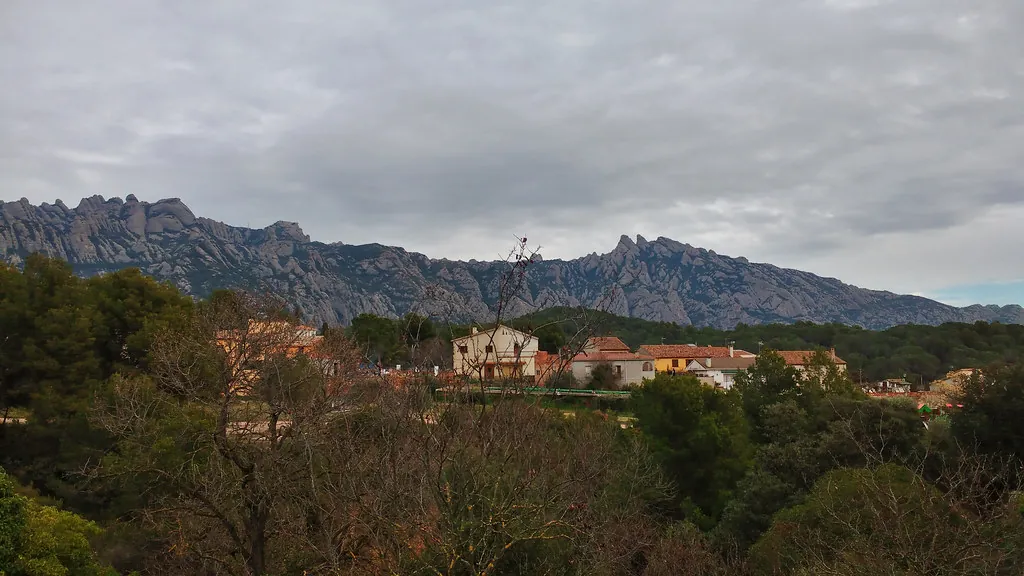
Three footpaths leave the upper square, each painted with a single stripe of yellow paint that fades after the first kilometre. The most straightforward follows the GR-7 long-distance trail south-east for 4.3 km to the hamlet of La Llacuna, passing an abandoned lime kiln where kestrels nest. The second drops 200 metres to the dried streambed of Riera de Carme, then climbs past two ruined farmhouses whose roofs collapsed the week Spain joined the EU. The third—least marked, most rewarding—circles the village at contour level, delivering 360-degree views: Montserrat’s serrated silhouette to the north-east, the faint silver ribbon of the Mediterranean forty kilometres south. Allow two hours, carry water, assume phone reception will vanish behind the second ridge.
Cyclists arrive with mountain bikes and expressions of evangelical relief. The BV-2241 from Igualada averages a 6 % gradient for the final eight kilometres, tarmac narrow enough that encountering a delivery van feels like a waltz. Descending requires stronger brakes than most hire bikes provide; the village mechanic, Pere, will true a wheel for €12 but only if you arrive before noon, when he locks up to tend his vegetable plot.
What Passes for Gastronomy
Bellprat contains zero restaurants, one bakery open three mornings a week, and a village shop the size of a London kitchen. Stock arrives on Thursdays: fresh milk, tinned sardines, a single brand of washing powder scented like 1987. Locals bulk-buy in Igualada; visitors should follow suit. The bakery’s coques—flat breads topped with escalivada (roasted aubergine and peppers)—sell out by 10:30. Arrive earlier and you might catch Maria arguing with her nephew about football while the dough proofs.
Serious eating happens in neighbouring villages. Five kilometres north, Cal Candi in Piera serves calçots (giant spring onions) from January to March, grilled over vine embers and dipped in romesco. Weekend tables book a fortnight ahead; weekday lunch menus cost €16 including half a bottle of house wine. Closer, the Bar Restaurant La Font in La Llacuna opens daily except Tuesday, offering a three-course menu del dia for €12.50: soup, grilled pork cheek, crema catalana, carafe of local wine strong enough to remind you altitude intensifies alcohol.
If you self-cater, look for Anoia olive oil sold in unlabelled five-litre tins from farm gates along the C-241. The variety is arbequina—small fruit, soft pepper finish—pressed in Igualada cooperatives since 1924. Bring your own container; they’ll fill it for €7 a litre and throw in gossip about who’s selling land to Barcelona weekenders.
When the Village Decides to Party
Festivity concentrates into two weekends. Festa Major, first weekend of August, imports a marque band, paella for 300, and a foam machine that terrifies the village dogs. Visitors are expected to buy raffle tickets (€2) for a ham; refusal causes genuine offence. Sant Pere, 29 June, is smaller: morning mass, afternoon sardana dancing in the square, evening barbecued rabbit and communal wine served from a rubber hose. Both events list “outsiders welcome” in the programme, but accommodation within the village fills instantly. The nearest beds are in Igualada’s Hotel Montserrat (€65 double, functional), or rural cottages in La Llacuna from €90 a night—book early, pay cash, bring your own towels.
Leaving Without Missing the Motorway
The last bus to Igualada departs at 19:10. Miss it and you’re hitch-hiking or calling Joan, the unofficial taxi driver (€25 flat rate, WhatsApp only, signal permitting). Driving back at dusk reveals why the village feels taller than it is: the road unwinds like released elastic, each bend exposing another ridge, another valley, another stone village glued to limestone. Bellprat’s bell reappears—first as glint, then as silhouette—before trees swallow it altogether. Down on the C-15, lorries accelerate towards Barcelona and the coast. Up there, someone is switching off the church bulb, locking the door, walking home under stars that haven’t needed rebranding.