Full Article
about Capellades
Town with a long paper-making tradition set on a travertine crag
Hide article Read full article
The water of the rec runs cloudy, heavy with lime, slipping beneath the millstones as if it knows every crack. It is the same water that once turned the wheels of Capellades, when this town of just over five thousand inhabitants was one of the papermaking centres of Catalonia. Now, at nine on a March Tuesday morning, there is only the steady splash of ducks and the distant rattle of someone pulling down the shutter of a workshop. River mist clings to the face like damp gauze. Winter lingers here: frost whitens the roofs of the houses facing the water and the air carries the scent of wet paper and freshly lit firewood.
The sound of the machines
Inside the Museu Molí Paperer, the smell settles into clothes. It is not pleasant, a mix of animal glue, caustic soda and something faintly sweet, almost like stale bread. When one of the historic machines is started, the mechanism jolts into motion with a metallic squeal and rag pulp begins its transformation into a continuous sheet that advances like a white tongue.
As the process is explained, how the workers handled the pulp and kept the wheels turning, it becomes clear that time here has not broken so much as folded over itself in layers. Many of the labourers ate something quick at midday, often a simple savoury coca, a flatbread typical of Catalonia. Life revolved around shifts, water levels and the steady rhythm of production.
Very close by lies the Abric Romaní, where traces of Neanderthal occupation were found against a wall of travertine rock. Long before hydraulic wheels and paper mills, people sheltered here. Much later came the industrial structures, each one harnessing the force of water. The industry expanded around the streams, using every channel and every natural drop in the land. Capellades grew with the rec, shaping itself to its flow.
Five paths and a lake
The route known as Els Camins del Paper begins behind the museum, where the rec del Corronaire splits into smaller channels that for centuries powered several mills. One of the simplest itineraries is a walk of just over an hour, moving between shade and water.
The path follows dry-stone banks, with willows leaning over the course and forming a green tunnel in places. In autumn the trail is carpeted with leaves and it is worth stepping carefully: the stones are often damp and the ground slopes down towards the Bassa.
Here the water widens into what was once a reservoir. Seen from a distance, it resembles a natural lake set between pale rock. In spring, when the sun has warmth at midday, it is common to see local people sitting on the walkway or edging towards the water. Even so, the temperature remains cool for most of the year. The travertine acts like a natural fridge, keeping the water fresh and cold.
Walking these paths, the presence of industry never quite disappears. Channels appear unexpectedly, stone walls bear the marks of past use, and the sound of water is constant. Capellades is small, and its relationship with the rec feels close and practical rather than decorative. Everything here has had a function.
Up to the Miranda Xica
The climb to the Miranda Xica takes about twenty minutes at an unhurried pace. The path alternates between stretches of earth and stone steps worn smooth by years of footsteps.
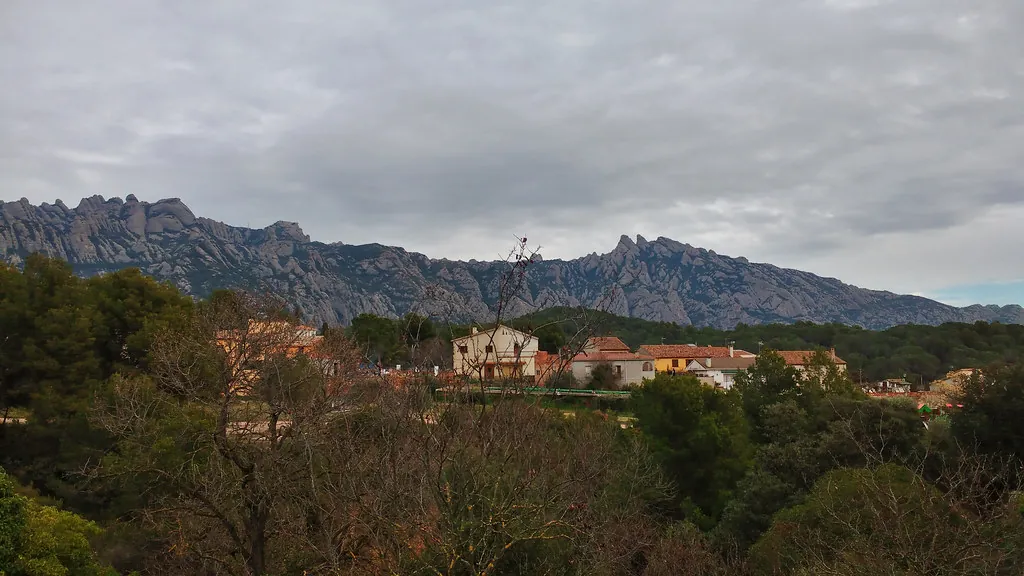
At the top, the valley of the Anoia opens out in terraces of cultivated land. On one side runs the road that follows the river towards the towns of the Penedès. On the other, Capellades gathers around the water and the old industrial chimneys that still shape the town’s outline.
When there is a light breeze, a warm scent of freshly baked bread drifts up from the urban centre below. Stay still for a while and, at times, a sharp thud can be heard carrying across the valley. It is the mill hammer striking during demonstration sessions organised for groups and schoolchildren. The sound is brief and forceful. It echoes and then fades, leaving the valley quiet again.
From this height the layers of Capellades become easier to read. Prehistoric shelter at Abric Romaní, hydraulic power and papermaking, the present-day town clustered close to its water source. The landscape explains the settlement as much as any display panel in a museum.
When to go and what to bear in mind
Spring is usually the most pleasant season for walking along the rec’s paths. The water runs strong and vegetation covers the travertine walls in green. Light reaches the valley floor for longer, and the contrast between pale rock and bright growth is at its clearest.
Winter has a different character. Moisture lingers at the bottom of the valley and the cold feels sharper than the thermometer suggests, so warm clothing is advisable. Frost often settles on the rooftops near the river, and the damp can cling to skin and clothes alike. The atmosphere is quieter, with fewer people about and the industrial past seeming closer to the surface.
For those who prefer to explore the old quarter or visit the Museu Molí Paperer at a slower pace, it helps to avoid the busiest hours in the middle of crowded weekends. Capellades is not large, and when excursions and school visits coincide the streets around the river fill quickly. On weekdays, especially in the morning, the town returns to a slower rhythm that it still retains.
Capellades does not separate nature from industry. The rec del Corronaire continues to divide and rejoin, the Bassa still reflects the pale rock, and the chimneys remain part of the skyline. Water, stone and paper have shaped this place for centuries, and the sound of a machine starting up in the museum is enough to suggest how much of that story is still within reach.