Full Article
about Carme
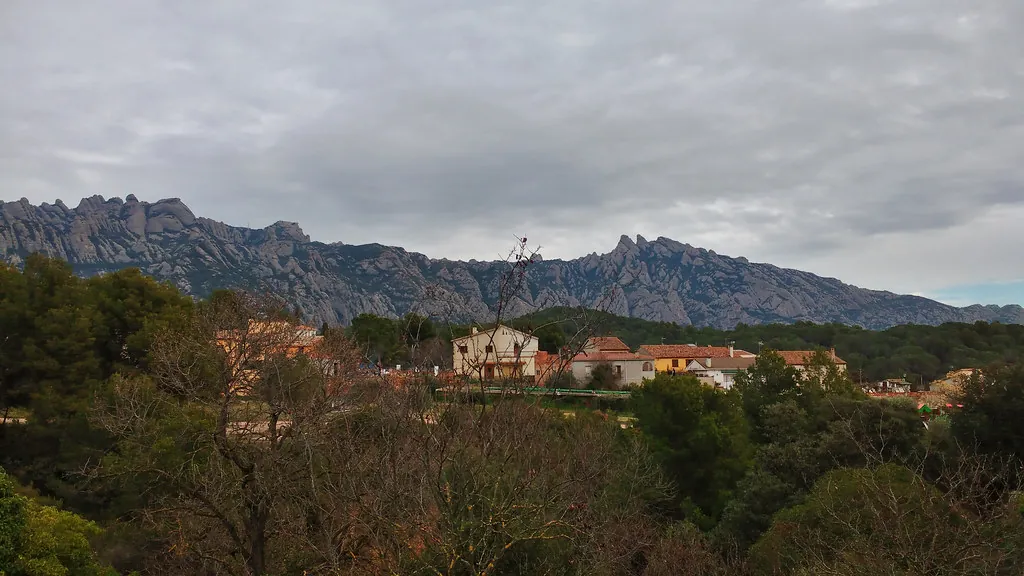
Small town in a quiet valley surrounded by woods and springs
Hide article Read full article
A shutter flies open and white midday light spills into the room. In the square, someone ties a dog’s lead to a chair while a car edges past, almost brushing the flowerpots. Tourism in Carme often begins like this: without headline monuments or dramatic skylines, but with small, ordinary gestures that shape the day.
Carme lies in the comarca of l’Anoia, a county in inland Catalonia, just a few kilometres from Igualada. The village sits among low hills and open farmland. Here, the calendar still shows in the soil. Cereals turn yellow in summer, stubble fields darken after the harvest, and almond trees bloom pale at the end of winter when the season is mild.
A Village at Ground Level
The streets in the centre are short and slightly irregular. At times they narrow so much that two cars pass with care. Facades shift between old stone, exposed brick and layers of paint faded by years of sun.
The parish church of Sant Martí holds the most visible position in the urban centre. It is a sober building of medieval origin, its bell tower marking the hours over a village that is usually quiet. By mid-afternoon the square often empties. Doors close softly, conversations drop to a murmur and, now and then, the sound of a tractor returning from the fields carries across the space.
There is little here designed to impress from afar. Instead, the rhythm reveals itself slowly. The square, the church, a handful of streets that bend and tighten without pattern. Carme feels gathered in on itself, shaped more by the land around it than by any desire to expand.
Farmhouses and Working Land
Step beyond the last houses and the masías appear almost immediately. These traditional Catalan farmhouses, once the heart of rural family life, stand scattered across the landscape. Some are still inhabited. Others sit behind closed gates, roofs partly repaired, thick stone walls bearing the marks of time.
Their irregular masonry is a reminder that this land has been worked for centuries. The surrounding fields change with the season. Cereals dominate, but there are also small vineyards and patches of olive trees. Between plots, holm oaks and pines grow in loose clusters. When the wind blows in from the interior, it carries the smell of dry straw and freshly turned earth.
Many of these properties are private. They can be seen clearly from the paths that cross the area, but approaching too closely is not always possible without permission. It is a landscape to look at from the track, rather than to enter freely.
What stands out is the sense of continuity. Fields follow familiar lines. Farmhouses remain where they have long stood. The land dictates the pace and use of space, and the village adapts accordingly.
Quiet Tracks Towards the Anoia Valley
Several rural tracks lead out from Carme towards nearby villages such as Capellades and Orpí. These are not demanding mountain routes. They are broad paths running between cultivated fields, with stretches of Mediterranean woodland where dry leaves carpet the ground.
Early in the morning, cooler air drifts down from the hills. In summer it makes sense to set out early. By midday the sun falls directly on the open sections and there is little shade. The light can feel harsh, especially in the height of summer when the hours around noon stretch out and the fields reflect the brightness.
Climb one of the small nearby rises and the landscape becomes easier to read. The valley of the Anoia opens out in a mosaic of pale fields, green patches of pine forest and straight tracks cutting across the plain. From above, the organisation of crops and paths shows how carefully the terrain has been shaped, field by field.
These routes are as much about the surroundings as the destination. The ground underfoot alternates between compacted earth and scattered stones. In wooded stretches, the air shifts slightly cooler and carries the scent of resin. Then the trees thin and the horizon opens again.
Secondary Roads Meant for an Unhurried Pace
The roads around Carme see little traffic for much of the day. They are narrow, with gentle bends and long views over the fields. It is common to see cyclists riding in small groups, especially on cooler days in autumn or spring.
Driving here calls for patience. Some stretches have no verge, and cyclists can appear suddenly as a bend straightens. The pace tends to be calm. Vehicles move without haste, following the natural curves of the land.
These secondary roads reinforce the feeling that Carme sits slightly apart from busier routes. The surrounding hills act as a soft boundary, and the approach is gradual. There is no dramatic entrance, simply a series of bends and open views that lead into the village.
Moments in the Year
Carme changes noticeably with the seasons. In August there is usually more activity, linked to the fiesta mayor, the annual village festival common across Spain, and to families who return for a few days. The streets feel less empty, voices carry further into the evening and the square regains a little bustle.
For walking or cycling along the tracks, spring and autumn tend to work best. The landscape shows more colour and the heat is less intense. Wild greens and fresh growth soften the edges of the fields in spring, while autumn light flattens the tones into golds and browns without the weight of summer sun.
In high summer the brightness is stark. The central hours of the day can feel long and exposed, particularly on open stretches with little shade. Winter brings its own shifts, with darker soil after harvest and almond trees that, in mild years, break into white blossom towards the end of the season.
Carme does not try to draw attention to itself. It is one of those places where the prevailing memory is a slow rhythm: worked fields, bells marking the afternoon and paths that have followed the same lines for generations. The sensation is simple and clear. The territory sets the terms, and the village adjusts to them.