Full Article
about Castellfollit de Riubregós
Small town dominated by the ruins of its castle and the Romanesque priory.
Ocultar artículo Leer artículo completo
The tarmac simply stops. One moment you're on the C-1411 threading between wheat fields, the next you're coasting onto packed earth as the village sign appears: Castellfollit de Riubregós, alt. 467 m. The only sound is gravel pinging the underside of the hire car. Ahead, stone houses crouch low against the wind, their roofs the same ochre as the surrounding soil. No souvenir shops, no coach bays, not even a cash machine. Just silence and the smell of dry straw.
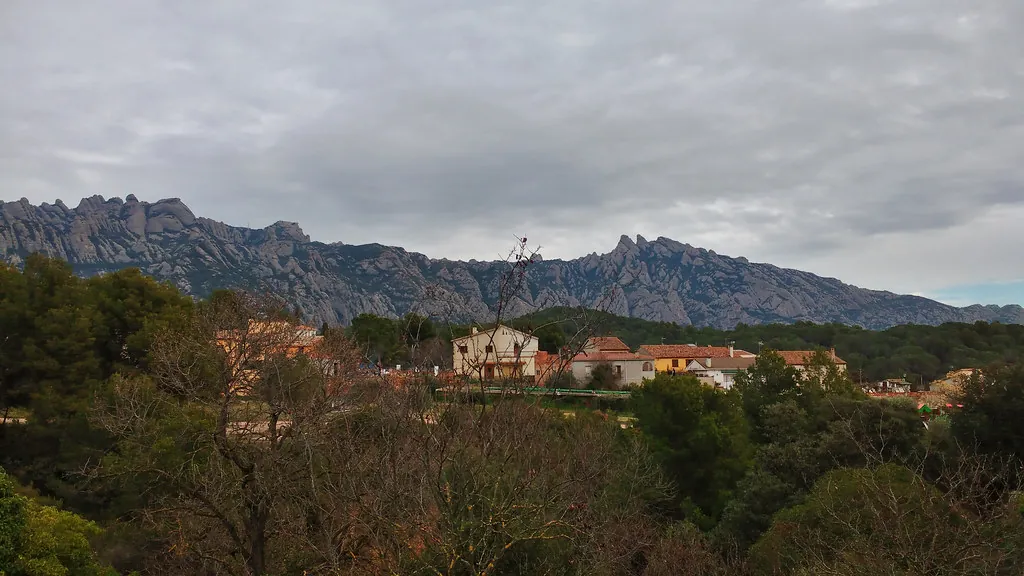
This is the Catalonia that rarely makes the brochures. Forty minutes' drive west from Manresa, the land buckles into gentle waves of dry-farming country. Castellfollit sits on one such ridge, a single-street settlement of 150 souls whose name remembers a long-vanished castle and the seasonal stream that briefly fills the ravines after autumn storms. The Romans passed through, the Moors raided, the Civil War skimmed the hills. None of it dented the village's essential rhythm: sow, harvest, prune, repeat.
Stone, Straw and Sunday Lunch
Park where the lane widens by the church—there are no yellow lines because no one has needed them. The parish church of Santa Maria is open only on request; phone the number taped to the door and the sacristan arrives within ten minutes, wiping flour from her hands. Inside, the single nave is cool and plain, the walls washed white except where 17th-century frescoes peep through like bruises. The bell tower doubles as the village timekeeper: three slow chimes for the hour, two quick ones for the half. When the wind is right you can hear it two kilometres away in the almond orchards.
Behind the altar is the only piece of ostentation: a wooden retable painted the colour of dried blood, gilded with what locals swear is real gold leaf salvaged from a bombed monastery in '38. Whether myth or memory, no one is checking. Faith here is practical—when the priest visits monthly he also brings the mobile post office, a white van whose passenger seat holds pension books and paracetamol.
Walk the five minutes to Can Pep before noon if you want lunch. The restaurant is simply the front room of a stone farmhouse; the menu is written on a paper tablecloth and changes according to what Pep's mother has decided to slaughter. Grilled lamb (€14 for half a kilo) arrives on a plank with roasted onion and a warning: "No doggy bags, eat what you order." The house white, pulled from a plastic demijohn, costs €2.50 a glass and tastes of green apples and dust. Vegetarians get coca de recapte, aubergine and red pepper on thin bread—no cheese, no fuss. Pudding is optional; coffee is not. They shut the door at four sharp, sometimes earlier if Pep fancies a nap.
Tracks that Remember Hooves
Afternoons are for walking off the wine. Three sign-posted loops leave the village, none longer than eight kilometres. The yellow route drops into the riubregós itself, a shallow gash thick with reeds and the wreck of an 1890 stone bridge dynamited during the war. Follow the dry riverbed south and you reach an era—a circular threshing floor—its stones still blackened from the last burn in the 1970s. Elderly locals remember winnowing here as children, singing to scare sparrows from the wheat.
The red trail climbs the opposite hill through a patchwork of barley and vines so dwarfed they look like bonsai. This is vinya seca, dry-farming country where yields are measured in desperation and every vine is spaced four metres apart so roots don't murder each other. At the crest the Pyrenees float on the northern horizon, snow-tipped until June. Between you and them lies 80 kilometres of empty plateau broken only by the occasional masia, its stone walls the same grey-pink as the earth. Turn 180 degrees and Barcelona's haze is a faint bruise on the eastern sky. The contrast feels deliberate: ancient hardship on one side, 21st-century bustle on the other, with Castellfollit balanced in the middle like a pause button.
Cyclists favour the network of farm tracks linking Castellfollit with neighbouring Pujalt and Rubió. Gradient rarely exceeds 5 % but the surface varies from packed grit to fist-sized limestone that will puncture weak tyres. Road bikes work; gravel bikes are happier. Carry two bottles—there is no café between villages and summer temperatures sit stubbornly in the low thirties. If you time it for late May you can ride through clouds of poppies so bright they seem to vibrate.
When the Wind Switches North
Winter is a different proposition. The same tracks turn to ochre paste after rain; mist pools in the hollows so thickly that headlights bounce back at you. Temperatures drop to minus five at night, warm enough to keep the almond trees honest but cold enough to make the church's stone walls sweat. The village empties further—weekenders stay away, Can Pep opens only at weekends, and the single grocery shortens its hours to 09:00-13:00. What you get instead is acoustic clarity: every dog bark echoes for miles, and on still evenings you can hear the slow freight train that runs through Igualada, 25 kilometres south, sounding its horn for level crossings that no longer exist.
Come February the calçotada season begins. Someone's cousin drives down from Valls with two sacks of calçots, the long sweet onions that Catalans char over vine prunings. A communal barbecue appears in the square: oil drums sliced lengthways, chicken wire stretched across the top. Locals donate branches, someone produces a bottle of romesco, and for one afternoon the population doubles. Tourists are welcome but there's no leaflet: you stand where there's space, peel blackened skin with your fingers, and mop sauce before it drips onto your shoes. The town hall supplies wine in plastic jugs; payment is a €3 coin dropped into a jam jar.
The Catch in the Idyll
Honesty requires footnotes. Mobile signal is patchy—Vodafone works on the church steps, O2 gives up entirely. There are no pavements; after dark you walk in the road trusting drivers to recognise your silhouette. Accommodation is limited to two guesthouses, five rooms each, both booked solid at Easter by Barcelona families who treat the village like their private campsite. If you must stay overnight, reserve early or base yourself in Igualada and drive up for the day. And remember the name confusion: Google still occasionally sends people 90 kilometres north-east to the cliff-top Castellfollit de la Roca. Triple-check your route before setting out; the wrong one has coach parks and souvenir basalt key-rings, this one has silence and a man selling onions from his boot.
Drive out at sunset. The wheat catches the light and turns metallic, the church bell tolls once for no reason, and a woman in an apron waves because she assumes you must be lost. You aren't any more. You've simply arrived at the place where Catalonia stops trying to impress anyone and just gets on with the harvest.