Full Article
about Copons
A village with a past as a muleteer trading hub, still home to charming arcaded squares.
Ocultar artículo Leer artículo completo
The church bell in Copons strikes seven times and the village loudspeaker crackles to life. A voice in Catalan announces that the baker’s van is delayed—again—because a tractor has wedged itself on the hill to the castle. At 430 metres above sea level, this is the morning news bulletin in a place where traffic jams involve livestock rather than hatchbacks.
Perched on the first wrinkles of land that separate the cereal plains of Anoia from the high plateau of Segarra, Copons is home to 333 permanent residents, two resident donkeys and, in high summer, a handful of overheated British cyclists who thought “inland Barcelona” sounded breezy. It isn’t. July temperatures sit stubbornly either side of 31 °C and the only shade is inside the stone thickness of the eleventh-century church of Sant Pere. Come April or late September, however, the air thins out, the thermometer retreats to a civilised 22 °C and the surrounding network of mare’s-tail paths becomes a proper walking playground.
Stone, Soil and Sky
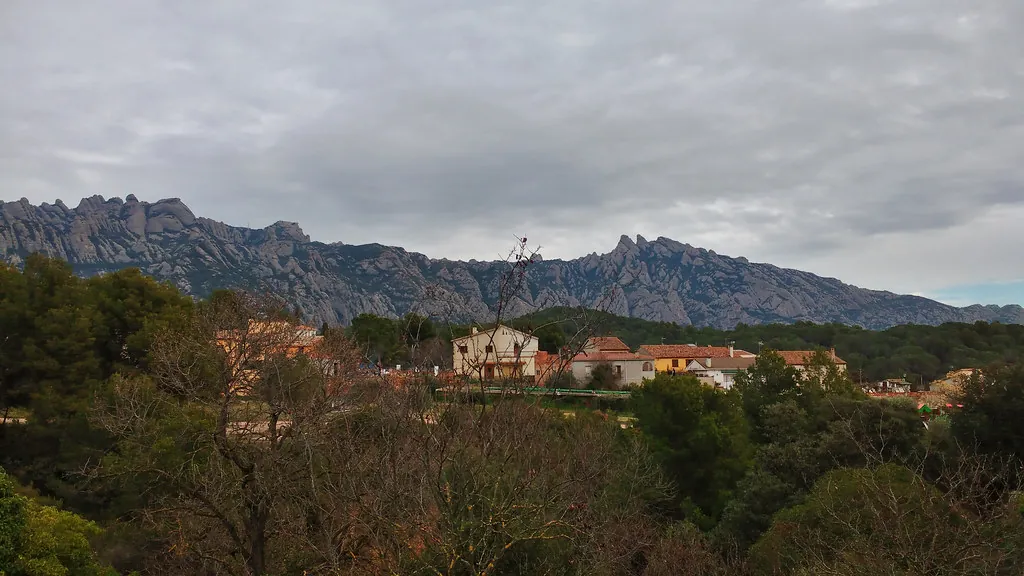
The village clusters around a single cobbled lane just wide enough for a hay trailer to scrape both walls. Houses are built from honey-coloured limestone hacked out of the neighbouring ridge; roofs slope at jaunty angles to shed the thunderstorms that roll across the plateau in October. Look up and you’ll see Montserrat floating on the south-western horizon, its serrated ridge lined up like broken teeth—40 kilometres away but appearing close enough to touch on days when the tramuntana wind has scrubbed the sky clean.
Outside the centre, the municipality unrolls as a patchwork of almond groves, durum-wheat stubble and centuries-old masías whose metre-thick walls once doubled as refuges from bandits. Most are still private farms; the owners will wave if you stand politely on the track but won’t thank you for wandering into the yard. Stick to the public camins—ancient bridleways wide enough for a single mule—that loop out for anything from 45 minutes to half a day. The classic circuit climbs to the ruined Castell de Copons, where only the base of the watchtower and a single Gothic window survive, but the 360-degree payoff stretches from the Pyrenees to the coastal range.
Eating (and the Art of Timing It)
There is no supermarket, no filling station and, crucially, no cash machine. Stock up in Igualada, 18 kilometres down the C-141a, before you wind up here. The solitary hostal, Cal Pons, opens its dining room at 13:30 sharp and will serve exactly one sitting. The €14 menú del día is reassuringly unadventurous: country soup, roast chicken with proper chips, and a wobbling custard. Children are welcomed with an immediate bowl of olives and a paper tablecloth they can doodle on. Vegetarians get an omelette, end of discussion. Supper is theoretically possible if you reserve before 16:00; otherwise the kitchen closes and the village retires with the sparrows.
Thirsty walkers can usually cajole the owner into selling them a chilled bottle of vi d’agulla, a lightly sparkling white from neighbouring Penedès served by the pint. Alcohol hovers around 11%, so you can still navigate the moonlit lane back to your room without zig-zagging.
Practicalities Without the Brochure Speak
Accommodation is limited to six rooms above the restaurant and one self-catering cottage opposite the church bell tower. Both are inexpensive (expect €55–€70 B&B) but August and Easter week sell out months ahead to Catalan families who drive up with bicycles strapped to the roof. If you’re locked out, the nearest alternatives are in Igualada or the fortified village of Òdena—each a twenty-minute drive that feels longer after dark when wild boar claim the road.
Mobile reception inside the stone houses is patchy on UK networks: step into the tiny plaça for a reliable 4G bar. Parking is free but designed for donkey carts; anyone hiring a seven-seat SUV should leave it in the signed entrada lot and walk the last 200 metres. Buses exist on Tuesdays and Fridays only; realistically you need a car. From Barcelona airport it’s 125 kilometres—allow two and a quarter hours once you’ve escaped the capital’s ring road and paid the €7.45 toll on the A-2.
When to Come, When to Stay Away
Early May brings a haze of green wheat and enough wildflowers to keep a botanist busy, while late October turns the almond trees bronze and fills the evening air with the smell of bonfires. Mid-winter is surprisingly sharp: night temperatures drop below freezing and the castle track becomes a toboggan run after rain. Snow is rare but mist is common, wrapping the village in a damp silence that makes the church bell sound like something from a Victorian novel. July and August are simply too hot for comfortable hiking unless you start before seven; they are also the months when every shutter is closed against the sun and the only voices come from the lone bar televising the Tour de France.
Copons will never elbow Barcelona or the Costa Brava off the front page. It offers nothing you can queue for, photograph and post before lunch. What it does give is rhythm: the clang of bells on the hour, the whisper of wheat when the wind changes, the smell of stone that has been cooling all night. If that sounds like a decent swap for souvenir shops and cocktail lists, come on a Tuesday evening when the bakery van finally crests the hill. The locals will be waiting, coins counted out in the palm of the hand, exchanging the day’s small news. Join the queue, buy a still-warm coc, and you’ll have experienced Copons exactly as intended—no filter required.