Full Article
about Els Hostalets de Pierola
Site of the Pierolapithecus find, with Modernist heritage
Hide article Read full article
At nine in the morning, the Centre de Restauració i Interpretació de la Paleontologia smells of glue and dust that is millions of years old. In Els Hostalets de Pierola, tourism often begins indoors, at a worktable rather than on a viewpoint. Through a pane of glass, a woman in a white lab coat patiently cleans what looks like an ordinary stone. It is in fact part of the jaw of Pau, the hominid discovered in these deposits, from a time when this area was humid forest and bore little resemblance to today’s vineyards and dry fields.
When the bones start to speak
The CRIP, as the centre is known, does not feel like a hushed museum of display cases. It functions more like an open workshop where palaeontologists can often be seen at work with tiny tools, almost like watchmakers. Children are able to handle fossil replicas and pull open drawers filled with teeth, vertebrae and fragments that are still under study.
The centre explains the discovery of Pierolapithecus catalaunicus, known as Pau, one of the finds that sparked considerable discussion in palaeoanthropology when it emerged from this area. What stands out is the blend of laboratory and exhibition. Science is not presented as a finished story but as a process unfolding in front of you.
On the lower floor, reconstructions depict the landscape as it was millions of years ago. Where there are now gentle vineyard-covered hills and pale dusty tracks, there would once have been broader watercourses, dense vegetation and animals more commonly associated today with tropical climates. A scale model helps visitors picture the contrast. Outside the window, a tractor passes by, reinforcing just how different the setting used to be.
If there is time to plan ahead, it is worth checking whether guided visits are available. They tend to clarify much of what you are seeing and provide useful context for the discoveries made here.
The tower that watched the valley
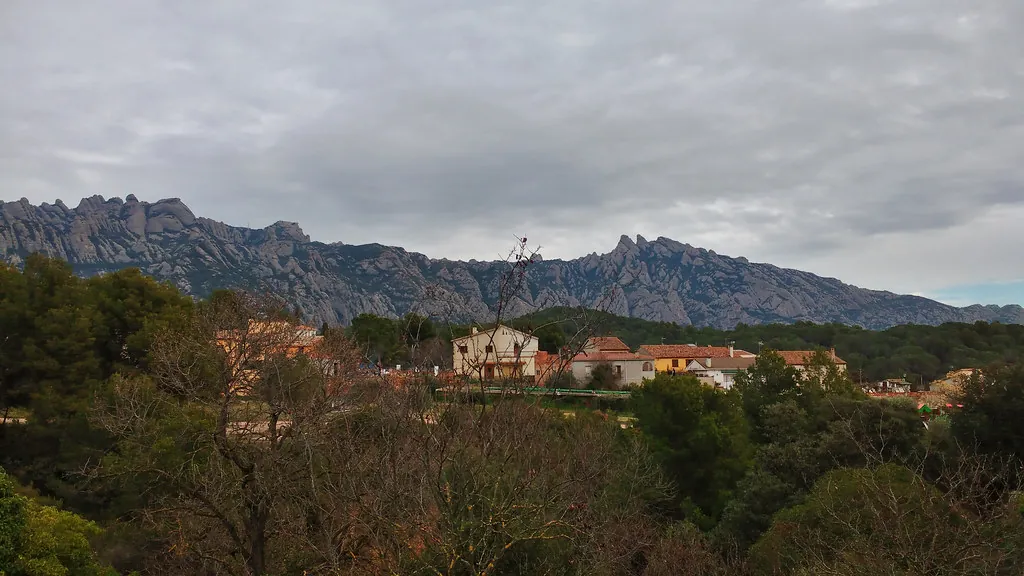
From the castle, or what remains of it, the valley of the Pierola stream opens out completely. A green ribbon winds between limestone hills and stepped fields.
The tower, of medieval origin, is still standing. By mid-afternoon the stone holds the warmth of the sun and feels almost warm to the touch, as if it has been storing heat for centuries. The site served a defensive function and has also been linked to episodes of banditry, something that was fairly common in parts of Catalonia during certain periods.
From the top, a narrow corriol, a small footpath, descends towards the old nucleus of the village. In summer, the path carries the scent of thyme and dry dust. The walk down is short but gives a sense of how the settlement shifted over time, from the fortified height to the flatter ground below.
Short streets and older façades
At the bottom, the houses press close together. The streets are short, the façades a mix of recent renovations and much older stonework. On some doorways, dates are still carved into the lintels, quiet markers of earlier centuries.
The church of Sant Pere stands at the centre of the present-day village. Compared with the castle, the building is relatively recent. The parish was moved from the hilltop when the inhabited nucleus began to grow on the plain below, reflecting a gradual change in how people lived and organised the space.
On Sunday mornings in particular, the square has an unhurried rhythm. There is the smell of freshly baked bread and the strong cologne of older men gathered to talk. Conversations drift between Catalan and Spanish, often blending naturally in a way that is common across the comarca, or county, around Els Hostalets de Pierola.
The scale is modest. There are no grand avenues or monumental buildings, just everyday architecture that reveals how the village has evolved. The interest lies in the details: a worn stone step, an iron balcony, a date chiselled above a doorway.
An unexpected touch of Modernisme
In the small Plaça de la Font, one building interrupts the rural tone: the former Renaixença school. Its ceramics in green and ochre tones, curved ironwork on the balconies and decorative details recall the Modernisme style that spread across Catalonia in the early 20th century. For readers more familiar with Barcelona, this is the same broad movement associated with architects such as Gaudí, although here it appears in a much humbler form.
Looking more closely around the village, further examples come into view. Some houses display plant-inspired wrought iron on their balconies. There are also residential towers built during the same period, when certain well-off families began constructing second homes here.
It is not a large ensemble, yet its presence in a small municipality comes as a surprise. The contrast between palaeontological digs, medieval remains and early 20th-century design adds another layer to a place that might otherwise seem defined solely by its rural setting.
When to pass through
Late winter and early spring are often good moments to explore the area. The countryside remains green and almond trees blossom across many plots. The fields and terraces surrounding Els Hostalets de Pierola form a patchwork that is especially clear at this time of year.
Summer brings more activity due to the village festivities, and the heat becomes intense from midday onwards. Those looking to walk quietly or approach the castle without many people around will find it more comfortable to arrive early in the day or during the week.
In the late afternoon, when the sun drops behind the hills, the valley grows quieter. From the tower, the terraced vineyards and the mosaic of fields around Els Hostalets de Pierola come into focus. The wind often carries the scent of rosemary and dry earth.
It is easy to remain there for a while, looking out over the same landscape where, millions of years ago, those bones emerged from the ground. The setting today feels agricultural and familiar. Yet beneath the soil lies the trace of a very different world, one that the Centre de Restauració i Interpretació de la Paleontologia continues to uncover, piece by careful piece.