Full Article
about Els Prats de Rei
Historic town with Roman remains and a notable Baroque church
Hide article Read full article
Light over the Anoia plain
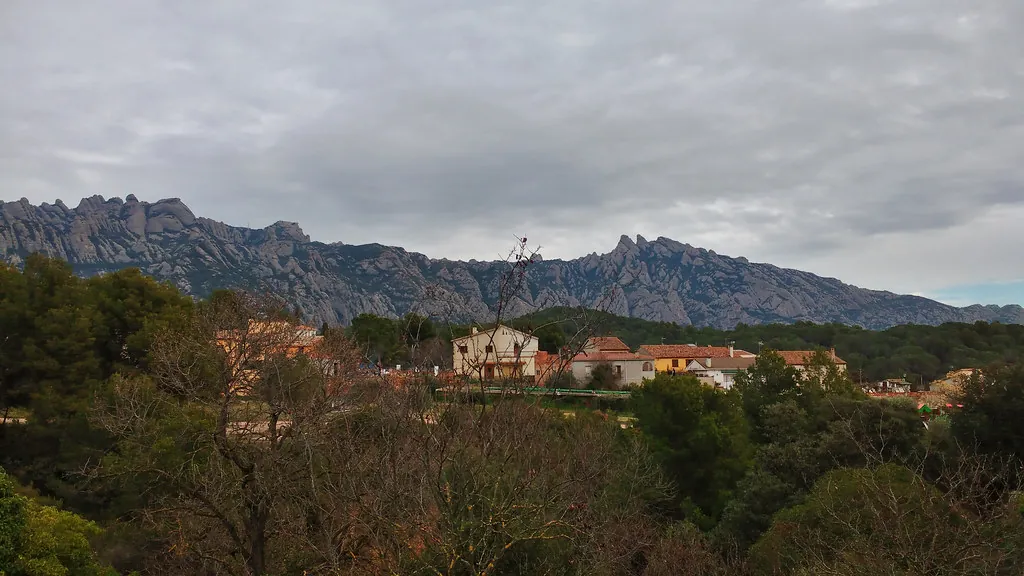
By late afternoon, the light settles on the tower and turns the stone the colour of old honey. From Els Prats de Rei, the landscape of the Anoia stretches out in a wide cereal plain that shifts with the seasons. Spring brings a soft green, while the heat of summer dries it to straw tones. The horizon feels open in every direction.
The village moves at an unhurried pace. Traffic is scarce. A shutter rolls down somewhere in the square, and further off comes the blunt sound of a garage door closing. It is the kind of place where the day winds down gently, without fuss.
The tower that watched two wars
The Torre de la Manresana rises above the plain, and reaching the top takes a bit of effort. Its twenty-one metres are climbed by way of a tight stone spiral, where each step is worn and uneven underfoot. The ascent demands attention, but the view at the top settles any doubt.
The structure is solid and purposeful. At the base, the walls are more than two metres thick, gradually narrowing as they rise, forming a cylindrical shape that feels carefully refined over time. The only entrance sits several metres above the ground, originally designed to be reached by ladder.
From this height, the surrounding territory opens completely. Paths stretch towards Bages, Osona and La Segarra, tracing routes that have long connected inland Catalonia. During the War of the Spanish Succession, the tower served as a lookout during the battle fought across these same fields. Today, there is little left of that conflict beyond the setting itself: stone, wind and a far-reaching view. On clear days, isolated farmhouses come into focus, along with the straight lines of cultivated land that define the area.
The climb is best taken slowly, with suitable footwear. After rain, the steps can be slippery.
Beneath the square, a Roman past
The Plaça Major appears simple at first glance, yet it sits over layers of history that are not immediately visible. Beneath the paving stones and many of the surrounding houses lie the remains of Sigarra, a Roman settlement that once occupied this plain.
Over the years, construction work has brought fragments to light: pieces of pottery, coins, sections of ancient walls. These finds are not always on display, but archaeologists have been able to reconstruct parts of the settlement’s layout. Sigarra held a certain importance along inland routes, linking different parts of the region.
Today, the square is quiet. Stone benches line the space, and the façades are modest. Conversations drift at a slow pace, especially towards the end of the day, when the atmosphere softens and the village returns to its usual rhythm.
The tympanum that left
A piece of Els Prats de Rei now resides elsewhere. In the Seu de Manresa, a Romanesque tympanum is preserved that originally belonged to the church of Santa Maria de Els Prats de Rei. It depicts the Annunciation, but with details that set it apart. The angel holds a censer, and several stars are carved into the scene.
The tympanum was removed in the 19th century, when the church required major repairs. Among older residents, the story still circulates with a mix of resignation and long memory, as something valuable that ended up outside the village.
The current church still reflects fragments of that layered past. A brief visit is worthwhile, particularly when the nave is empty and quiet. The interior holds that cool, distinct scent often found in very old stone buildings.
Sant Ermengol among the fields
A short walk of about fifteen minutes leads out from the village along a dirt path. In spring, the ground releases the scent of crushed rosemary and thyme underfoot. At the end of the path stands the hermitage of Sant Ermengol.
The building is small, with medieval origins. Its thick walls and limited windows give it a compact, enclosed feel. In the early 18th century, the structure was reinforced and its bell tower raised, giving it a slightly sturdier appearance than many rural hermitages.
Inside, the light remains dim even during the day. The stone retains warmth and the lingering smell of wax. On one wall, a carved cross stands out in relief. Some interpret it as a reused sarcophagus lid, though its exact origin is uncertain.
The hermitage is not always open. Those who wish to enter usually ask in the village, where someone may hold the key or know who can provide access.
When to come
Late spring and early summer, particularly May and June, tend to suit walks around Els Prats de Rei. The cereal fields are still green, and the wind moves across them in waves, like water shifting under a breeze.
The Torre de la Manresana offers little shade, so earlier or later parts of the day are more comfortable for the climb. Carrying water is sensible. In the height of summer, the sun falls directly on the stone and the ground becomes very dry.
August brings a noticeable change. Cars arrive from second homes, and the village becomes busier than usual. Those looking for quiet may prefer a weekday outside that period.
As evening approaches, shadows stretch over the rooftops and the wind moves freely across the plain once again. Els Prats de Rei returns to its steady pace, shaped by routines that favour early closing doors and paths that have existed far longer than the present moment.