
Full Article
about Jorba
Town by the highway, dominated by the ruins of its castle
Ocultar artículo Leer artículo completo
A Village You’ve Already Passed
Most Britons who reach Jorba have done so by accident. The bonÀrea truck stop at junction 545 on the A-2 is a pilgrimage site for Spanish lorry drivers, praised on UK forums for “cleaner loos than Watford Gap and coffee under two quid.” Few realise that five minutes uphill lies a village older than the tarmac they’ve just left behind.
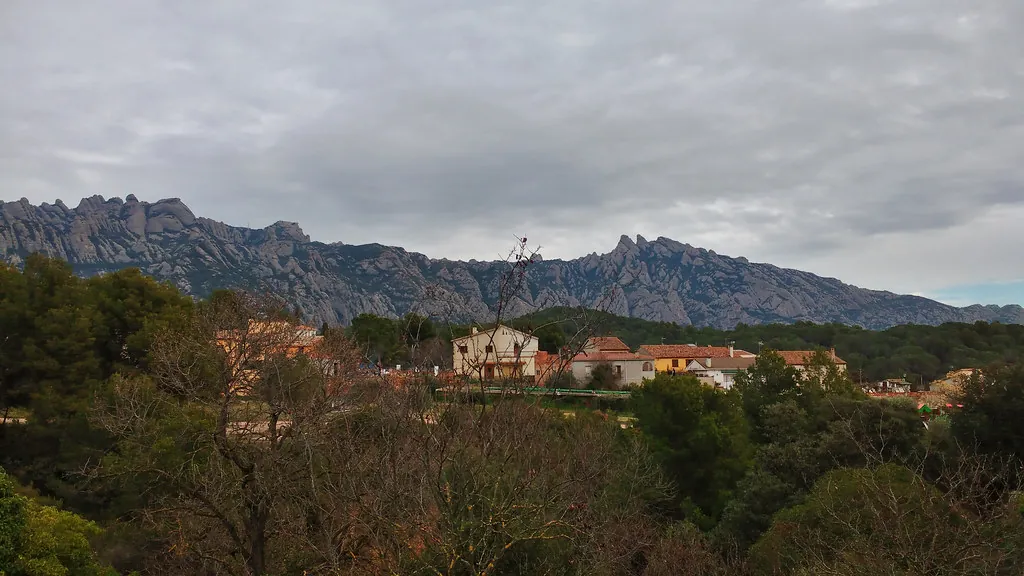
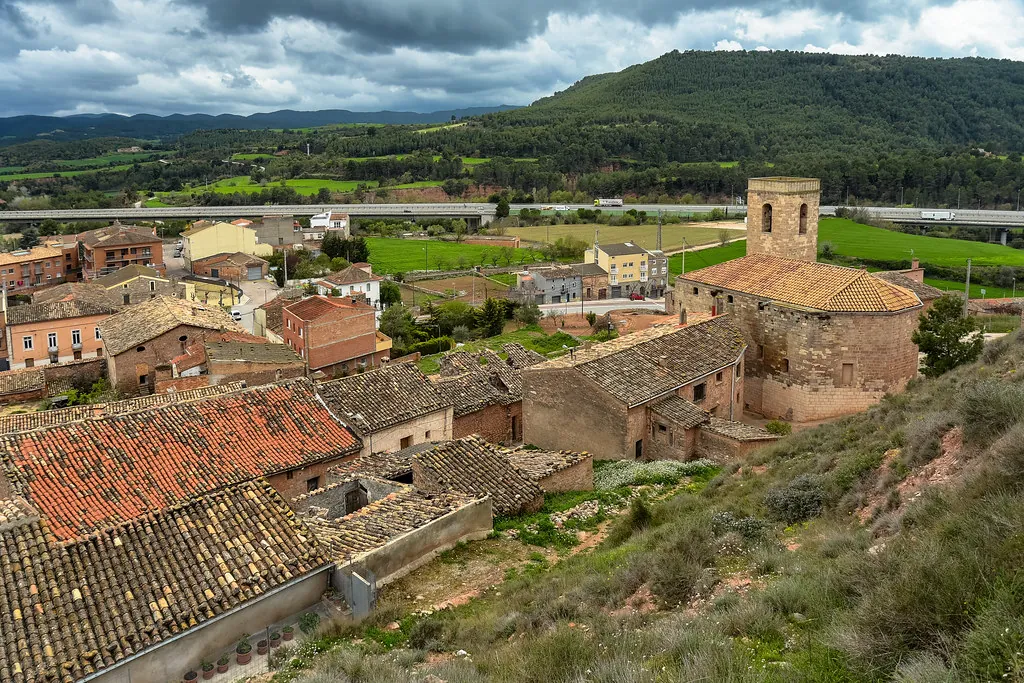
Jorba sits 380 m above sea level on a ridge that once carried Roman hooves, medieval merchants and, today, the high-speed rail to Madrid. The motorway roar is audible if the wind blows east, yet the old centre keeps the slow pulse of an interior Catalan pueblo: gossip at the bakery, almond blossom brushing stone walls, a single bar that still closes for lunch. It is not a chocolate-box scene; the houses are nineteenth-century pragmatic, patched with cement and painted the colour of dried oregano. What you get instead is continuity—people living in the same plots recorded in twelfth-century charters, still arguing about irrigation turns.
Castle in the Clouds, Bakery on the Ground
The Castell de Jorba began as a Moorish watch-post, swapped owners during the Reconquista and was finish-blasted by Napoleonic troops in 1810. What remains is a waist-high outline of walls and a 270-degree balcony over the Anoia valley. Park by the cemetery (signposted “Castell”) and walk the stony track—fifteen minutes, calf-stretching gradients, no handrails. At the top you’ll share the breeze with red kites and, at weekends, a handful of locals walking dogs. There is no ticket office, no audio guide, no gift shop: just stone, sky and the smell of wild thyme.
Back in the grid of narrow lanes, the parish church of Sant Estepe does duty as both spiritual and Wi-Fi hub; the priest has taped the password to the noticeboard. Romanesque bones survive inside, but the skin is eighteenth-century baroque, whitewashed every spring whether it needs it or not. The building unlocks only for Mass (Sunday 11:00) and the annual fiesta; at other times peer through the iron grille at gold leaf glinting like a Travelodge chandelier.
If the church is closed, the bakery is not. Forn Pa i Dolços opens at 6 a.m., sells almond cocas still warm, and will let you practise GCSE Spanish while the owner replies in brisk Catalan. Thursday is market morning: one fruit stall, one haberdashery, one van hawking cheap bras. The square fills for exactly ninety minutes, then empties back to a echo.
Paths, Pedals and the Thirty-Minute Rule
Jorba’s best attraction is the web of farm tracks that radiate into cereal fields and almond terraces. Maps are available—ask in the bakery—yet the routes are intuitive: follow the ridge west to the hamlet of La Guàrdia (thirty minutes, water fountain), or drop south through vineyards toward the Cistercian monastery of Santes Creus, twenty-two kilometres away if you feel ambitious. Cyclists rate the loop east to Igualada for its smooth tarmac and absence of tourist coaches; gradients hover around four per cent, equal to a Surrey lane without the potholes.
Summer walkers should set out before nine; by noon the thermometer kisses 35 °C and the only shade is your own shadow. Spring brings poppies and feral asparagus along the verges; autumn smells of crushed grapes and wood-smoke from smallholdings burning pruning’s. Winter is crisp, often 10 °C warmer than the Pyrenees an hour north, but tramontana winds can whip across the plateau—pack a windproof.
Eating: From Truck-Stop Menu to Grandma’s Stew
The bonÀrea complex is Jorba’s de facto town hall. HGV drivers queue for the €11.95 menú del día: soup or salad, grilled chicken or hake, pudding, bread and a half-bottle of house wine. Coffee is extra but still under a euro. British motorists appreciate the contactless pumps, free air line and cashpoint that dispenses fivers—rarer in rural Spain than you’d think.
In the village itself, choices shrink to two bars. Cal Pau sticks to weekday lunches: a single dish written on the blackboard—perhaps rabbit with peas or monkfish stew thickened with almonds. Arrive after 2 p.m. and the kitchen is mopping the floor. Bar Jorba opens evenings, showing La Liga on a crackling telly; order a plate of filet americain (spiced steak tartare) and a glass of local cava for under four euros. Vegetarians get tortilla or cheese toast; vegans should keep driving.
If you’re self-catering, the bakery sells thinly sliced jamón that tastes of acorns rather than water, and local almonds at half U.K. supermarket prices. Picnic tables sit beside the castle path—bring your own knife; the Spanish assume everyone travels with one.
When to Come, When to Leave
Jorba does not reward a week-long stay unless your hobby is photographing changing light on barley. It works as a half-day leg-stretch between Barcelona and Zaragoza, or as a gentle overnight if you’ve rented a car and want stars instead of neon. Spring (mid-March to May) and early autumn (September–mid-October) deliver 20 °C days and clear skies; August is furnace-hot and half the shutters are closed; December can be T-shirt noon, fleece dusk.
Accommodation is limited. There is no hotel; the nearest are motorway chains at Igualada, fifteen minutes by car. One cottage rents rooms on booking sites—expect lace curtains, ecclesiastical paintings and a Labrador that hogs the sofa. Prices hover around €70 for a double, breakfast of thick hot chocolate and supermarket croissants included.
The Honest Verdict
Jorba will not change your life. It offers no souvenir magnets, no sunset jazz, no infinity pool. What it does give is a twenty-minute taste of inland Catalonia without the coach-party soundtrack: a castle you can scramble over unsupervised, bread that was dough an hour earlier, and the low hum of a place that functioned long before you arrived and will continue long after you leave. Stop, walk, eat, leave. Sometimes that is exactly enough.