
Full Article
about La Llacuna
Mountain town with a beautiful arcaded main square.
Hide article Read full article
The scent of woodsmoke from a morning hearth is the first thing you notice in La Llacuna on a cold day. By ten, the sun hits the main square and the only sounds are the scrape of a chair being set outside a door and the low murmur of a conversation from a balcony. The air up here, at over six hundred metres, is clear and carries sound for miles.
This is not a village that performs. Life follows the rhythm of the fields, a pattern set by the surrounding hills of l’Anoia. You see it in the mud on a tractor’s tires parked by the church, and in the way conversations pause as a neighbour passes.
The quiet geometry of the old centre
You can walk from one end of the historic centre to the other in ten minutes, but it’s better to take thirty. The lanes narrow as they funnel towards the church of Sant Pere, their cobbles worn smooth in the middle. The architecture is a patchwork of exposed stone and rough render, with the occasional arched doorway hinting at a much older structure beneath.
The church itself is sober, built from the same pale stone as the hills. Inside, it’s cool and dim. Light cuts in through high, small windows, catching dust motes and falling on worn wooden pews. The smell is of cool stone and, faintly, of old wax.
Come early and you’ll have these streets to yourself. By midday, a few more doors are open, the clatter of dishes echoes from a kitchen, and the square begins to hold pockets of shade.
Where the streets end and the fields begin
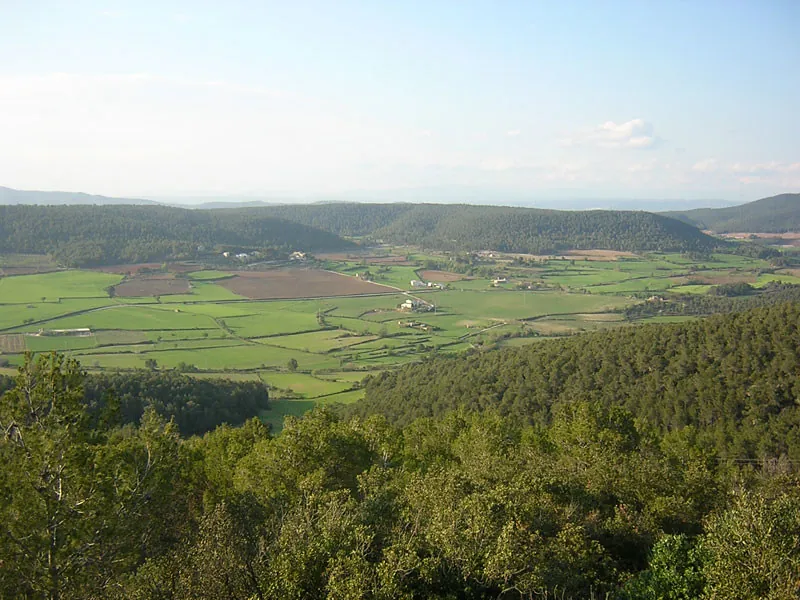
The transition from village to countryside is abrupt. One moment you’re on a paved lane, the next you’re on a dirt track with cereal fields stretching out to a line of holm oaks. This is the upper edge of the Penedès, a landscape of gentle rolls and wide skies.
Masías dot the horizon. Some are lived-in, with tidy yards and working outbuildings; others are slowly being reclaimed by ivy and weather, their roof tiles slipping into the long grass. They tell two different stories about this land.
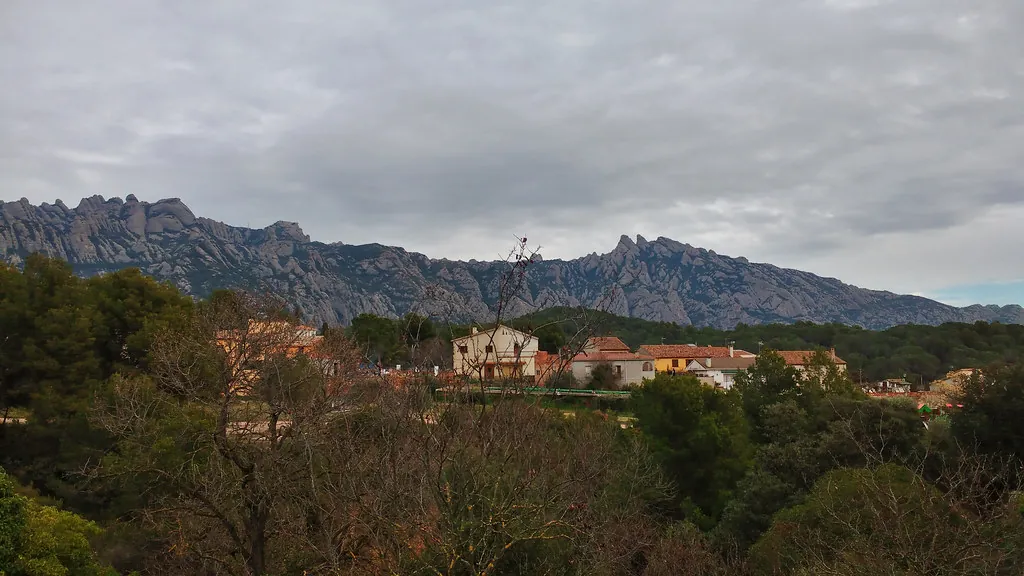
Walking here requires no effort, just time. The farm tracks are wide and firm underfoot. On days when the haze lifts, look north: the serrated silhouette of Montserrat floats on the horizon, unmistakable and distant. In autumn, the light turns amber and sharpens the edges of everything. In high summer, it bleaches the fields to a pale gold and the only movement is the shimmer of heat.
Moving through the landscape
The signposted routes around La Llacuna are practical, not dramatic. They follow old farm tracks and ravines, used as much by a local on a bicycle as by a visitor on foot. They’re for moving through the landscape, not conquering it.
Go at first light if you can. That’s when you might see a fox cutting across a track, or hear the chatter of goldfinches in the brambles before the day grows still. By late morning in summer, the sun is direct and heavy; shade is found in isolated pockets under an oak tree, not in long stretches.
What comes from nearby
The food here has weight and history. It’s built from what lasts: pulses, cured meats, olive oil. You’ll find slow-cooked stews that make sense when the wind comes down from the hills, and botifarra amb mongetes on almost every menu—a simple plate of sausage and white beans that tastes different here than by the coast.
When calçots are in season, usually late winter, the smell of grilled spring onions fills certain corners. They’re served with romesco, a sauce that balances charred pepper with ground nuts.
Note that outside of weekends, service can be unpredictable. A place that’s open for lunch on Tuesday might be closed on Wednesday. It’s not inconsistency; it’s just following a different calendar.
The rhythm of Sant Pere
For most of the year, La Llacuna is quiet. The annual shift comes during the Fiesta Mayor at summer’s end. For a few days in August, music spills into the square at night, and there’s a different energy in the streets—a quicker pulse that feels both festive and slightly borrowed.
Afterwards, the village reverts to its normal state. The decorations come down, and the deep quiet returns, broken only by church bells marking the hours.
A practical note on timing
Spring and autumn are when this landscape is at its most expressive—green returning or leaves turning—and walking is a pleasure. August has its own vibrant atmosphere, but it is also when La Llacuna is least itself, busier and noisier.
If you want to hear the place breathe, come on a weekday morning before noon. That’s when you catch it in its own time: sunlight moving across stone, an old dog sleeping in a doorway, the wind in the poplar trees.