Full Article
about La Torre de Claramunt
Municipality with a medieval castle and several housing estates in a rural setting.
Hide article Read full article
First sight: a castle above the road
Anyone heading to La Torre de Claramunt quickly understands what defines the place. The castle appears without warning from the road, perched on top of a hill like a broken tooth against the sky. You do not even need to step inside to grasp its original purpose. The tower is pierced with narrow arrow slits, and the stone vault looks damp even in photographs.
You park below, look up, and that is the introduction. This is a village shaped by its fortress.
La Torre de Claramunt lies in the comarca of Anoia, about 50 minutes from Barcelona via the A-2. After leaving the main road, you continue along the BV-2241 until you reach the main settlement. It is a straightforward drive, and the castle guides you in for the final stretch.
Parking is usually simple. Visitors tend to leave their cars near the town hall or behind the sports centre. In summer it can be more difficult, but for most of the year it is manageable.
There is a dirt track that climbs almost to the castle entrance. It is in poor condition. The usual approach is to park in the village and walk up. The climb takes around fifteen minutes and is entirely uphill.
Castell de Claramunt, the reason to come
The Castell de Claramunt is the main reason to visit. Without it, La Torre de Claramunt would probably pass unnoticed by most travellers.
It began as a watchtower around the 10th century and gradually expanded into a substantial fortress. Over time it belonged to the Claramunt family and later to the Cardona lineage. For centuries it also served as a prison. Today it is partially restored and open to visitors depending on the day.
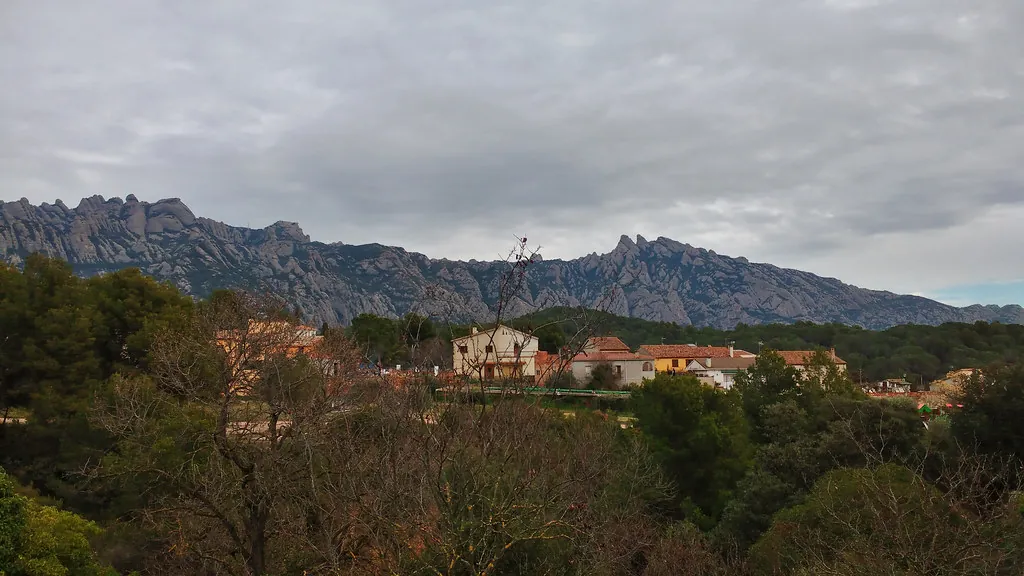
From the top, much of Anoia spreads out below. On a clear day you can see as far as the Penedès, a neighbouring region known for its vineyards. The setting is broad and open rather than dramatic. In March, almond trees in the surrounding fields bring a wash of colour to the landscape, softening the stone and earth tones.
The complex itself still feels solid and austere. Even with restoration, there are sections that show their age. The arrow slits, thick walls and vaulted spaces make its defensive origins obvious. It is not an ornate castle built for display. It was designed to watch, to protect and at times to confine.
Back in the village centre, next to the town hall, stands the church of Sant Joan Baptista. It dates from the 12th century and is Romanesque in style, a form of medieval architecture common in Catalonia with simple lines and solid stone construction. It was restored some years ago and now looks very clean. Perhaps too clean for some tastes, as much of the weathered character has been removed.
Beyond these two landmarks, there is little in the way of major monuments. The castle dominates both the skyline and the visit.
Walking by the river and through dry stone
La Torre de Claramunt works well for a short walk. Two routes in particular give you a sense of the surrounding countryside.
Behind the cemetery begins the path that follows the River Carme. This is known as the route of the old mills. The walk is about four kilometres and relatively easy underfoot. Along the way you pass the remains of former flour mills, once powered by the river. Most are heavily ruined, but their basic structure can still be made out. Information panels explain how they functioned and how the water was channelled to drive the machinery.
If it has rained recently, expect mud that clings stubbornly to boots. The route is straightforward, more about atmosphere than dramatic scenery, with the river as a constant companion.
The other regular walk heads towards Vilanova d’Espoia, one of the settlements within the same municipality. This is a circular route that crosses terraces and passes dry stone constructions, a traditional building technique that uses no mortar. The terrain is open, with little shade and wide views across the area. In just over an hour you can complete the loop.
Neither route demands serious preparation, but both add context to the castle above. They show how the land was worked, how water was used and how small communities shaped the landscape over centuries.
Village life and the Festa de l’Olla de Murri
Vilanova d’Espoia hosts one of the area’s most distinctive events each November: the Festa de l’Olla de Murri. At the centre of the celebration is a hearty game stew prepared with mushrooms and wine. It is served in traditional casserole dishes and is unapologetically robust. There are no modern presentations or delicate plating here. It is food designed to warm and fill.
For much of the rest of the year, daily life in La Torre de Claramunt is simple. Local bars offer a set lunch menu, the television is on, and conversation happens at the counter. The food is decent and straightforward. Nothing more is claimed, and nothing more is needed.
In July and August, the different settlements within the municipality hold their summer fêtes. These bring orchestras, communal dinners and a busier atmosphere in the main square. Outside those dates, the mood is calm, almost edging towards silent. The castle keeps watch over a place that moves at its own pace.
A short stop in Anoia
La Torre de Claramunt is best approached with modest expectations. It is not a destination that demands a full day. Instead, it works well as a short stop while travelling through Anoia.
Climb to the Castell de Claramunt and take in the view. Walk through the main settlement and step inside Sant Joan Baptista. Stretch your legs along the River Carme or towards Vilanova d’Espoia. Then continue your route through the comarca.
For most visitors, a couple of hours are enough. The image that lingers is simple: a stone fortress on a hill, watching over fields, river and village as it has done for centuries.