Full Article
about Pujalt
Town with medieval streets and a memorial to the Popular Army
Ocultar artículo Leer artículo completo
The church bell strikes noon, yet only a handful of swallows circle the square. In Pujalt, population 213, time doesn't stop—it simply stretches. At 770 metres above sea level, the village sits where Catalonia's cereal fields surrender to the first ripples of the Pre-littoral range, and the horizon feels close enough to touch.
A Landscape That Refuses to Compete
Most visitors barrel past Pujalt on the C-25, eyes fixed on Barcelona or Lleida. Those who peel off discover a municipality scattered like seeds across 52 square kilometres: one small nucleus, dozens of isolated farmhouses, and kilometres of dirt tracks that dissolve into wheat. The approach road climbs gently; car windows frame a moving postcard of stone walls, solitary oaks, and clouds that cast shadows the size of football pitches.
This is not countryside groomed for weekenders. Working tractors kick up ochre dust. Farmers still stack straw into the traditional cylindrical bales that look like giant Swiss rolls. In late June the wheat turns metallic gold; by August the stubble resembles a crew cut. Bring sunglasses—the glare is brutal—and expect your shoes to collect a fine layer of silt that will later sprinkle across the hire-car footwell.
The village proper clusters around the parish church of Sant Andreu, a modest sandstone rectangle that has absorbed Romanesque, Baroque, and 1960s practicality without ever becoming photogenic. Locals use its steps as a windbreak; photographers usually give up after ten minutes. That’s the point. Pujalt trades in atmosphere, not architecture.
What You Can (and Can’t) Do
Walking options radiate in all directions, but the council doesn’t spoon-feed tourists. Maps at the tiny information board are sun-faded, and way-marking is sporadic. Download a GPX file before leaving home, or follow the stone margins that separate one field from the next and trust your sense of direction. A rewarding loop of 12 km heads south-east to the ruined masia of Colom, then swings back via the oak wood of La Riba. Gradient is gentle, but the altitude means UV is fierce even in April; carry more water than you think necessary.
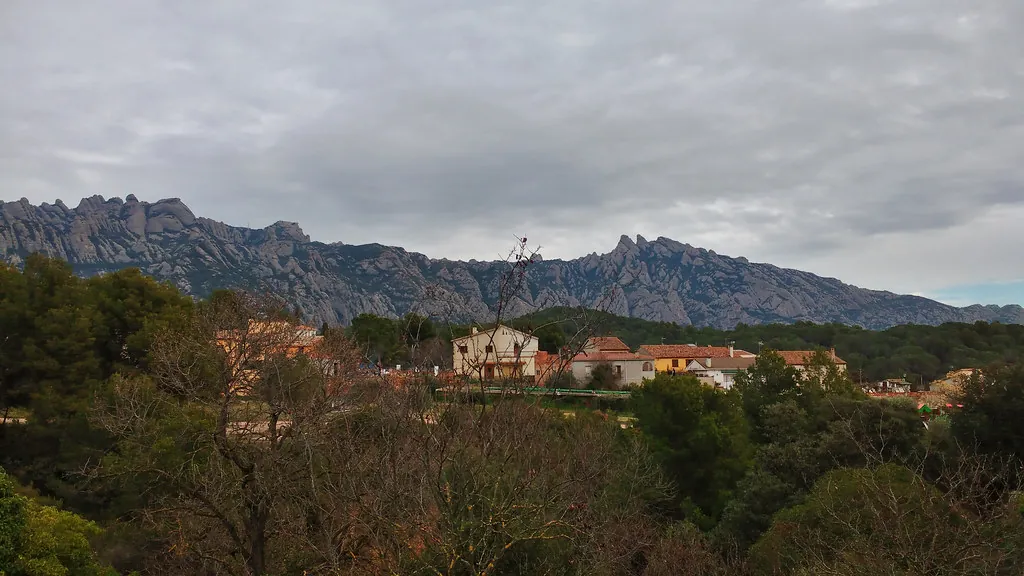
Mountain-bikers find the same tracks ideal for gravel tyres. Expect to brake for the occasional sheepdog; it will regard you with the disdain reserved for unpaid farmhands. Night rides under a full moon are spectacular—the stones glow silver, and Montserrat’s serrated silhouette floats on the western horizon like a broken bread knife.
If you prefer two feet on solid ground, drive (there’s no bus) three kilometres north to the astronomy viewing point signed “Espai Obert”. No fancy domes, just a concrete platform and a waist-high information panel that shows constellation positions. On clear winter nights the Milky Way looks smeared on with a decorator’s brush; Jupiter’s moons are visible through 10×50 binoculars. Temperature drops sharply after sunset—pack a down jacket and a thermos of something hot.
Where to Sleep, What to Eat
Accommodation within the municipal boundary totals two farm-stay houses and a handful of weekend lets booked months ahead by Catalan families. Cal Carulla, a fortified 16th-century farmhouse turned into four apartments, keeps original arrow slits but adds under-floor heating. Doubles from €90, minimum two nights, no daily maid service—owners Martí and Mercè live in the adjoining wing and will lend you a star chart if you ask nicely. Cal Senyoret, smaller and slightly cheaper, offers a single studio with a kitchen sharp enough to fillet the local trout you won’t find in the shops.
There is no village shop. The solitary bar opens Thursday to Sunday, hours approximate, menu limited to whatever Maria has decided to defrost. Most visitors self-cater. Stock up in Igualada (35 minutes) where the Mercadona sells decent Manchego and bottles of Priorat at half UK restaurant prices. If you crave someone else’s cooking, drive 20 minutes to Calaf for Restaurant 3/8 and its €14 three-course lunch—grilled pork cheek that falls apart at the sight of a fork.
Seasons of Silence
Spring arrives late. Almond blossom appears in March, two weeks behind the coast, and the wind that barrels across the plateau can still knife through a fleece. Come May, however, the fields turn a green so intense it seems almost artificial, and skylarks deliver a free soundtrack. This is the sweet spot for hikers: daylight until 9 p.m., temperatures in the low twenties, and only the occasional tractor for company.
August is a furnace. Shade is scarce; stone barns radiate heat until midnight. Most farm work starts at dawn and finishes by 11 a.m.; sensible visitors follow suit. The village fiesta, usually the second weekend of the month, doubles the population for forty-eight hours. There’s a communal paella, a foam machine for children, and a disco in a marquee that stops at 3 a.m.—late enough to annoy light-sleepers, early enough for farmers who rise at six.
Autumn brings combine harvesters and the smell of chaff. By late October the landscape resembles a sepia photograph; mornings carry a nip that justifies lighting Cal Carulla’s wood-burning stove. November’s Fiesta Mayor celebrates Sant Andreu with a modest procession and a bean stew cooked in a cauldron big enough to bathe a Labrador. Visitors are welcome, though seating is bring-your-own-chair.
Winter is not picturesque. Mist pools in the valleys, roads ice over, and the wind whips across the plateau like a sand-blaster. Yet the clarity of light after a cold front is extraordinary—on a good day you can pick out the snow-capped Pyrenees 120 km away. Hotels drop prices by 30%, but check access: the BV-3001 is periodically closed after heavy snow.
The Honest Verdict
Pujalt will never feature on a “Top Ten Catalan Hideaways” list, and locals would be horrified if it did. Infrastructure is minimal, public transport almost non-existent, and the nearest proper beach is 90 minutes away. Rain turns dirt tracks to porridge; phone signal vanishes behind the smallest hill. Those seeking tapas trails or boutique shopping should stay on the coast.
What the village offers instead is scale—human and geographical. A morning walk can cross three micro-climates without meeting another soul. Night skies are darker than most of rural England has seen in decades. And the silence is so complete you’ll start to hear your own pulse.
Pack a paper map, a spare tyre, and enough supper for the first night. Then do very little. In Pujalt, the sky does the entertaining; you just need to look up.