Full Article
about Rubió
Rural municipality with a castle and dolmens amid wind farms.
Hide article Read full article
Quiet ground at 600 metres
Winter mornings in Rubió come with a kind of silence that feels almost physical, frost still clinging to the grass and very little movement in the air. At that hour the only sounds are a distant car on the road and the wind brushing through holm oaks. The village sits a little over 600 metres above sea level, in the comarca of Anoia, and has just over two hundred inhabitants. Stone houses, low walls dividing plots, and a strong sense of continuity define the place. Landscape and way of life have shifted slowly here over decades.
Rubió is not gathered into a single compact centre. There are narrow streets around the church, but also scattered masías and rural tracks that seem to have developed over generations rather than from any recent plan. Fields alternate with woods of holm oak and pine. In autumn the ground turns ochre and dark green; in summer the light is harsher and dust rises from the tracks as cars pass.
Igualada lies relatively close, and Manresa is not far either. That proximity means many people come only briefly, perhaps for a morning. Anyone planning to walk the local paths at a relaxed pace will need time, and it helps to avoid the middle of the day in hotter periods, as some stretches offer little shade.
Around Sant Pere
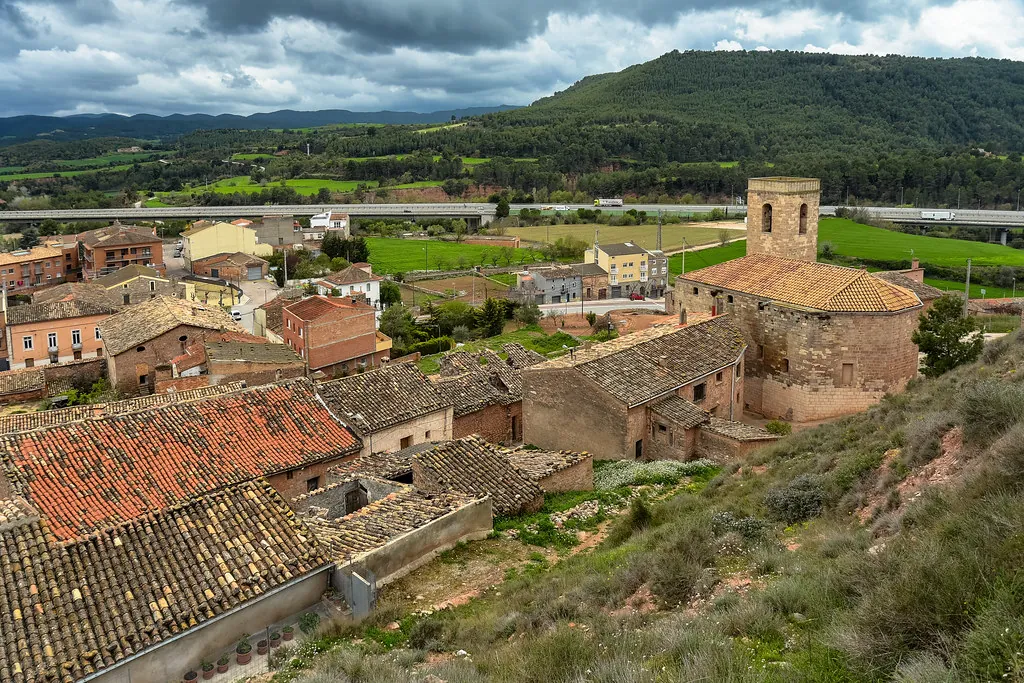
The small historic centre is organised around the parish church of Sant Pere. Its origins go back to the medieval period, although the building has been altered over time and not everything visible today belongs to that first phase. The bell tower rises above the rooftops and acts as a reference point when approaching along the secondary roads in the area.
Nearby are a handful of grouped houses, enclosed courtyards edged with stone walls, and narrow passages where footsteps echo off rough façades. This is not an urban layout built for hurried movement. In the middle of the afternoon, when light falls at an angle, the walls take on a warmer tone and the village settles into near silence.
Beyond this core, dispersed rural architecture tells much of Rubió’s story. Stone masías, livestock enclosures, agricultural stores and small hermitages appear along paths that connect one to another. Many remain inhabited or linked to farming activity. While walking, it is common to hear dogs announcing a presence from behind a gate or to see machinery kept under open-sided shelters.
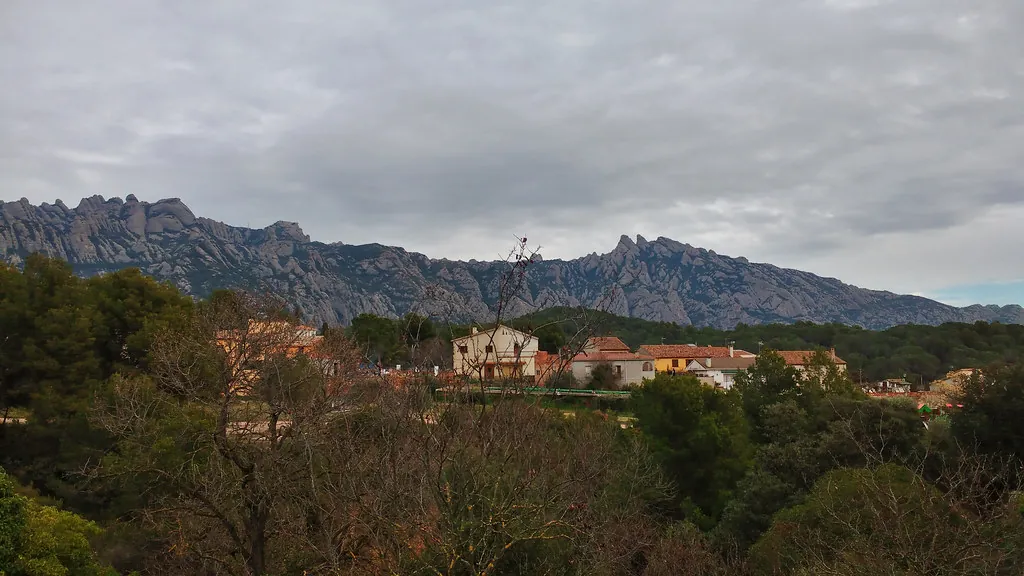
From some of the higher points in the municipality, when the air is clear, the outline of Montserrat can be made out to the east.
Walking the tracks
Rubió is best explored on foot or by an easy-going cycle. Rural tracks link masías and small rises from which the rolling landscape of Anoia opens up. Gradients are usually gentle, though signposting is not always clear, so it is sensible to carry a map or have a route saved on a mobile.
Moving through this area encourages a slower kind of attention. A stone wall softened by moss, an old corral partly taken over by ivy, the uneven shade of a lone holm oak in the middle of a field. Summer brings a dry, direct light across the ground. In spring the greens deepen and wildflowers appear along the edges of the paths.
Services within Rubió itself are limited, so many visitors combine a walk with a meal in nearby villages. In this part of the comarca, simple dishes of traditional Catalan cooking are common, along with local produce ranging from cured meats to wines from nearby wine-growing areas.
Small festivities, shared closely
The festive calendar in Rubió follows the pattern of many villages of similar size. Around the end of June, the Festa Major linked to Sant Pere, the patron saint, usually takes place. During those days the tone of the village shifts. Residents who live elsewhere return, and streets that are normally quiet fill with long tables and conversations that continue into the evening.
Sant Joan is also marked, with bonfires and gatherings that signal the start of summer. It is not a programme designed to attract large crowds. Instead, it reflects life in a small municipality where most people know one another.
Rubió moves at its own pace, without grand gestures. What remains is open landscape, the sound of wind through pine trees, and the sense of being in a place where time continues forward but does so slowly. A visit makes most sense with unhurried time and a willingness to walk without watching the clock too closely.