Full Article
about Santa Margarida de Montbui
A municipality with a modern center and an older one atop the Tossa.
Hide article Read full article
The bells of the Baroque tower mark half past seven when the sun has yet to fully rise. From the square, where the concrete benches are still cold and damp, the outline of the castle of La Tossa stands against a sky slowly turning pink. Tourism in Santa Margarida de Montbui often begins with that hill in front of you and the sense that the town is waking up at its own unhurried pace.
At that hour, only the occasional car heads towards Igualada. The air can carry the smell of freshly baked bread from a nearby kitchen, and if it rained overnight, damp earth too.
Santa Margarida de Montbui lies in the comarca of Anoia, in Catalonia, closely linked to the neighbouring town of Igualada. The relationship between the two is visible in daily life and in the landscape itself.
The Road Up to La Tossa
The track that leads to La Tossa begins between fields and residential developments that have expanded over the years, as the municipality has gradually grown closer to Igualada. Old wooden gates with iron fittings still survive on some houses, set beside modern garages and metal fencing.
The climb is steady. It is not especially long, yet it demands a measured pace. Near one of the final bends, the church of Santa Maria de la Tossa suddenly comes into view, standing at the top of the hill. It is Romanesque, built around the 10th century, with thick walls of greyish yellow stone that have endured centuries of wind and sun.
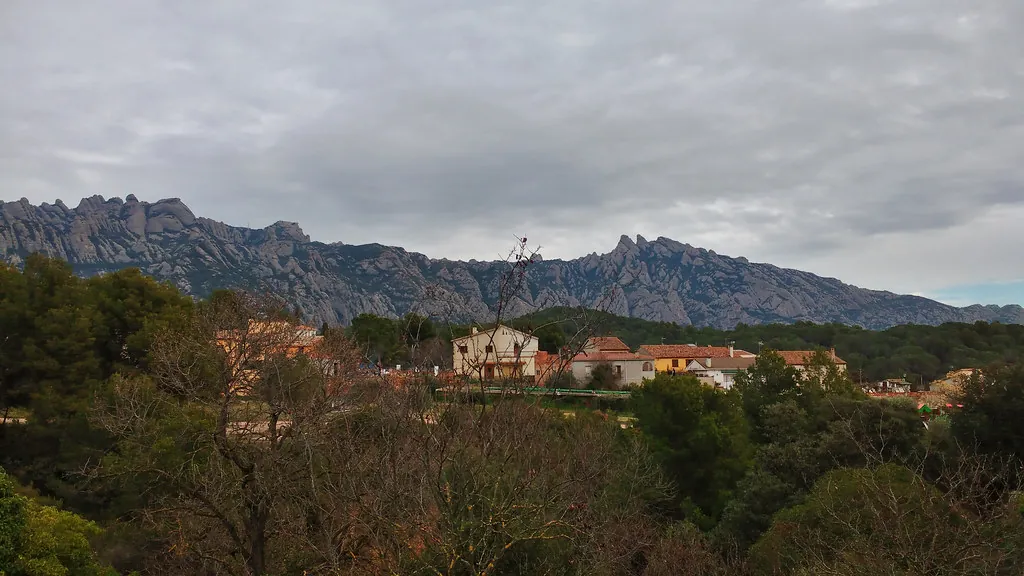
Inside, there is usually silence. The scent is that of cool stone and spent candle wax. Light enters through small Romanesque windows and falls in clear rectangles on the floor, shifting gradually as the morning advances. Step outside and the landscape opens wide: the valley of the Anoia, fields that change colour with the seasons, industrial estates near Igualada, and the motorway cutting across the valley floor.
This is where the character of the area becomes clear. Ancient farmland, recent industry and fast roads exist within a few kilometres of each other. The contrast is not hidden; it defines the view.
Old Stone, New Streets
The descent from La Tossa brings you back to the present without pause. The neighbourhood of Sant Maure, home to much of the population, feels more like a residential expansion than a historic centre. Semi detached houses line broad streets, roundabouts organise the traffic, and large supermarkets serve the area.
Move away from the busiest roads and into the historic centre of Santa Margarida, and a different texture appears. There are houses with stone doorways and coats of arms carved into the arches. Some façades retain bold colours such as dark green or brick red, breaking up the softer tones of the stone.
The current parish church was built in the 17th century. Its Baroque bell tower followed later, well into the 18th century, and the clock was installed afterwards, at a time when it still had to be wound by hand. At midday, when the bells ring, the sound mixes with traffic from the nearby road and the activity of surrounding industrial units. That blend sums up Santa Margarida de Montbui rather well. It is neither fully rural nor entirely urban, but something in between.
The First Sunday in May
Traditionally, the first Sunday of May brings a collective walk up to La Tossa. It is not a large scale pilgrimage. It feels more like a shared outing in which most participants know each other: families who have followed the same route for decades, neighbours who meet at the same bend in the path year after year.
People set off with bottles of water, sandwiches wrapped in foil and rucksacks carrying fruit. On the way up, conversation turns to everyday matters. Someone has moved house, the farming season is approaching, there has been enough rain this year or perhaps not.
At the top, a brief Mass is usually held in Catalan. Afterwards, people remain seated on the stone benches for a while, sharing simple food. Children run around near the small cemetery beside the church, with few restrictions. For a few hours, the hill resumes its older role as a meeting point for the municipality, something it had already been centuries ago.
For visitors unfamiliar with the tradition, this type of annual walk is common in many parts of Spain and Catalonia. It combines a religious element with a social one, and the emphasis is often as much on community as on ceremony.
Practical Notes and the Best Moments
To reach La Tossa, most people leave their car in the lower part of the municipality and follow the signposted track up to the hill. The walk is manageable for anyone with a reasonable habit of walking, although the gradient is noticeable.
It is sensible to take water, particularly in summer. At the top there are hardly any facilities and shade is limited around midday. In July and August the heat can be intense during the climb.
Autumn tends to bring the most pleasant days, when the air is drier and the landscape of the Anoia begins to fade into shades of ochre and brown. Winter has its own appeal, especially on mornings when low fog fills the valley and La Tossa rises above it like a stone island. On those days, the silence is close to complete, broken only by the wind or a distant bell.
Santa Margarida de Montbui does not present itself as a dramatic destination. Its appeal lies in that steady coexistence of eras and uses. A 10th century Romanesque church overlooks modern industrial estates and a motorway. A Baroque tower marks the hours over residential streets built in recent decades. The hill of La Tossa continues to gather people, whether in quiet solitude or on the first Sunday of May, when the town walks up together and sits for a while above the valley of the Anoia.