Full Article
about Santa Maria de Miralles
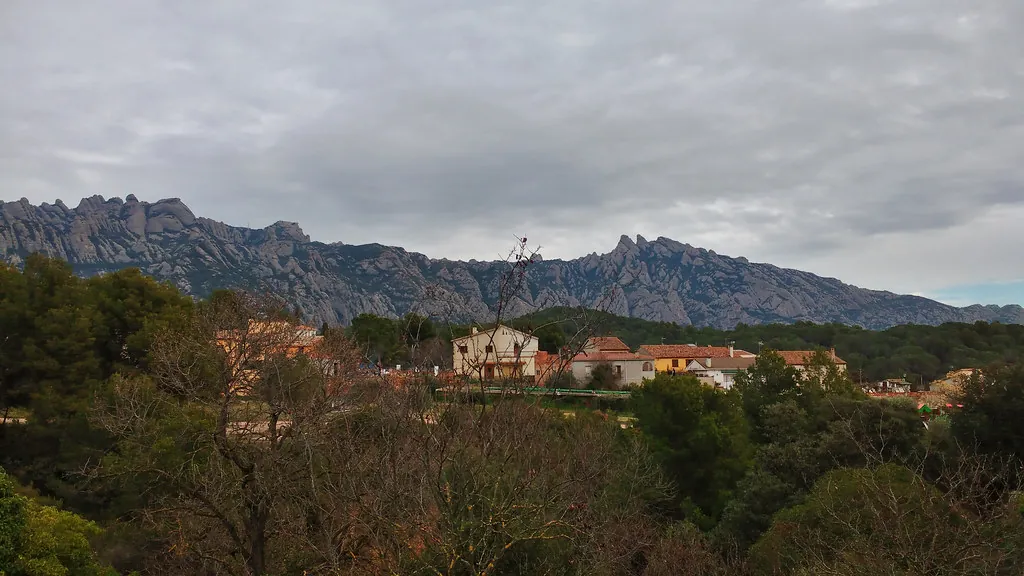
Scattered farmhouses and the castle of Miralles
Ocultar artículo Leer artículo completo
The church bell strikes noon and every barn door seems to exhale. A tractor rumbles to a halt outside the single grocery, its driver swapping Catalan pleasantries with the woman who has run the shop since 1983. In Santa Maria de Miralles, population 138, this is the daily rush hour.
Seventy-five kilometres west of Barcelona, the C-37 motorway shrinks to the A-2, then to a two-lane comarcal road that winds through wheat and vines. Suddenly the Pyrenees vanish in the rear-view mirror and you’re alone on a ridge at 543 m, looking down on a cluster of stone roofs that appear to have slid off the surrounding fields. No sea view, no souvenir stalls, just the smell of warm thyme and the sound of your own tyres on gravel.
A Village That Measures Time by Harvests
Miralles doesn’t do postcard perfection. Walls bulge, iron balconies rust gracefully, and the parish church of Santa Maria sports a bell tower that leans two degrees off vertical – not enough for guidebook fame, just enough to remind you that medieval mortar is patient. The whole place can be walked in twenty minutes, yet most visitors stretch it to an hour, pausing to read the stone plaques dedicating streets to long-gone farmers or to photograph the way afternoon light turns ochre plaster the colour of Burnished Sugar No. 6.
Traditional masías – thick-walled farmhouses with Roman-tile roofs – still outnumber weekend second homes, a rarity in Anoia. One, Ca l’Artigues, has its original 1782 datestone; another has been converted into the village’s only B&B, where breakfast eggs arrive still warm from the hens that peer through the kitchen door. The absence of estate agents’ boards feels almost revolutionary this close to the Costa Brava.
Footpaths, Fork-lifts and the Friday Bread Van
Leave the car by the stone trough at the entrance and pick up the signed camí that drops past almond terraces towards the seasonal stream. Within ten minutes the only mechanical noise is the distant buzz of an irrigation pump. The loop to the abandoned hamlet of Clariana and back is 6 km with 120 m of ascent – enough to justify lunch but gentle enough for sandals if you’ve forgotten walking boots. Spring brings poppies between the wheat rows; in late September the vines blush garnet and farmers snip bunches of Sumoll into yellow plastic crates.
Cyclists arrive with thicker tyres and bigger appetites. The locals’ club, Grup BTT Miralles, way-marks circular routes of 25 km and 45 km that thread together hamlets whose names read like a spelling test: Sant Martí de Tous, Vallbona d’Anoia, La Pobla de Claramunt. Expect gradients of 6–8 %, buzzards overhead, and the smell of hot pine on the descents. Road riders can link to the Cava circuit at Sant Sadurní d’Anoia, twenty minutes north, though the reward here is solitude rather than cellar-door discounts.
What Passes for Gastronomy
There is no Michelin teepee, no tasting menu narrated by a chef who once staged in Copenhagen. Instead, Restaurant Miralles occupies a former hay store opposite the church and serves exactly eight dishes, hand-written on a laminated card. Order the xai (grilled lamb cutlets) and they arrive four at a time, pink, smoky, tasting of rosemary that grows wild along the lane. Pa amb tomàquet – toast rubbed with tomato, garlic and local Arbequina oil – costs €3.50 and could teach many a London gastropub the meaning of simplicity. House Cava is poured from a magnum kept in the fridge between the ketchup and the Estrella; it’s brut nature, mouth-wateringly dry, and by the glass it’s cheaper than mineral water in Barceloneta.
The bakery opens at seven, sells out of coques (Catalan pizza-like flats) by nine, and shuts when the loaves are gone. If you miss it, the next food is fifteen minutes away in Sant Martí Sarroca, so stock up before evening beer. Vegetarians survive on tortilla and grilled vegetables; vegans should bring a cool bag.
When to Come, When to Stay Away
April and May stripe the fields green and yellow, temperatures hover around 18 °C, and you’ll share the lanes with more swallows than people. October adds the perfume of new wine and the annual Fira de la Font in neighbouring Tous – a country fair where farmers display giant onions and children compete to see whose baguette ripens fastest in the wood-fired oven.
July and August are honest about heat: 32 °C by noon, cicadas drilling into your skull, shade only on the north side of the church. Accommodation prices don’t rise – there simply isn’t enough demand – but the bakery shortens its hours and the single village fountain becomes the social hub. Mid-winter brings sharp, blue-sky days when the tramuntana wind whistles through bell tower arches; overnight frost is common, snow occasional, and the B&B will lend you a hot-water bottle because central heating in an 18th-century masía is a philosophical concept.
The Useful Bits, Without the Bullet Points
You will need a car. The 550 bus from Igualada reaches the village square on Tuesdays and Fridays, then turns round and leaves. There is no petrol station; fill up in Igualada or risk an expensive tow from the AP-7. Mobile coverage drifts in and out – Vodafone fares better than EE – so screenshot your onward directions. Cash remains king; the nearest ATM is 9 km away and the bakery treats chip-and-pin like witchcraft.
Stay at Cal Tico, the three-room guesthouse, and you’ll pay €70 for a double, including breakfast strong enough to restart a stalled tractor. Larger groups rent Ca l’Artigues whole (sleeps eight, €180), handy if you want to cycle with friends and argue over whose turn it is to drive to the supermarket. Hotel alternatives lie in Igualada, fifteen minutes east, but then you miss the night sky: with the streetlights off at midnight, Orion looks close enough to snag on the church cross.
Leave the village as you found it – quiet. Slamming car doors at dawn, drone photography over private farms, or requesting oat milk in your coffee will earn the gentle Catalan shrug that means “you’ve misunderstood the place.” Santa Maria de Miralles isn’t hiding from the twenty-first century; it simply agreed with the centuries it already had and saw no reason to trade up. Approach on those terms and the reward is a measured slice of rural Catalonia that no coastal promenade can replicate.