Full Article
about Artés
Bages municipality with a winemaking tradition and an old quarter set on a hill.
Hide article Read full article
The bells of Sant Martí ring out at half past eight while mist still clings to the vineyards. From a bench in the plaça Major, just as the forn opens its iron door, the scent of freshly baked pa de pessic drifts into the square, mixing with wood smoke and roasted coffee. Tractors roll steadily down the carrer Major. Someone has already settled in for the first vermouth on the terrace of the Casino. Here, time is counted less in hours than in harvests.
The communal oven and its famous cake
The communal oven on the plaça Major is little more than a hollow in the wall with a door blackened by decades of smoke. Bread has been baked there daily for generations. Yet what many people associate most strongly with Artés is pa de pessic, a light sponge cake made with eggs, sugar and flour, without yeast or butter.
When the festival dedicated to this cake comes round, the village pavilion fills with trays set out on long wooden tables. Each family brings its own version. Some add candied figs. Others stir in a touch of aniseed. The debate over texture can sound as serious as a discussion about wine—what matters is that the inside stays light and dry.
Outside festival days, the oven tends to prepare pa de pessic towards the end of the week. Mornings are the safest moment to look for one; by midday they have often sold out.
Stone, fields and open horizons
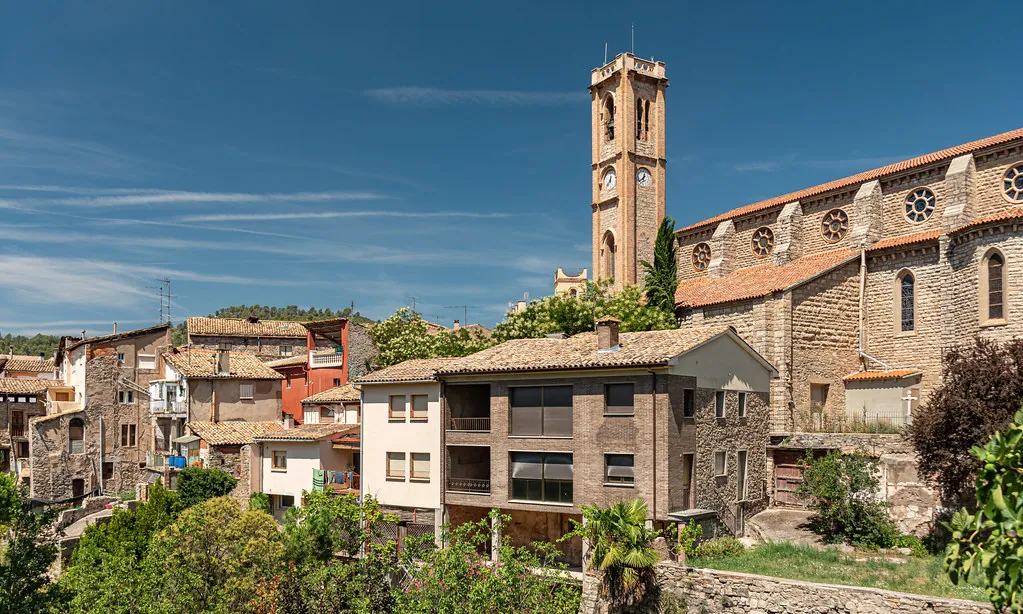
Sant Martí stands over the carrer Major with a solid presence. Its Baroque façade takes on a yellowish glow towards the end of the afternoon. Inside, the silence feels dense. The wooden pews creak if someone shifts position. There is a faint scent of wax and old incense.
Around two kilometres away, the road to les Torrotes climbs gently between cereal fields and twisted olive trees. At the top stands the small hermitage of Sant Miquel. From the hill, the Bages region spreads out in irregular plots of green and brown. In summer it is wiser to make the ascent early; the air is dry and carries the smell of thyme crushed underfoot. Stay long enough and the stone begins to turn the colour of honey as evening approaches.
A rhythm guided by the kitchen
In many homes here, cooking follows an unhurried rhythm. Bacalao a l’artesenca is left for hours over a very low heat with olive oil, pine nuts and raisins. The result is a gentle stew with a golden broth that calls for bread close at hand.
Coca de recapte usually comes topped with escalivada and sometimes a slice of black butifarra that toasts in the wood-fired oven. These are dishes for extended meals. On Sundays, close to one o’clock, whole families gather and linger well into the afternoon. During the week the atmosphere is calmer, particularly midweek. On Mondays many places in the village close for a day of rest.
When winter festivals arrive
In winter, around the feast of Sant Blai, the plaça Major shifts in tempo. Stalls appear selling honey and herbs. Children search out the lengths of sugar cane available at this time and spend the afternoon chewing on them as they dart between stands.
As evening falls there are usually songs beneath the town hall porch. People remain talking with a glass in hand while the cold of the night settles in.
Carnaval brings a different mood. Groups in homemade costumes parade through the streets. The following day sees the burial of the sardine near the football ground, a traditional closing ritual before Lent. For hours afterwards the air holds a mingled scent of smoke and fish.
Walking where trains once ran
The former railway that once linked Manresa with inland Bages is now a compacted dirt track. From Artés towards Calders, the first stretch runs almost flat, shaded by large plane trees that cover the route of the old carrilet.
Further on, the path opens out to longer views across agricultural land. In spring the almond trees come into blossom and there are sections where the air smells faintly sweet, like honey warmed by sun. Water is worth carrying; there are very few fountains along this stretch. On hot days it’s better to set off early, before nine, as later on there’s little shade.
Choosing your moment
Artés changes noticeably with the seasons. In spring the fields turn a deep green and morning mist usually lifts before noon. August brings heavy heat, and mosquitoes from the riera make themselves known at dusk—it helps to have something to keep them at bay.
Winter often offers very clear days. From certain nearby roads you can see distant outlines in Pre-Pyrenees when air is clean. When local festivals coincide—Sant Blai in February or Festa Major in September—the centre becomes busier and parking takes longer than usual. Those in search of quiet should come on an ordinary weekday. There are still mornings here when village moves at its own steady pace guided more by land than by clock