Full Article
about Avinyó
Rural municipality known for its vineyards and quality pork.
Hide article Read full article
A hill above the Gavarresa
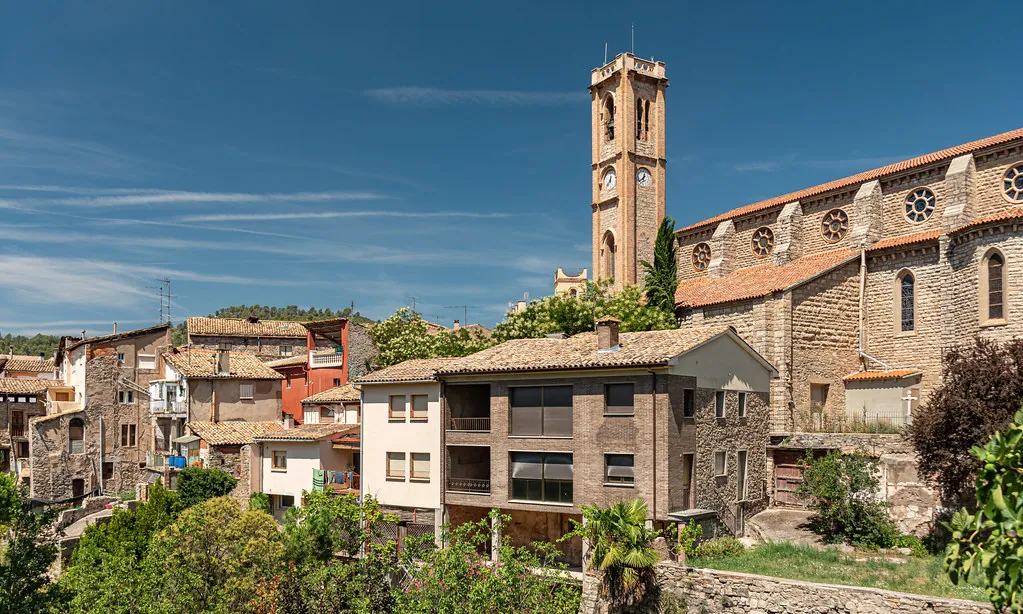
Avinyó sits on a rise above the valley of the riera Gavarresa, at the eastern edge of the comarca of Bages. The landscape here is transitional, where the plains of central Catalonia begin to buckle into the first folds of the Pre-Pyrenees. The village follows this uneven ground: streets climb, and houses gather around the hilltop where the church was built.
Just outside the village, the Pont Vell de Avinyó crosses the Gavarresa. The bridge is medieval, though the size of its stone blocks can suggest an older origin. It served for centuries as a main crossing point. The settlement pattern is straightforward: the higher ground offered a clear view over the valley, which meant oversight and a degree of security.
A landscape that never quite flattens
The land around Avinyó folds into small valleys and low hills. Dry-stone walls terrace the slopes, evidence of the work required to farm this kind of terrain. Vines have long been part of that effort, and the village belongs to the wider wine-producing mosaic of Bages.
This agricultural past is written into the buildings. In the old quarter, many houses have large doorways and additional upper floors added later, features typical of periods when wine and dry farming sustained the local economy.
The parish church of Santa Maria stands at the highest point. The building shows several phases of construction and alteration, which is common for a church that has been in continuous use. Its location is its main feature: from here, the valley opens below, and the reason for building on this particular hill is immediately apparent.
A small place within wider conflicts
Like many towns in inland Catalonia, Avinyó found itself on the periphery of larger conflicts. Its position within Bages placed it along routes connecting neighbouring comarques, which explains records of troop movements during the wars of the Hispanic monarchy or the Carlist wars of the nineteenth century.
This history has left faint traces in the landscape. Old paths link settlements, and watchtowers occupy certain high points. You might also find remains of communication posts from the nineteenth century. They don't dominate the view, but they point to a countryside that has long been monitored and crossed.
The Gavarresa as organiser of space
The course of the Gavarresa shapes everything around it. Along its valley, cereal fields alternate with vineyards and patches of Mediterranean woodland. Agricultural tracks lead out from the village, passing features from an older way of working the land.
Among these are eras de trillar, circular paved threshing floors. They were central to farm life until mechanisation made them obsolete around the mid-twentieth century. Some remain beside fields, now quiet and unused.
Prehistoric and megalithic remains have been identified in the wider area, a common find in this part of Bages. They are not always signposted, but they confirm a long occupation of this territory, well before the medieval village took shape.
The local cooking comes from the same rural background. Dishes are practical, based on what the dry fields and scrubland could provide: slow-cooked rabbit, snails, and pulses.
Walking the old centre and beyond
The historic centre is compact and follows the slope of the hill. It's best to leave your vehicle at one of the access points and walk up towards Santa Maria. The view from the church clarifies how settlement and topography are tied together.
The oldest streets have an irregular plan, adapted to the ground. Stone façades and those large doorways speak of the agricultural cycles that once dictated life here. The scale is modest, making it easy to see how houses, church, and countryside relate.
With more time, you can follow the rural tracks that lead down towards the Gavarresa valley. These are simple routes, more a stroll than a hike, that show the agricultural character of Bages. Fields follow contours, dry-stone walls edge old terraces, and you might pass a forgotten threshing floor.
Avinyó’s interest lies in its clarity. It shows how the geography of eastern Bages—a hill above a river—has dictated where and how people lived for centuries. The church, the bridge, and the river frame a place that only makes sense when you see it from above.