Full Article
about Callús
Former textile village on the banks of the Cardener river with industrial heritage
Ocultar artículo Leer artículo completo
The church bell strikes noon, and nothing happens. No tour guides raise their umbrellas, no souvenir shops flip their signs to "obert". In Callús, the silence simply stretches a bit wider across 260 metres of altitude, broken only by a tractor grinding through gear changes somewhere beyond the wheat fields. This is rural Catalonia stripped of performance—no medieval banners, no wine-tasting theatrics, just a village of 2,000 souls who happen to live where the Bages plain begins its gentle roll toward Montserrat.
The Parish that Points the Way
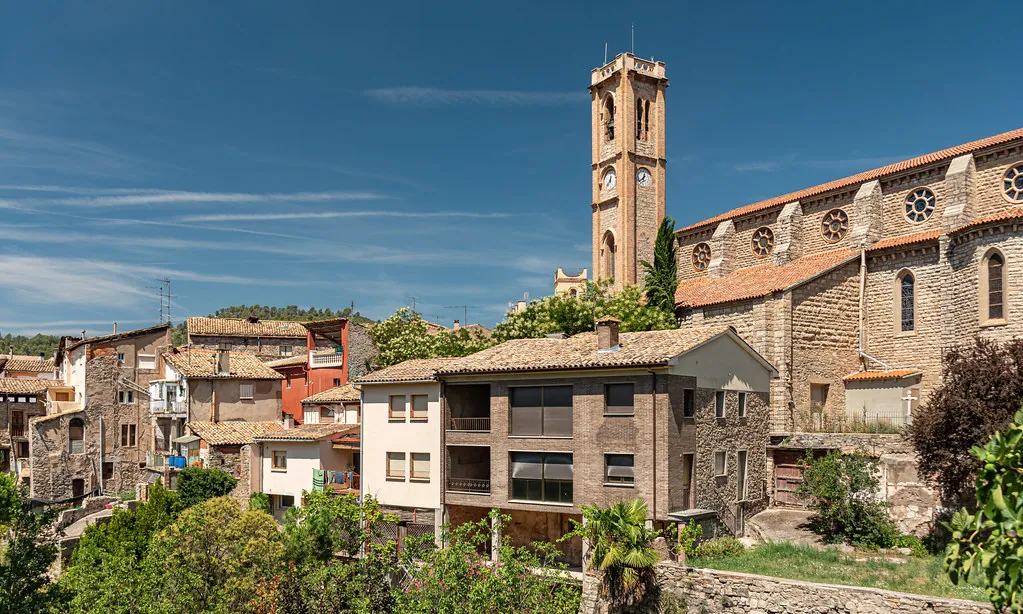
Sant Martí’s squat bell tower rises above stone roofs like a compass needle fixed on “ordinary”. Built in stages between the 12th and 18th centuries, the parish church won’t make the cover of glossy Catalan heritage magazines, yet its walls retain the memory of every harvest that paid for another arch or altarpiece. Step inside and you’ll find a single nave cooled by thick masonry, a 17th-century wooden Christ whose realism errs on the gaunt side, and pews that still fill for Sunday mass. Locals use the tower as a landmark when giving directions: “If you can see Sant Martí’s shadow, you’ve overshot the bakery.” That bakery, Forn Pa i Company, opens at 6.30 am and sells Coke-bottle-shaped loaves for €2.30; arrive after 10 am and the choice is down to crumbs.
Behind the church, three narrow lanes form the medieval kernel—short enough to walk in four minutes, long enough to reveal architectural hiccups: a 16th-century doorway grafted onto 1970s brick, a Gothic window blocked up to fit an air-conditioning unit. These collisions aren’t picturesque; they’re evidence of a place that refuses to fossilise. A brass plaque on Carrer Major marks the house where Republican mayor Joan Soler was dragged out and shot in 1939. No QR code, no audio guide—just a name and two dates that the villagers themselves suggested be engraved.
Fields without Filters
Leave the church square by the downhill road and tarmac gives way to a graded track within 300 metres. From here the municipality unrolls as an agricultural checkerboard: wheat the colour of dried lemon peel, rows of tempranillo vines tied to wires like musical staves, and the odd square of alfalfa so green it looks backlit. The paths are wide enough for a combine harvester, so walkers can step aside without choreography. Signage is refreshingly minimal: a wooden post every kilometre or so, hand-painted with fading arrows. On a clear day Montserrat’s serrated outline hovers forty kilometres south-west, a geological exclamation mark that prevents the landscape from feeling flat. When the tramuntana wind drags haze across the plain, that visual anchor disappears and the horizon collapses to a dull beige line—still walkable, just less memorable.
A 45-minute circuit south of the village links three masías—fortified farmhouses built between the 15th and 17th centuries. Cal Masó, the largest, has a working winery that sells young red in one-litre plastic bottles for €4. Ring the bell marked “vendes” and someone’s grandmother will appear with a funnel and a wipe-clean price list. Cal Marçal, closer to the road, keeps storks on its roof and opens only for pre-booked Sunday lunches (three courses, water and wine included, €22). These buildings are private, so trespassers will be greeted by dogs whose barks sound like corrugated iron tearing. Photographs from the track are fine; hopping the gate is not.
Pedal Power, Not Pyrenean Pain
Cyclists allergic to Lycra politics will appreciate the Bages terrain: rolling rather than alpine, quiet rather than deserted. Road bikers can loop 38 km south to Montserrat and back with only 450 m of climbing—compare that to the 1,200 m you’d chew through on a single Coll de Sa Calobra ascent in Mallorca. Traffic on the C-55 is steady but courteous; drivers expect bikes. Mountain bikers have a lattice of farm tracks heading north toward the Cardener river. None are technical—think hard-packed gravel with the occasional pothole deep enough to swallow a front wheel if approached with misplaced confidence. Bring spare tubes; the nearest shop is in Manresa, 9 km away.
If you’d rather walk than wheeze, pick up the leaflet “Camins de Callús” from the ajuntament (open 9 am–2 pm weekdays). The shortest route is 5 km and takes you past the vine nursery and the municipal rubbish bins—honesty again—before climbing a low ridge where kestrels hover. Autumn brings the smell of crushed grapes and the risk of getting slapped by irrigation tubing. Spring means mud the colour of café con leche and the sound of cuckoos that have clearly outsourced their logistics to the same Catalan calendar as everyone else.
What Passes for Gastronomy
Forget tasting menus. Callús eats like a village that has never heard the word “concept”. Bar Restaurant Xavi on Plaça Major does a three-course menú del dia for €14 Mondays to Fridays: starter of lentil stew thick enough to support a standing spoon, followed by grilled pork cheek that slides apart at the threat of a fork, finishing with crema catalana cooled just enough to keep its glass-thin sugar crust intact. Evenings add rice dishes that require forty minutes’ notice and serve two minimum—order the arròs negre only if you like your lips stained purple. Locals drift in at 10 pm for a quick beer and stay until the television finishes broadcasting Barcelona’s post-match autopsy.
Weekend calories arrive in the form of calçotada outings between January and March. Calçots—long, sweet onions—are charred over open fires, stripped of their blackened skins, and dipped in romesco until your beard drips. Callús doesn’t commercialise the ritual like Valls does; you’ll need a Catalan friend or a willingness to loiter near smoke plumes on Saturday lunchtimes and look hungry. Bring wet wipes and a change of shirt.
Getting There, Getting Out
Callús sits 9 km north-west of Manresa, which itself is 65 km from Barcelona. Drive out of the airport on the C-58, switch to the C-55 at Terrassa, and follow signs for Manresa. After the second tunnel, take exit 191 for the B-431; Callús appears six minutes later, speed cameras included. Parking is free but chaotic during festa week in late August—locals double-park across junctions with the confidence of people who know every neighbour’s number plate.
Without a car, catch the train from Barcelona-Plaça Espanya to Manresa (R5 line, 1 h 15 min, €8.10), then bus L 301 to Callús—eight departures Monday to Friday, four on Saturday, zero on Sunday or bank holidays. Miss the last bus and a taxi costs €18 flat. Cycling from Manresa takes 25 minutes on a service road that smells faintly of chicken feed.
Accommodation within the village limits totals one: Casa Pairal, a three-room guesthouse above a bakery that prefers WhatsApp to booking platforms (€70 double, breakfast roll included). Otherwise stay in Manresa where the three-star Hotel Urbi offers underground parking and a lift wide enough for bikes (€85–95 depending on trade-fair traffic). Callús works better as a day trip anyway; once the sun drops behind the ridge, entertainment is limited to counting how many stars you can see before the streetlights flick on.
The Quiet Exit
Leave at dusk and you’ll spot tractors heading home with their hazard lights blinking like slow amber heartbeats. The wheat catches the last sun and turns the colour of British bitter. Nothing dramatic happens, nobody waves you off, but the plain smells of warm soil and diesel—an honest mix that sums the place up. Callús doesn’t need to be “discovered”; it simply continues, one harvest after another, while the rest of Catalonia looks the other way.