Full Article
about Castellbell i el Vilar
Set on a Llobregat bend with prime views of Montserrat.
Hide article Read full article
A River Curve That Tells the Story
The commuter train reveals the landscape before it reaches the platform. Just before Castellbell i el Vilar station, the River Llobregat traces a pronounced C-shape around a small, wooded islet, as if the water had been forced to skirt a wall of rock before continuing downstream. Through the carriage window, between willows and the sharp light of summer, the tower of the castle rises above the rooftops of the former industrial colony.
That single view sums up tourism in Castellbell i el Vilar. Geography shaped the first defensive structures here and, centuries later, determined where industry would take root. The river carved out a natural corridor between Barcelona and inland Catalonia, and the settlement grew in response to that constant movement along the valley.
The Castle That Still Watches the Valley
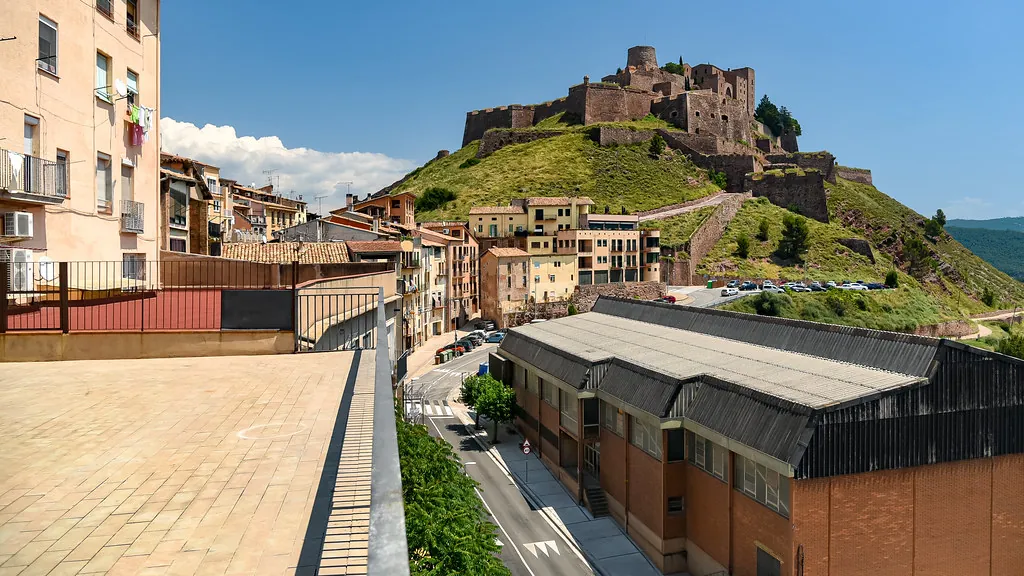
Medieval documents mention the castle as early as the 10th century, under the name “Castelobello”, in a donation linked to the monastery of Sant Llorenç del Munt. What remains today is above all its position: a promontory overlooking the Llobregat’s passage through the valley.
Visible structures include stretches of wall and a square tower that has been substantially rebuilt. They help sketch out the outline of what once stood here, though the real interest lies in the setting rather than the surviving stonework. From this height, the logic becomes obvious. The hill commands the natural river corridor that for centuries offered the most direct route between Barcelona and the interior of Catalonia.
The castle changed hands several times during the Middle Ages and gradually lost its military importance. By the 19th century, the hill’s significance no longer centred on defence. Instead, attention shifted to the factories that began to harness the hydraulic power of the Llobregat below.
A short footpath leads up to the site from near the cemetery. At the top, the valley opens out, and the meander, the bridge and the industrial buildings form a single landscape shaped by water and rock.
A Town Born of Industry
Castellbell did not grow around a medieval square. Its present-day core developed from a textile colony, a type of planned industrial settlement common in parts of Catalonia during the 19th century. That origin is still evident when walking through the main neighbourhood.
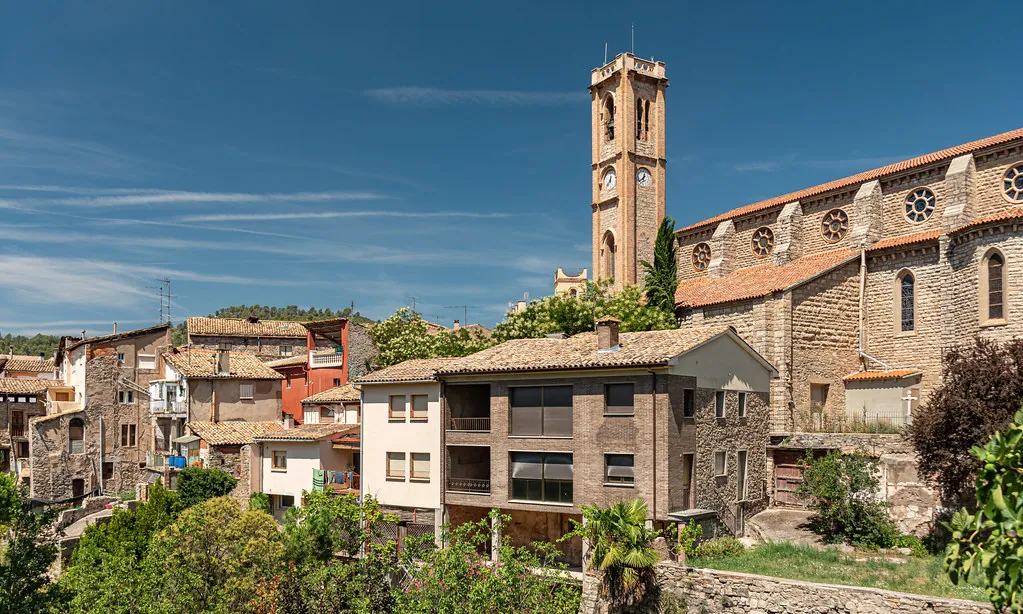
Rows of brick workers’ houses, aligned with surprising regularity for this part of the Bages region, remain occupied. The layout revolved around the factory and essential facilities such as the school, the company shop and the church. Some former industrial buildings have been repurposed for municipal and educational uses. The tall chimney of the old factory continues to define the skyline, a reminder that the modern municipality emerged thanks to the river’s energy.
A short distance away, El Vilar has a different feel. Here the landscape resembles that of inland Bages: scattered masías, or traditional farmhouses, agricultural tracks and cereal fields stretching towards the first foothills of Montserrat. Between these two centres, the municipality is home to around four thousand residents. The contrast between factory rows and open farmland gives the area a dual identity, shaped equally by industry and agriculture.
The Meander and the Pont Vell
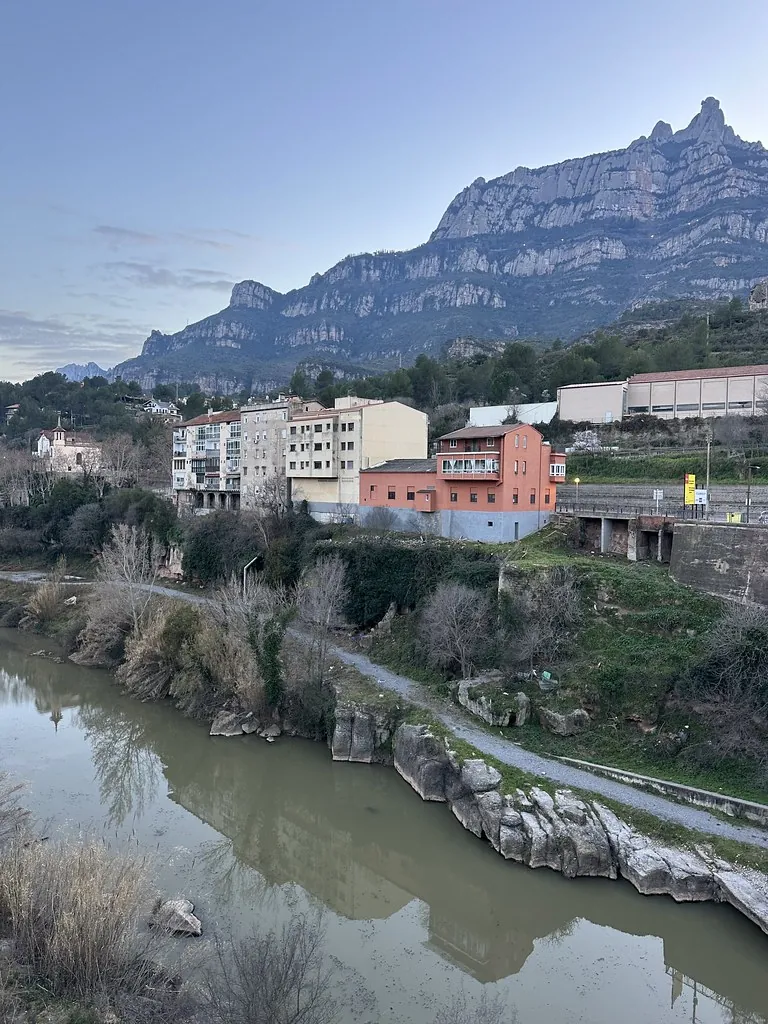
The defining natural feature of the area is the meander of the Llobregat. This broad curve of the river has remained relatively intact and now includes a walking route that follows the water’s edge and crosses the small central island. It is a short, easy stroll and a popular spot with local residents.
The calmer waters created by a small weir attract birdlife. Depending on the time of year, species associated with river habitats can often be seen here, including herons, ducks and occasionally a kingfisher. The setting is simple but distinctive: water looping around greenery, with the hilltop castle in the background.
From the path, there is also a clear view of the Pont Vell reflected in the river. The bridge is of medieval origin, although it has been heavily altered over time. It replaced earlier fords and for centuries provided the usual way to cross the Llobregat at this point. Its arches, mirrored in the slow-moving water, have become one of the most recognisable images of Castellbell i el Vilar.
Together, the meander and the bridge illustrate how the settlement has always depended on crossing and controlling the river. The scene may look peaceful today, but it was once a strategic and economic lifeline.
Between Montserrat and Sant Llorenç del Munt
Castellbell i el Vilar sits between two well-known natural areas: Montserrat to the south and Sant Llorenç del Munt i l’Obac to the north. This location explains why many walking routes pass close by.
From the town, it is relatively quick to reach the base of Montserrat, the striking mountain range famous for its serrated silhouette and monastery. At weekends, the road in that direction often becomes busy. Heading the other way, towards Mura and the Sant Llorenç massif, the atmosphere tends to be quieter, with dense holm oak woods, long forest tracks and areas where mobile coverage can easily disappear.
Within the municipality itself, several traditional lime kilns survive in the woodland. These dry-stone structures were once used to heat limestone and produce lime for construction and agriculture. They are not always clearly signposted, but they form part of the area’s historical landscape, linking rural practices to the broader story of settlement and industry.
Practicalities and the Best Time to Visit
Castellbell i el Vilar has a railway station on the line that follows the Llobregat valley, connecting Barcelona and Manresa. It is also easily reached via the C‑16, known as the Eix del Llobregat, which passes close to the municipality.
Spring and autumn are generally the most pleasant seasons for walking the meander or climbing up to the castle. The river usually carries more water, and temperatures are comfortable for being outdoors. In summer, the town celebrates its festas majors, local annual festivals that bring increased activity to the former colony.
For a brief visit, an afternoon is enough to combine the castle, a stroll around the meander and a look at the Pont Vell. With more time, the surrounding landscapes between Montserrat and Sant Llorenç del Munt offer further opportunities to explore on foot.
Castellbell i el Vilar is not defined by a single monument but by the way river, hill and factory fit together. The curve of the Llobregat, the square tower on its promontory and the straight lines of workers’ housing each tell part of the same story: a place shaped first by defence, then by water-powered industry, and always by the geography of the valley.