Full Article
about Castellfollit del Boix
Scattered rural municipality among forests and fields on the border with Anoia
Hide article Read full article
A Small Village at 700 Metres
Some places feel like those secondary roads you take almost by accident. You were not looking for anything in particular, yet you slow down, glance around and think, this will do nicely. Tourism in Castellfollit del Boix has that same unforced quality. It is a small municipality in the comarca of Bages, in inland Catalonia, sitting at around 700 metres above sea level and home to just over 460 residents. Its pace has little in common with the busier routes of Catalonia.
Time here seems to follow the church bells or the moment the sun drops behind the surrounding hills rather than the clock on a phone screen. For a short break, that change of rhythm can be exactly the point.
Castellfollit del Boix is not a place of headline attractions. It works better as a pause, somewhere to stretch your legs, breathe in the countryside and get a sense of rural Bages without complication.
Stone Streets and Traces of the Past
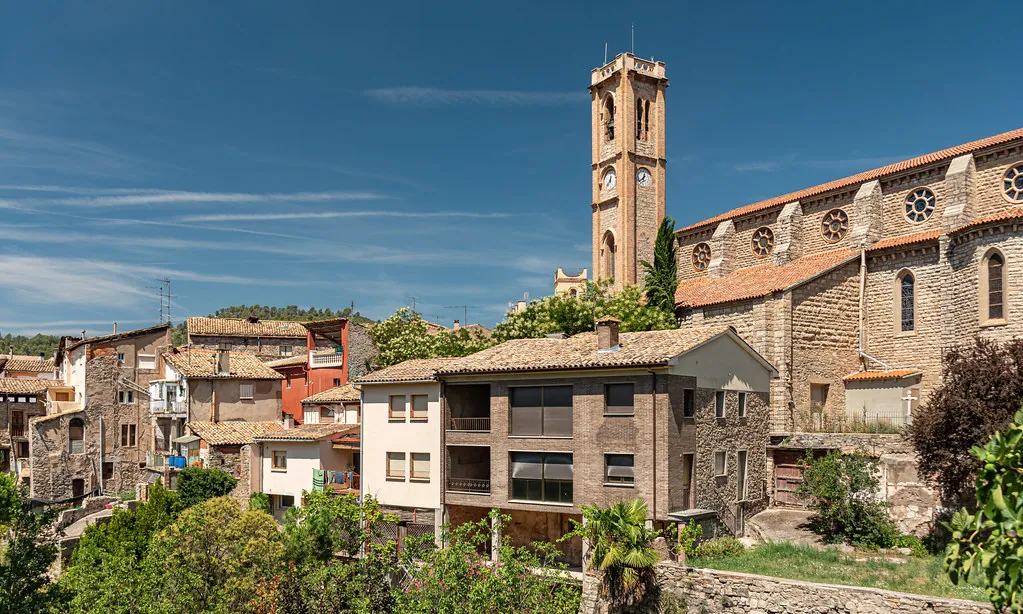
The centre of Castellfollit del Boix is straightforward and easy to explore without a map. A handful of narrow streets wind between stone houses built close together, giving the impression of a village that has grown gradually, without grand urban plans shaping its layout.
The parish church of Sant Andreu is the most prominent building. Its base is Romanesque, a medieval architectural style common across Catalonia, although later alterations are clearly visible in the walls if you take a closer look. Nearby are remains associated with the former castle. Today these are fragments of walls and scattered structures rather than a complete fortress, yet they hint that this small hilltop once had some defensive importance centuries ago.
Along Carrer Major, the main street, a few houses display Gothic or Renaissance details. They are not monumental façades or major landmarks. Instead, they appear as small clues to the village’s past, like an old doorway set into an otherwise ordinary home, prompting quiet questions about how many generations have crossed that threshold.
There is no grand circuit to follow. A slow wander through the centre is enough to get a feel for the place, its scale and its unhurried character.
Holm Oaks, Tracks and Open Views
Beyond the village core, the landscape quickly becomes the defining feature. Holm oaks, pines and some oak trees spread across the surrounding hills. Rural tracks link farmhouses and small valleys, creating a network of simple routes through the countryside.
There is no need to plan an elaborate hike. It is perfectly possible to leave on foot from the village itself and follow one of these tracks for half an hour or an hour. Encounters with other walkers are rare. More often, the steady background sound is the wind moving through the trees or the distant hum of a tractor.
On clear days, from certain points along the way, the distinctive silhouette of Montserrat appears on the horizon. There is no formal viewpoint with railings or information panels, just an opening in the landscape where the view suddenly expands and the jagged outline of the mountain range comes into sight. Montserrat is one of Catalonia’s most recognisable natural landmarks, and seeing it from this quieter corner of Bages adds an unexpected sense of scale.
The overall feeling is of space and stillness. Even a short walk can feel like a proper break from busier roads and towns.
Easy Routes on Foot or by Bike
For those who prefer to keep moving, Castellfollit del Boix offers several gentle options. The paths connecting it with other parts of Bages combine very minor stretches of tarmac with manageable dirt tracks.
This is not an area of heavily signposted trails with markers every few metres. It helps to arrive with a general idea of the route you want to follow or a simple track to guide you. In exchange, the surroundings reward an unhurried approach. It suits walkers who prefer steady progress over steep challenges, and cyclists on touring or leisure bikes who do not mind the occasional incline.
The terrain rolls rather than dramatically climbs, making it accessible for a relaxed outing rather than a demanding expedition. The appeal lies in the rhythm of movement through open countryside rather than ticking off specific sights.
Food Rooted in the Countryside
The local cooking remains closely tied to the land. Expect hearty dishes, plenty of meat and cured sausages, and, when in season, a generous presence of wild mushrooms. There is little interest in modern presentation or culinary experimentation. The emphasis is on filling, straightforward food that feels especially welcome after time spent walking in the hills.
In a place like this, a long lunch can easily become the main plan of the day. The atmosphere tends to encourage lingering at the table rather than rushing back out.
Part of a Wider Route Through Bages
Castellfollit del Boix fits naturally into a broader exploration of the comarca of Bages. This inland region of Catalonia is dotted with castles, notably old Romanesque churches and small villages separated by short distances. Travelling by car makes it simple to link several stops in a single day.
Manresa, the comarca’s main town, lies relatively close, as do other municipalities with a strong medieval character. Within that context, Castellfollit functions more as a quiet interlude than as a destination that fills an entire itinerary.
It works well as a short detour, a place to slow down between larger sites and experience a more rural side of central Catalonia.
When Sant Andreu Brings a Change of Pace
For most of the year, the atmosphere remains calm. In summer, however, the village celebrates its festa major in honour of its patron saint, Sant Andreu. A festa major is the main annual festival typical of towns and villages across Catalonia. In Castellfollit del Boix, these days bring music, communal meals and activities primarily intended for residents and people from nearby areas.
It is not a large-scale event designed to draw crowds from afar. Instead, it is a moment when the village gathers and the mood shifts for a few days before returning to its usual quiet routine.
Is It Worth the Stop?
That depends largely on expectations. Castellfollit del Boix is not packed with major monuments, nor does it offer a long list of activities to fill every hour.
For travellers who enjoy small places, unhurried walks and a glimpse of rural life in Bages, it makes sense as a short break or a stop along a wider route. The most satisfying approach is a simple one: park, wander through the centre, head out along a track for a while, then sit down for a relaxed meal.
In villages like this, uncomplicated plans often fit best.