Full Article
about Castellgalí
Town with a Roman past and strategic views over the river confluence and Montserrat
Hide article Read full article
A village best seen on foot
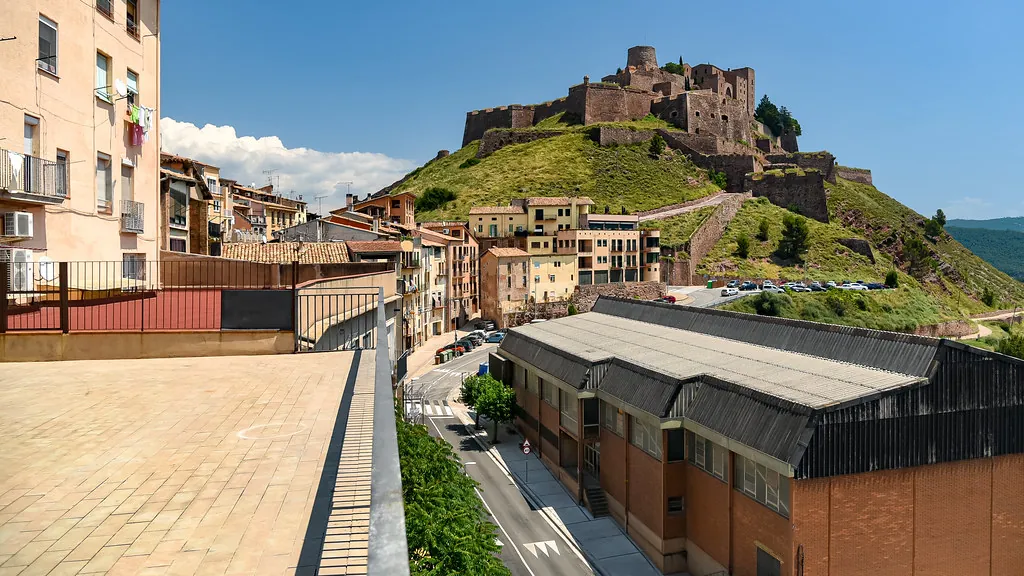
If you are heading to Castellgalí, start by parking in the centre and leaving the car there. The village is small enough that everything can be reached on foot without effort. The castle, despite being the headline feature, is actually seen to better effect from the road than from the top itself. It sits roughly 200 metres above the valley and has been in ruins since 1472. Climbing up does not dramatically improve the view. What waits there is limited: a few stones and an information panel.
What remains of the castle
The site appears in records as early as 867, referred to as the “castillo de Galí”. It formed part of a network of lookout points during the county period, monitoring movement through the Cardener valley. From here, the route towards Manresa and Sant Vicenç de Castellet could be controlled.
Today, the landscape it overlooks has changed. The most visible elements are the C‑55 road and nearby industrial buildings rather than any historic panorama.
The approach is along a forest track. It can be driven slowly, ending at a small clearing where you can leave the car. From there, it is a five-minute walk through pine trees. What you find at the top is essentially a section of wall about two metres high and a spread of fallen stone. The sign describes it as a “medieval defensive structure”, which is accurate, if not especially revealing. There is little else to explore on the site.
The “tower” that is not a tower
In the cemetery stands the so-called Roman sepulchre of Breny, dated to around the 3rd century. Locally, it is often referred to as a tower, though that label is misleading. It is in fact a funerary monument made of stone, with a square base of about three metres and a large slab resting on top.
For years, it was used as an improvised storage space. Once it was recognised as a protected heritage element, it was closed off with metal bars. It can be viewed from the outside in a minute or two, and that is enough to take in its scale and form.
The village as it is
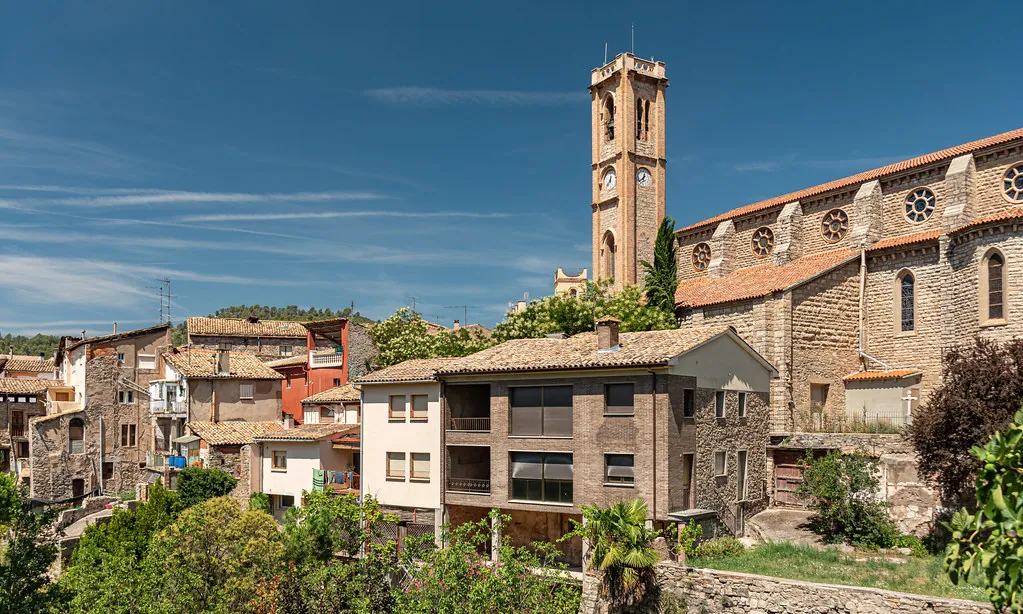
Castellgalí slopes down towards the Cardener river. Much of what you see today dates from the mid-20th century, with a scattering of older houses and a noticeable amount of more recent construction in the upper part of the village.
The main square is modest in size. There are benches, a terrace, and a sense of everyday life when the weather is good. On Saturday mornings, a simple market usually takes place. Stalls sell fruit, clothes and a few other basic items, giving the square a bit more movement than usual.
Down by the river, there is a walking path of about a kilometre. It is not particularly distinctive, but it serves its purpose if you want to stretch your legs. There are benches along the way, patches of shade that come and go, and local residents walking or cycling. In summer, families tend to gather here. There is no designated swimming area and no beach bars or similar facilities.
What you will not find
Castellgalí does not present itself as a fully developed tourist destination. There is no structured visitor offering, no clearly marked network of routes, and no visitor centre. If you ask at the town hall, they usually have a basic leaflet about the municipality and its surroundings, but little beyond that.
The main annual celebration takes place around 15 August, during the fiestas mayores. A stage is set up in the square and there is live music in the evening, typically with an orchestra. It is also common to see the local castellers, the human tower builders typical of Catalonia, raising a pillar. Many of the meals during these days are shared outdoors, with long tables set up in the streets among neighbours.
A practical way to approach it
To see everything, allow a little over an hour. That is enough time for a walk through the centre, a look at the Breny sepulchre, and the climb up to the castle if curiosity gets the better of you.
It is best to arrive early in the day or later in the afternoon. After that, Manresa is only about ten minutes away, and there you will find a wider range of things to do.