Full Article
about Gaià
Quiet rural municipality with scattered farmhouses and pine forests.
Ocultar artículo Leer artículo completo
The church bell strikes noon and nobody appears. Not because Gaia's 179 residents are ignoring the hour, but because they're three kilometres away, guiding tractors across wheat fields that glow bronze in the altitude-bright sun. At 480 metres above sea level, the village sits high enough for the air to carry a snap missing from the Costa Brava below, yet low enough that Mediterranean heat still ripens almonds in the cracks of dry-stone walls.
This is the Bages comarca, an hour's drive northwest of Barcelona, where guidebooks thin out and rental cars rarely appear. Gaia's single paved road arrives from the C-25 motorway, climbs past stone houses the colour of weathered parchment, then stops. Beyond that point, tracks become gravel, signs disappear, and the only sound is wind moving through holm oaks. The village functions as it has for centuries: an agricultural hub whose residents measure distance in time rather than kilometres. When the bakery in neighbouring Moià runs out of croissants, locals shrug—it's a twenty-minute downhill walk, longer coming back uphill with shopping.
Stone, Sun and Silence
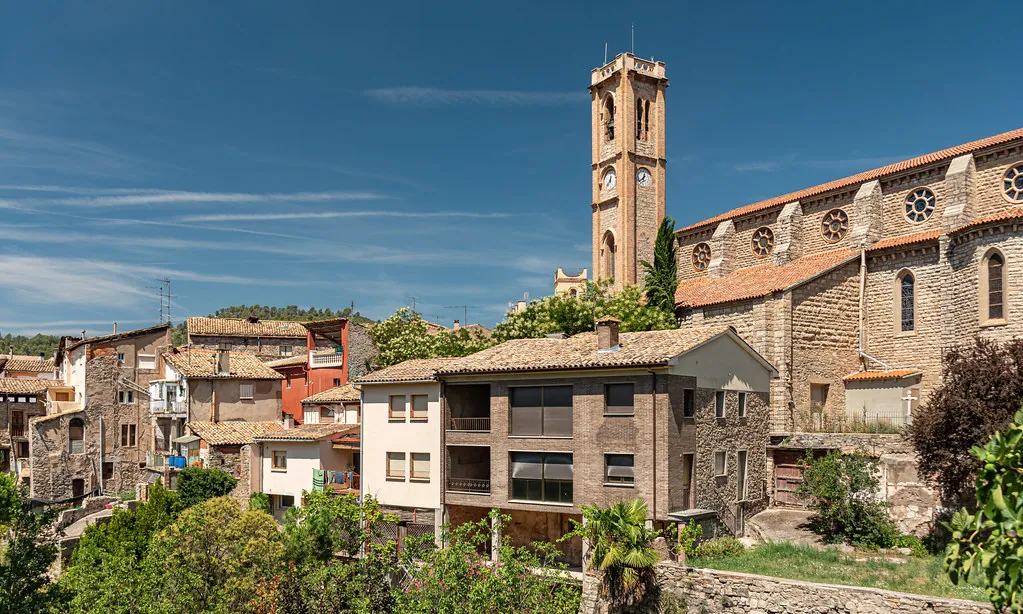
The parish church of Sant Martí dominates what passes for a centre, its Romanesque bones visible beneath 18th-century additions. Step inside and the temperature drops ten degrees; the stone floor bears grooves where centuries of worshippers have worn a path between altar and door. No admission charges, no audio guides, just a printed notice requesting visitors close the door gently to keep swallows from nesting in the rafters. Outside, the church square measures perhaps fifteen metres across, bounded by houses whose ground floors once stabled animals. Look closely and you'll spot the original feeding troughs, now filled with geraniums rather than hay.
Walking the village takes twenty minutes if you dawdle. Better to treat Gaia as a launch point for understanding how interior Catalonia actually works. Follow the camí de Sant Jaume westward and within ten minutes you're amid wheat terraces that predate the Romans. The path climbs gently—this is roller-coaster country where every ascent repays effort with views across the Central Depression. On clear days you can see Montserrat's serrated profile 35 kilometres south, while northwards the Pyrenees appear as a blue wall marking the French border.
When Altitude Changes Everything
Gaia's elevation creates microclimates that catch first-time visitors off guard. Summer mornings start fresh—21°C at 8 am—before temperatures rocket to 34°C by midday. The dry air means you'll underestimate dehydration; carry more water than thinks necessary. Spring arrives late but dramatic: almond blossom appears in March, a full month behind coastal Tarragona. Autumn brings morning mists that pool in valleys like milk, while villages including Gaia float above cloud level like islands.
Winter transforms access completely. The BV-4311 road from Manresa receives gritting, but approach roads from smaller villages don't. When snow falls—perhaps three days each winter—the village becomes temporary inaccessible to anything without four-wheel drive. Residents stock up accordingly, treating supermarket runs as military operations. Visiting between December and February requires checking weather forecasts and carrying snow chains, despite Barcelona enjoying 16°C sunshine two thousand feet below.
Eating (or Not) in Agricultural Time
Gaia itself offers zero dining options. No bars, no restaurants, not even a village shop. The last grocery closed in 2008 when its proprietor retired aged 84; shelves now gather dust behind metal shutters. Instead, eating becomes part of the adventure. Five kilometres north in Moià, Cal Xic serves three-course lunches for €14, featuring escalivada (smoky aubergine and peppers) and rabbit stew that tastes of thyme and woodland. Book ahead—locals arrive at 2 pm sharp and tables fill fast.
For self-caterers, Manresa's Saturday market supplies everything needed for picnics. Look for formatge de tupí, a soft cheese matured in clay pots, and botifarra negre blood sausage that tastes best grilled over vine cuttings. Buy bread from Forn de Baix in the old town; their coca de recapte flatbread carries roasted vegetables and costs €3.50 per generous slice. Then drive ten minutes to Gaia and eat beside the 12th-century font de la Vila spring, where water runs cold enough to chill wine naturally.
Walking Without Waymarks
Official hiking routes bypass Gaia, which suits residents perfectly. Instead, a network of farm tracks links the village to hamlets most maps ignore. Head east towards Castellnou de Bages on the GR-3 long-distance path—waymarked here, mercifully—and you'll pass Masia Can Piqué, where stone lintels carry 1674 dates and stables now house vintage tractors. The farmer, Josep, waves visitors through his yard provided dogs stay leashed and gates close behind.
A gentle three-hour circuit runs south to Santpedor, returning via the Camí dels Bons Homes, a medieval trail once used by Cathar refugees fleeing persecution. The route crosses limestone ridges where wild rosemary grows waist-high, filling the air with resinous scent when brushed. Total ascent: 220 metres. Difficulty: moderate if you carry water, impossible if you don't—shade exists only in church porches spaced kilometres apart.
Beyond the Village: Industrial Heritage and Living Culture
Ten kilometres north, the Museum of the Territory in Moià explains why villages like Gaia survived while others vanished. Exhibits show how sharecropping systems distributed land into strips too small to mechanise effectively, preserving traditional farming into the 21st century. Entry costs €5; allow ninety minutes including the short film that subtitles Catalan into English without losing agricultural nuance.
Back in Gaia, the annual summer festival happens during the last weekend of July. Streets fill with folding tables; neighbours contribute rabbit paella cooked over wood fires while children chase footballs between tractors. Visitors welcome—bring wine, join queues for food, and accept that proceedings run ninety minutes late. The village choir performs Catalan folk songs whose lyrics reference crops most British visitors can't identify; clap anyway.
Practicalities Without Pretty Packaging
Accommodation requires planning. Gaia offers no hotels, campsites or official guesthouses. Closest beds lie in Moià: Hotel Urbisol provides modern rooms from €65 nightly, breakfast included, though you'll need transport five kilometres back to Gaia. Alternative: rent the restored masia Cal Porxo through rural tourism websites—sleeps six from €120 nightly, minimum two nights, with pool and views across cereal fields that glow amber at sunset.
Driving remains essential. Public transport reaches Moià twice daily from Barcelona (2 hours 15 minutes, €12.50), but Gaia lies six kilometres further with no connecting bus. Hire cars from Barcelona airport cost €35 daily; parking in Gaia means finding space beside the church, avoiding farmers' gateways. Cyclists can manage the climb from Manresa in 45 minutes if fit, longer if honest about fitness levels.
The Honest Truth
Gaia won't suit everyone. Those requiring nightlife, shopping or spas should stay in Barcelona. Mobile phone signal drops to one bar between houses; WiFi exists only in the town hall during office hours. Rain turns tracks to mud that clogs footwear for days. The village offers no postcard racks, no fridge magnets, nowhere to prove you've visited beyond your own memory.
Yet for travellers seeking to understand how Mediterranean Europe functioned before tourism, Gaia provides a masterclass. Here, agriculture dictates rhythms, neighbours share olive presses, and lunch remains the day's main event. Come prepared—carry water, respect private land, close every gate—and the village rewards with something increasingly rare: authentic rural life continuing regardless of whether anyone watches. The bell tower still marks time, wheat still ripens by Saint John's Day, and somewhere among the fields a tractor hums through afternoon heat, ensuring Gaia endures long after visitors depart.