Full Article
about Marganell
Small town at the foot of Montserrat mountain, known for its fresh cheese.
Ocultar artículo Leer artículo completo
The morning bell at Sant Pau church strikes seven, and the only reply is the clink of a farmer's trailer somewhere below the pine ridge. At 370 metres above the Llobregat valley, Marganell wakes slowly, more a scattering of stone farmhouses than a conventional village square. Most visitors race straight past on the C-55, bound for the cable-car queues that snake up the neighbouring mountain. Turn off, however, and the same rock wall of Montserrat becomes a backdrop rather than a traffic jam.
What you find is a working corner of the Bages comarca where almond orchards replace souvenir stalls. The municipal map lists twice as many masías as houses in the modest centre, and the roads taper into gravel almost as soon as you leave the church. That dispersal makes a car – or stout walking boots – almost essential, but it also explains the silence: no tour buses can squeeze past the stone terraces.
Stone, Pines and the Monastery Shadow
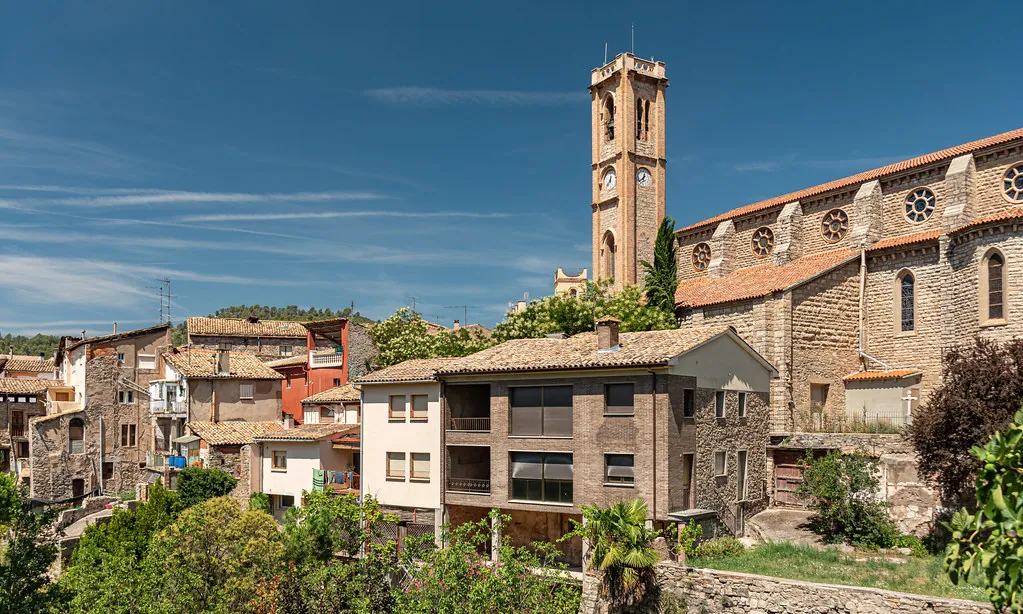
The parish church may be twelfth-century in origin, yet its thick render and modest bell-tower feel more functional than grand. Step inside and the air carries a faint smell of extinguished candles and sun-warmed timber; the font is still used, because this remains a parish of fewer than three hundred souls. Outside, a panel shows the GR-6 long-distance footpath departing immediately behind the apse. Follow the white-and-red flashes and within forty minutes the track tilts sharply upwards, holm oaks give way to Aleppo pines, and the monastery of Montserrat materialises overhead like a stone ship. Fit walkers can reach the basilica in an hour and three-quarters, bypassing the €18 cable-car fee and, more usefully, the mid-morning crowds.
If that sounds too energetic, a flatter loop strikes south-east along the torrent de la Culla. The path is wide enough for two, though you'll more likely meet a tractor than another tourist. After 4 km the route climbs a low saddle where picnic tables sit under umbrella pines; from here the whole of the Catalan pre-coastal range ripples southwards, ochre in summer, emerald after October rain. No entry fee, no interpretive centre – just a painted yellow arrow on a limestone boulder.
Where to Eat and Stock Up
Marganell itself offers a single restaurant, Cal Jaume, in what was once the village grocer's. Inside, the floor tiles are the original 1920s pattern, and the day's menu is pegged to a wooden board. Expect 'canelons de la iaia', cannelloni baked in béchamel and finished under a grill until the top blisters – comfort food that would pass muster in any British gastropub, though here it costs €12 for three courses at lunch. Between January and March the kitchen switches to calçots, fat spring onions charred over vine cuttings and served with romesco. Locals demonstrate the technique: grip the blackened stalk, peel back the outer layer, dip, lower into mouth, repeat. A bib is provided; white shirts survive only through abstinence.
Shopping is less straightforward. The village shop closed in 2018, so self-caterers should stock up in Manresa (15 minutes' drive) or call ahead to one of the farmhouses that sell their own produce. Masia la Tordella keeps a fridge of goat's cheese and home-made 'butifarra' sausages; ring the bell and someone emerges from the barn, wiping hands on overalls. Card payments are accepted, but only because their daughter studied e-commerce in Barcelona.
Seasons and Access
Altitude tempers the summer furnace that scorches the coast. July afternoons hover around 28°C rather than 34°C, and the night air carries enough chill to make a light jumper welcome even in August. Conversely, winter can trap the village under a lid of cold fog while the monastery basks in sunshine 600 metres higher. Snow is rare but not impossible; if the Met Office equivalent (AEMET) issues a yellow alert, the twisting access road from the C-55 can ice over. Chains are rarely needed, yet rental-car drivers unused to mountain gradients sometimes stall on the 12% slope leaving the church.
Spring and autumn deliver the best compromise. Almond blossom appears in late February, a full month before the upland trails open reliably. By late October the woodland glows with chestnut and beech tints, and mushroom hunters fan out with wicker baskets. British visitors accustomed to sign-posted rights-of-way should note that many tracks cross private land; stick to the marked GR and PR routes to avoid a voluble Catalan telling you you've strayed into somebody's 'vinya'.
The Practical Bits No-one Mentions
There is no cash machine. The nearest ATM stands beside a BP garage 2 km away, but it charges €2 per withdrawal and sporadically rejects foreign cards. Bring euros or stop in Manresa on the way up. Mobile coverage follows a similar hit-and-miss pattern: Vodafone and EE generally lock onto a signal near the church square, but Three and O2 cut out the moment you drop behind a ridge. Download Google Maps offline before leaving the main road.
Public transport exists, though only just. Two Rodalies trains an hour link Barcelona-Plaça Espanya with Monistrol de Montserrat, 7 km below the village. From there a pre-booked taxi is essential – there is no rank, and calling a cab on spec can mean a 45-minute wait. If you plan to walk up to the monastery and ride the rack railway down, check the last return; miss it and a taxi back to Marganell costs about €60, roughly the same as a night in the local guest-house.
Why Pause Here at All?
Because Montserrat looks better when you approach it on foot, and because the silence after the last monastery coach departs is worth missing one Barcelona supper for. Marganell will never feature on glossy regional brochures; it offers no souvenir tea-towels and no evening entertainment beyond the church bell marking the quarters. What it does provide is a base where you can start walking at dawn, be among the first inside the basilica, and still return for a three-course lunch that costs less than a London sandwich. Stay a night, and you may hear nothing louder than a nightjar until the farmer restarts his tractor at daybreak.