Full Article
about Mura
One of Catalonia’s most beautiful medieval villages, in the Sant Llorenç park.
Hide article Read full article
Morning Light in a Village of Stone
Early in the morning, when there is still dampness on the stone paving, Mura sounds mostly like footsteps. Your own, because hardly anyone else is around. Smoke drifts from a chimney here and there, and the air comes down cold from the mountain. Looking south, the outline of La Mola rises like a pale rock table cutting across the sky, the building of the former monastery marking its summit.
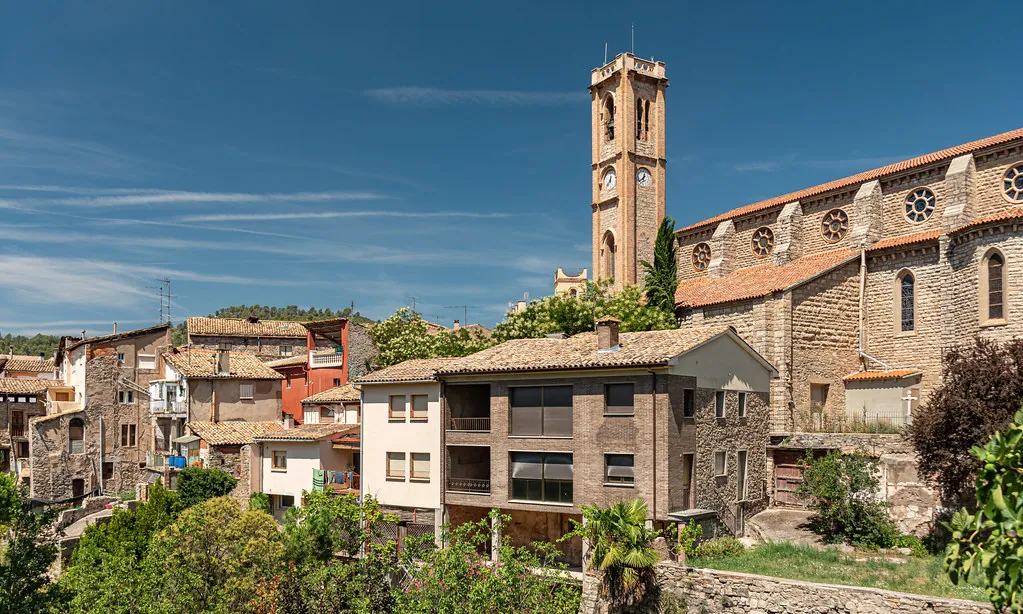
Tourism in Mura revolves around a very small place in the comarca of Bages, with just over two hundred residents, set between ravines and slopes in the natural park of Sant Llorenç del Munt i l’Obac. The streets climb and dip without much apparent logic, adjusting to the incline. Most houses are built of stone, showing repairs from different periods: a rebuilt arch, a newer window, beams that seem to have lasted through several generations.
Light filters in between the rooftops at intervals. By mid-afternoon, when the sun drops behind the ridge, the façades take on shades between pale grey and muted ochre. There are no grand squares or sweeping views. Mura makes sense at a slow pace, accepting that every corner shifts the gradient and changes the perspective.
Around Sant Martí
The church of Sant Martí shapes the centre of the village. Medieval in origin, it has been altered over the centuries, though Romanesque features are still visible in some windows and in the compact form of the building.
Around it lie narrow courtyards, short flights of steps and houses pressed close together as if sheltering from the wind. In certain corners, vines or ivy climb up the walls. There is no need for a fixed route. The entire core can be walked in under an hour, although most people pause more than once, particularly where a narrow lane opens out and the mountain suddenly comes into view.
One practical point: on fine weekends quite a few day-trippers arrive from the Barcelona metropolitan area. Those seeking quiet are better off visiting during the week or early in the day.
Paths into the Rock of Sant Llorenç del Munt
The landscape around Mura carries as much weight as the village itself. It sits at one of the access points to the Sant Llorenç del Munt massif, a limestone mountain range where water has shaped spires, cliffs and small rocky channels over time.
Many paths start directly from the village or from nearby tracks. Some run through pine and holm oak woodland. Others cross more open ground where bare stone breaks through the surface. The terrain is uneven and stony in places, so footwear with a solid sole is advisable even if the walk looks short on the map.
The ascent to La Mola is one of the best-known routes in the area. It is not a gentle stroll. The path gains height steadily and, depending on the route chosen, can include rocky sections. At the top, the building of the former monastery dominates the rock platform. On clear days it is possible to make out Montserrat to the west and, further away, the first lines of the Pyrenees.
Caves and Hollows in the Limestone
The karst landscape has left small cavities scattered across the area. The Coves de Mura are the most familiar. These are not vast underground chambers or dramatic cave systems, but rather cracks and galleries slowly formed by water in the limestone.
Some walking routes pass near these cavities. It is worth approaching carefully and with sufficient light, as the ground can be damp or slippery in places. Part of their appeal lies in their modest scale, seeing up close how the mountain has gradually been hollowed out from within.
Masías and the Rural Pattern of Bages
Beyond the village centre, masías dispersas appear among fields and low woodland. A masía is a traditional rural farmhouse typical of Catalonia, often linked to farming or livestock. Many retain their characteristic structure: thick walls, sloping tiled roofs and enclosed courtyards where tools or firewood are still kept.
Not all are inhabited. Some show closed doors and boarded windows. Others continue agricultural or livestock activity. Walking between them helps explain how this part of Bages has historically been organised, with farms separated by terraces, dirt tracks and small cultivated plots.
The sense of distance between properties contrasts with the compact streets of Mura itself. It also underlines how closely life here has been tied to the land, to slopes that are not always easy to work and to routes shaped more by terrain than by planning.
Rock Faces and Climbers
The limestone walls around Mura also draw local climbers. In certain sectors there are equipped routes of varying levels, and on stable days in spring or autumn it is common to see ropes hanging against the rock.
This is not a destination designed for absolute beginners, yet climbers with experience often find quieter sectors here, away from the busier climbing areas elsewhere in Catalonia.
Before Setting Off
Mura is small, and parking within the village is limited. On busy days it may be necessary to leave the car a little further away and walk in. There is also limited shade on some routes across the massif, so the heat can be noticeable in summer.
In return, when evening falls and many visitors have already left, the atmosphere shifts again. The stone cools, footsteps become audible once more, and the outline of La Mola returns to the horizon. In those quieter hours, Mura feels defined less by sights to tick off and more by its rhythm: slopes that set the pace, rock shaped by water, and a village that reveals itself gradually to anyone willing to walk without hurry.