Full Article
about Sant Mateu de Bages
The largest municipality in Bages but sparsely populated and very natural.
Hide article Read full article
A Municipality Shaped by Its Map
In the centre of the comarca of Bages, Sant Mateu de Bages is best understood by looking at a map of its municipal boundaries rather than at the village itself. With just over six hundred inhabitants spread across scattered settlements and isolated masías, the area follows an older rural logic. Large stretches of dry farmland, detached houses and small clusters gathered around a church define the pattern of settlement.
The landscape tells much of the story. Cereal fields extend across gentle slopes, broken up by holm oak woods and pine forests. This mix of crops and woodland explains how people have lived here for centuries, working the land, managing livestock and organising daily life around dispersed farmhouses rather than a dense urban centre.
Sant Mateu de Bages is less a single village than a broad rural territory with a modest focal point.
The Village and Its Church
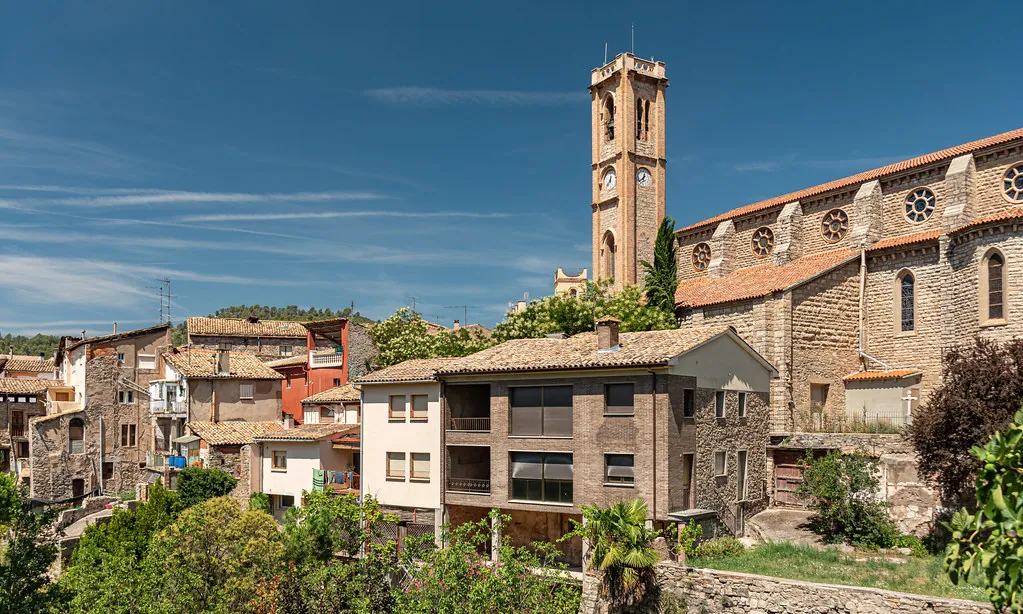
The nucleus of Sant Mateu is small, reflecting the structure of many rural settlements in inland Catalonia. A handful of streets, stone houses and the parish church form its core. The church of Sant Mateu, probably of medieval origin though altered in later periods, occupies the symbolic centre of the village.
It is not a monumental building, yet it helps explain how local life was arranged. The square nearby, the houses clustered around it and the paths leading out towards the masías show how the community functioned. The church was both reference point and meeting place, anchoring a population otherwise dispersed across fields and woodland.
Rather than a compact townscape, the village operates as a small gathering point within a much larger municipal area.
Masías and the Agricultural Landscape
Much of the municipality’s heritage lies beyond the village streets, in the masías scattered across the territory. Some date back several centuries and follow the classic model of Catalan rural architecture: thick stone walls, tiled roofs and adjoining buildings linked to farming or livestock.
Many of these farmhouses are still inhabited or in use, so they are best observed from public paths. Even so, walking or driving along the rural tracks offers insight into how the land was organised. Each masía traditionally controlled surrounding fields, woodland and access routes, forming small, largely self-sufficient units. Together, they structured rural life in inland Bages.
This pattern of settlement explains why Sant Mateu de Bages feels so open. There is no single dominant centre. Instead, life has long been distributed across a network of farmsteads connected by paths and shared traditions.
Walking Through Fields and Holm Oak Woods
The surroundings of Sant Mateu lend themselves to walking without significant technical difficulty. Numerous agricultural tracks link masías, small clusters of houses and cultivated areas. Many of these are old cart paths, used for generations to transport grain, firewood or livestock.
The terrain is gentle, with low hills and wide horizons. From certain small rises, the scale of the municipality becomes clear. Fields of dry crops alternate with patches of holm oak, creating a varied but coherent landscape.
Signposting is limited and orientation is not always straightforward. For longer routes, carrying a map or GPS is advisable. Part of the experience lies in reading the land itself: understanding where cultivation gives way to woodland, noticing how paths converge on a masía, and seeing how settlement and agriculture are interwoven.
This is not walking defined by dramatic peaks or marked trails. It is about moving at a steady pace through working countryside and recognising the patterns that have shaped it.
Flavours of Inland Bages
The cuisine of the area reflects what the land provides. Legumes, olive oil and pork products form the basis of many dishes, often hearty and rooted in farming tradition. Sant Mateu is a small municipality and options within the village itself are limited, so many visitors combine a trip here with time in other nearby towns in Bages.
Across the comarca, wine production has been developed for years under the Pla de Bages designation. This denomination of origin revives a much older winemaking tradition in this part of Catalonia. Vineyards once played a significant role in the local economy, and the renewed focus on wine links present-day production with that historic background.
Food and drink here are tied closely to the agricultural landscape. The same fields and slopes seen while walking also underpin what appears on the table.
Festivals and the Local Calendar
The feast day of the patron saint, Sant Mateu, is usually celebrated in September. It brings together residents from the different settlements and masías across the municipality. In a place where the population is dispersed, such occasions have a clear social function. They are moments when the scattered community gathers again in a shared space.
Throughout the year, other celebrations connected to the traditional calendar also remain part of community life. Bonfires for Sant Joan in early summer and autumn castañadas, centred on roasted chestnuts, continue to be observed. These events reflect customs found across Catalonia, adapted to the scale of a small rural municipality.
Festivals here are not large spectacles. Their importance lies in maintaining connections between households spread across fields and wooded hills.
A Quiet Way to Understand the Territory
Sant Mateu de Bages is not a destination defined by major monuments or extensive urban routes. It is best appreciated slowly, by following paths, observing how houses sit within the landscape and noticing how small nuclei relate to the wider territory.
Water, comfortable footwear and a sense of direction are advisable for those planning to explore on foot. The interest lies in the land itself and in the way rural life has been organised here for centuries.
In the centre of Bages, Sant Mateu de Bages offers a clear example of how a municipality can function without a dominant town centre. Fields, woods, masías and a modest church form a coherent whole. Understanding it means looking beyond the village streets and paying attention to the broader map, where the true shape of the place becomes visible.