Full Article
about Santpedor
Birthplace of Pep Guardiola with a well-preserved medieval old town.
Hide article Read full article
Santpedor is a bit like that uncle who never left the village. He does not boast, but once you get him talking he casually mentions that his house dates back to the 14th century, that Saint Francis of Assisi once passed along his main street and that a neighbour beat the drum that helped drive the French out at El Bruc. All delivered without changing expression.
Tourism in Santpedor has that same understated quality. The town sits in the comarca of Bages, very close to Manresa and just over an hour from Barcelona by car. It is not large, with around 7,700 inhabitants, yet it carries the feeling of a place that has been here for centuries, getting on with life without worrying too much about drawing attention.
A former villa on a small hill
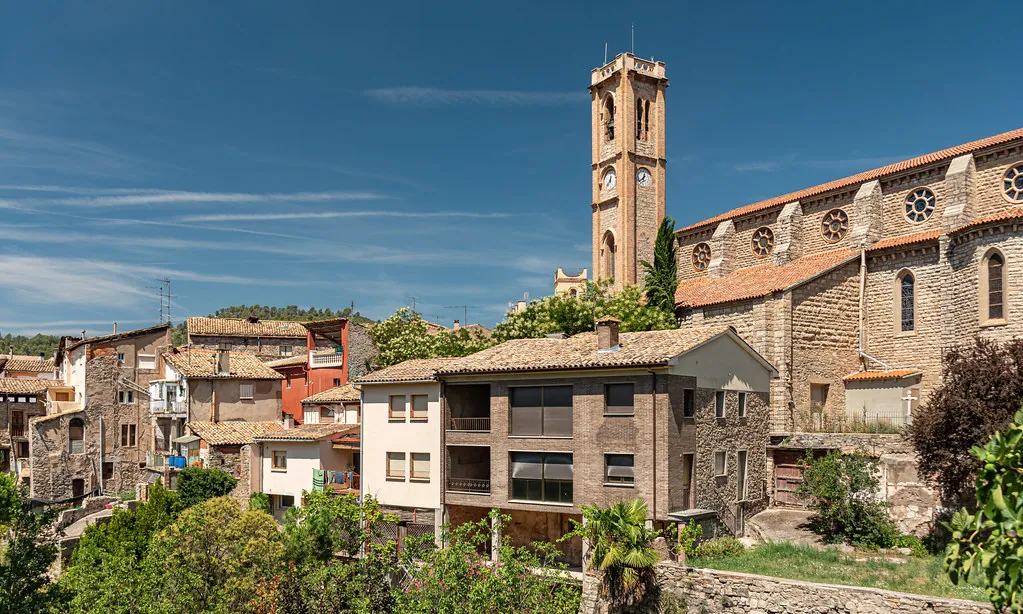
The old quarter clings to a modest hill. Narrow streets wind between stone houses, and doorways look as though they have watched half of Catalonia’s history pass by. At the centre is the Plaza Gran, which functions as the town’s living room. Someone is always crossing it, greeting a neighbour or stopping for a chat.
From here begins the so called Ruta del Timbaler. The route tells the story of Isidre Lluçà, known as the Timbaler del Bruc, who according to tradition was born in Santpedor. The episode has the air of legend. A young lad beating a drum in the mountains, Napoleon’s soldiers hearing the echo and believing an entire army was advancing on them. The house identified as his birthplace is signposted, so the tale becomes part of the stroll through town.
Another key stop is the church of Sant Pere d'Or. Its Romanesque doorway is often dated to the 12th century. The church is not monumental in scale, yet standing close to the stone you quickly sense how long that portal has been watching people come and go. Santpedor has lived through epidemics, wars and more prosperous times, and the building remains.
The town’s past includes a period when it held the status of villa, a medieval term that indicated certain rights and importance. Today it is simply a poble, a town, though traces of that earlier standing linger in its historic core and in the pride with which locals recount their stories.
When the loudest sound is water
About ten minutes on foot from the centre lies l'Aiguamoll de la Bòbila. Years ago clay was extracted here. In time the pit filled with water and has become a small wetland.
You tend to hear it before you see it. Ducks arguing among themselves, a heron standing motionless like a statue, birds flitting through the reeds. There is a wooden viewing platform and a couple of benches. Nothing dramatic, yet it is a good place to pause and let time pass.
Bringing binoculars is a good idea if you have them. If not, it hardly matters. Watching a heron spend the afternoon fishing is reason enough for the short walk.
The contrast between the compact old town and this patch of water and reeds is part of Santpedor’s rhythm. Within minutes you move from stone streets and church portals to open sky and birdsong.
Evenings when everyone swaps roles
Towards the end of October Santpedor usually hosts one of those traditions that only make full sense when seen in person: the Sopar de bigotis i faldilles. The name translates roughly as “Dinner of Moustaches and Skirts”. On that night, men turn up wearing skirts and women sport fake moustaches.
Long tables fill the square. There is laughter, plenty of photographs and images that circulate in local WhatsApp groups for weeks afterwards. The precise origin of the idea is not entirely clear, yet by now it forms part of the town’s calendar.
In June comes the Fiesta Mayor, the main annual festival typical of inland Catalan towns. Expect music in the square, sardanas and fireworks. Sardanas are traditional Catalan circle dances where participants join hands and move in measured steps to live music. The atmosphere is shaped by neighbours who have known one another all their lives.
September usually brings the Fira de Sant Miquel. This event leans more towards market stalls and food than spectacle. It adds another date to the year when the Plaza Gran and surrounding streets fill with activity.
These celebrations may not be grand on a national scale, yet they reveal how Santpedor understands community. Public space is shared, roles can be playfully reversed and traditions are maintained without too much explanation.
A practical way to spend a day
If arriving by car, the simplest approach is to park near the centre and explore the old quarter on foot. In a couple of hours it is possible to see the Plaza Gran, visit the church and wander through the streets that rise and fall around the hill. Part of the pleasure lies in allowing yourself to get slightly lost among the lanes before emerging again in the square.
For those who prefer walking or cycling, the Pla de Bages surrounding Santpedor offers pleasant agricultural tracks. The landscape opens into fields with scattered masías, traditional Catalan farmhouses. On clear days Montserrat appears in the distance, its distinctive silhouette breaking the horizon.
There are no grand monuments demanding a checklist, no endless queue of sights to tick off. Santpedor works differently. It suits a slow wander, perhaps a pause at a terrace to watch daily life unfold.
What remains at the end is a simple impression. Life here moves at an unhurried pace. In a time when many destinations compete to be louder and larger, that calm feels quietly valuable.