Full Article
about Talamanca
Medieval village, site of historic battles in Sant Llorenç park
Hide article Read full article
A small village that sets its own pace
Some places reveal themselves almost immediately. Talamanca is one of them. Tourism in Talamanca is not about ticking off a long list of sights. It is about walking slowly and paying attention to what is around you.
With just over two hundred residents, this small municipality in the comarca of Bages has a calm, unforced atmosphere that you notice as soon as you park the car. It lies relatively close to Manresa, a short drive away, and a little over an hour from Barcelona depending on traffic and the route you take. Even so, once you arrive it feels much further removed from the city.
This is not a village that overwhelms you with attractions. It works better as a pause, a change of rhythm, somewhere to spend a morning or an afternoon without rushing.
A compact centre with medieval roots
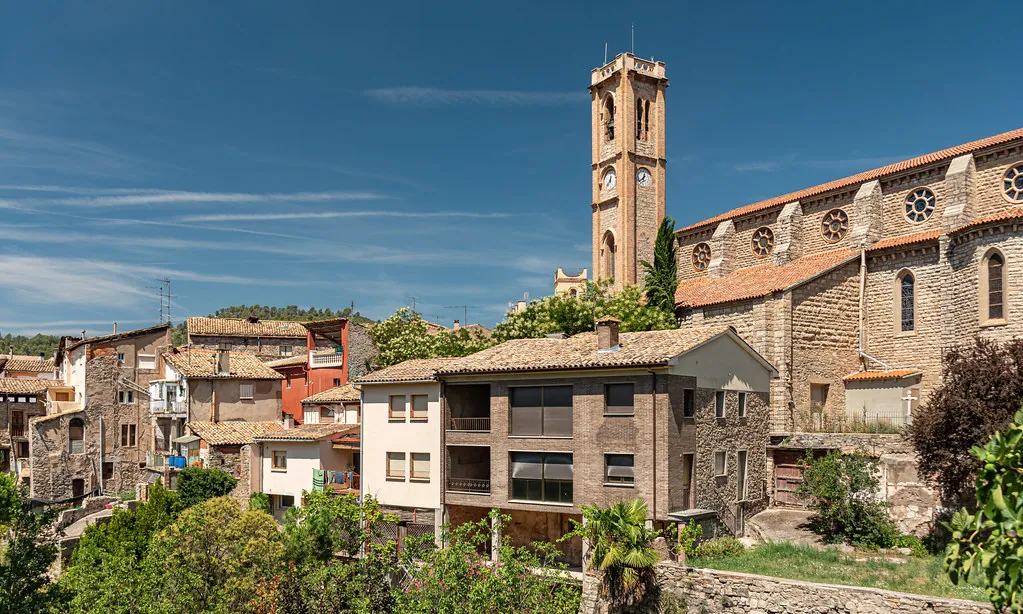
The historic centre of Talamanca is easy to cover on foot. It is small and makes no attempt to appear otherwise. Narrow streets wind between houses built with plenty of visible stone. Some of the slopes are steep enough to make you watch your footing as you climb.
At the heart of the village stands the church of Santa María, originally Romanesque and often cited as the oldest building in Talamanca. Like many churches in small Catalan villages, it has undergone alterations over the centuries. Even so, it retains the solid, restrained character typical of Romanesque architecture in inland Catalunya.
Higher up are the remains of the old castle. Visitors should not expect a complete fortress. What survives today are fragments integrated into the fabric of the village itself. Sections of wall and parts of towers have been absorbed into later houses. A slow walk along calle del Castell or calle Major reveals arches and doorways where these older structures are still visible within more recent buildings.
The overall impression is not of a grand medieval complex, but of a place that has evolved gradually, adapting old structures to new uses while keeping their outlines in place.
The bridge and the shape of the landscape
A path leads down towards the torrent, where a simple bridge crosses and doubles as an informal viewpoint. From here you can see clearly how Talamanca is positioned. The village sits on a small rise, with red-tiled roofs clustered together and a few vegetable plots at the lower edge.
The view is not dramatic. Instead, it reflects something very typical of the Bages landscape: stone and dry soil for much of the year, alongside fields that mix active cultivation with plots that have long since fallen out of use. The scene feels open and unvarnished, shaped by agriculture and the climate rather than by design.
This relationship between village and surroundings is one of the most distinctive aspects of Talamanca. The built centre is compact, and within a few minutes you are looking out over fields and woodland.
Vineyards, Mediterranean forest and walking routes
The countryside around Talamanca follows the familiar patterns of this part of the comarca. Vineyards spread across terraces. Pine woods cover large stretches of higher ground. Tracks and paths link old masías, the traditional rural farmhouses scattered across the territory.
Several footpaths begin in or near the village. Some connect with longer routes that head towards the nearby natural park of Sant Llorenç del Munt i l’Obac. The walks are not especially demanding, yet decent footwear is advisable because many sections are stony underfoot.
Cyclists who enjoy road riding may also appreciate the area. The secondary roads tend to carry little traffic and link a series of short climbs with stretches where you can ride at a steady pace. This is not a landscape of long mountain passes. Instead, elevation accumulates gradually as the road rises and dips across the terrain.
The setting encourages unhurried exploration. A short circuit on foot or by bike is often enough to get a sense of how the village connects to its agricultural and forested surroundings.
A good place to take a camera
Talamanca does not rely on major monuments or a long catalogue of historic buildings. Its appeal lies in smaller details: worn wooden doors, irregular stone walls, strong shadows early in the morning.
The compact layout makes it easy to move between narrow streets and more open spaces in a short time. Light shifts noticeably from one corner to the next. Those interested in photographing small rural villages may find that this variety, within such a limited area, offers plenty to work with.
Because everything is close together, there is no need to plan a route. A simple wander through the centre, followed by a short walk beyond the last houses, provides a range of perspectives.
Food, wine and local life in Bages
The cooking you encounter in this part of Catalunya tends to remain closely linked to local produce. Embutidos, olive oil and seasonal vegetables from kitchen gardens are common features. In Bages, wine also plays an important role thanks to the comarca’s winemaking tradition. In nearby villages it is not unusual to find wineries working with local grape varieties.
As in many small municipalities, Talamanca’s festive calendar centres on the summer festa major, usually held in August. During these days the village changes noticeably. Relatives return, activities take place in the main square and evenings often include music or communal meals.
For the rest of the year, daily life is quiet. Winter in particular brings a slower atmosphere, and the village regains the stillness that can fade during busier periods.
Getting there and taking your time
Reaching Talamanca is most practical by car. Public transport options are limited, and many of the more interesting paths and routes lie outside the village itself.
The approach that suits Talamanca best is simple. Arrive without a tight schedule. Park, wander through the old centre, walk up towards the castle area, then head out along one of the surrounding tracks. In the space of a morning or an afternoon you will have seen it all. The lasting impression is of a village that continues to live at its own steady pace, close to larger towns yet comfortably apart from them.