Full Article
about Aldover
Riverside village on the Ebro with a small beach, ringed by citrus groves in quiet countryside.
Hide article Read full article
A small town with unexpected contrasts
Aldover is the kind of place that sounds almost contradictory when someone describes it. It has a beach, yet there is no sea. It once had a railway station, yet trains no longer pass through. And in its streets, it is common to see more bicycles than cars. All of this unfolds in a municipality of around 900 residents in the Baix Ebre comarca of Catalonia, where any conversation about food will sooner or later lead to coca de recapte.
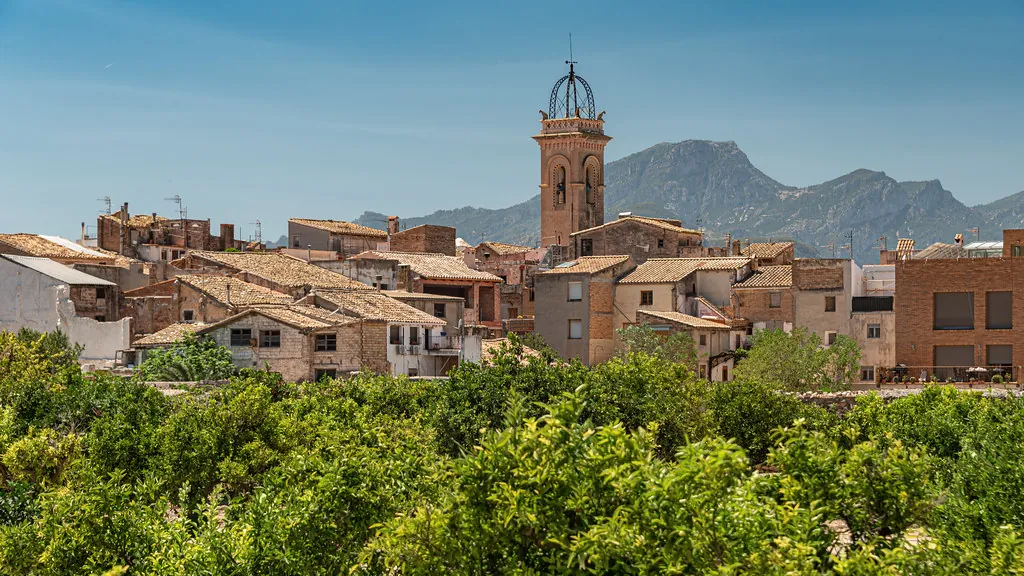
At first glance, Aldover can seem modest. It is not a town of grand landmarks or busy shopping streets. Its scale is small and its pace unhurried. Yet its setting, pressed close to the River Ebro and surrounded by market gardens, gives it a distinct identity shaped by water and cultivated land.
Life beside the River Ebro
Aldover sits along the final stretch of the Ebro before the river reaches its delta. The air here does not feel coastal in the usual sense. Rather than salt or sea breeze, there is the scent of worked soil and vegetable plots. Artichoke season leaves its trace, and the landscape speaks more of orchards than beaches.
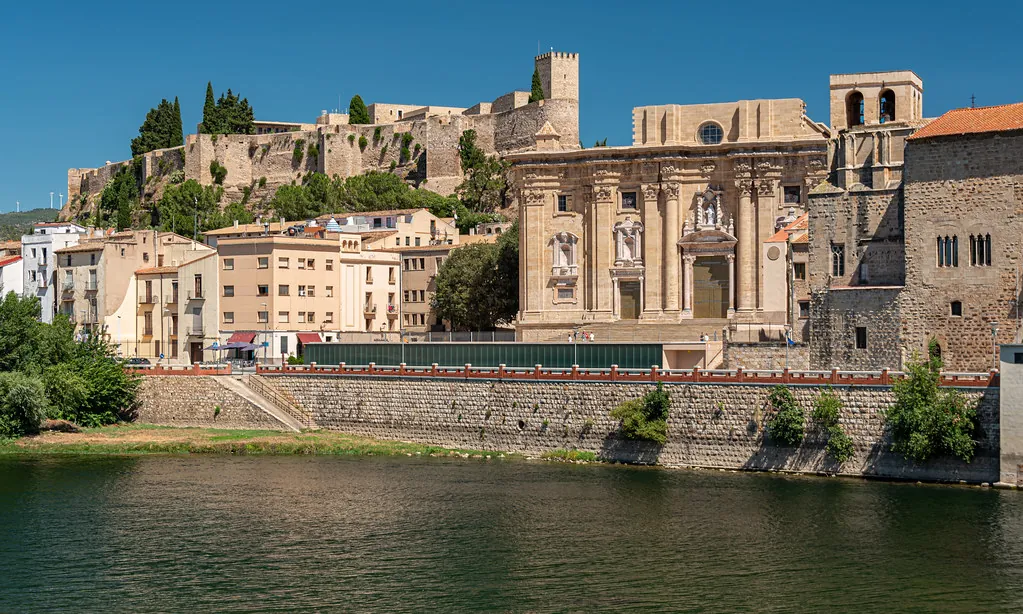
The Ebro passes wide and steady at this point. It is not a dramatic mountain river, but a broad, slow-moving presence that quietly orders the landscape around it. The water occupies space and attention, defining how fields are laid out and how the town relates to its surroundings.
One of Aldover’s most unexpected features is its river beach. The term may sound unusual until it comes into view: a wide sandy bank beside the Ebro that becomes a gathering place in the warmer months. In summer it draws people from Tortosa and nearby villages who want to cool off without heading all the way down to the Delta. For much of the year it is calmer, a stretch of sand and water that reinforces how closely the town’s life is tied to the river.
From railway station to cycle stop
The former railway station still stands on the edge of Aldover, even though trains stopped running here decades ago. In many places such buildings have fallen into disuse. Here, it has been given a second purpose.
Today the station functions as a stopping point on the Vía Verde del Val de Zafán, one of the greenways that follow the route of a disused railway line. These routes are known for their gentle gradients and long, straight stretches, making them popular with cyclists and walkers alike. The Val de Zafán line attracts a steady flow of people travelling at an easy pace, often passing through tunnels and open countryside.
The station building has been adapted in a practical way to serve those travelling by bike or on foot. It is a place to pause, rest briefly and then continue along the route. The sense of continuity is striking. Although the trains have gone, the structure remains active, connected to movement in a different form.
Cyclotourists from various countries use this stretch of the greenway. The ongoing use of the station underlines a broader pattern in the area: rather than erasing its railway past, Aldover has folded it into its present-day rhythm.
Food rooted in the huerta
With a population of around 900, Aldover’s food scene reflects the scale of the town. What stands out is how closely it draws on the surrounding huerta, the irrigated market gardens that spread out in neat plots around the river.
Coca de recapte appears frequently. This traditional Catalan flatbread is usually topped with escalivada, a mixture of roasted vegetables such as peppers and aubergine. In some versions it may include salted fish or cured meats. In Aldover it is eaten at different times of day and is closely associated with everyday life rather than special occasions.
Another local speciality mentioned in the town is gazpacho de almendras. Despite the name, it bears little resemblance to the tomato-based Andalusian gazpacho many visitors know. This version is a pale, chilled soup made with almonds and bread. It is lighter in flavour and tends to appear when the weather turns hot.
Festive dates bring food to the forefront. During local celebrations it is common to see large paellas or suquets cooked outdoors in the street. On those days, relatives who live elsewhere return and the population briefly swells. For a few hours, the town feels larger, animated by shared meals and conversation.
Sant Jaume and the agricultural landscape
The parish church of Sant Jaume does not dominate the skyline in a dramatic way. Its appearance is solid and somewhat austere, built with durability in mind rather than ornament.
Inside, however, there is a notable contrast. The church houses a striking Baroque altarpiece that stands out against the building’s restrained interior. In a town of this size, such a feature can come as a surprise, precisely because expectations are modest.
From the area around the church and its bell tower, the setting becomes clear. The huerta stretches out in orderly grids. The River Ebro marks the course of the landscape. In the distance, the outline of Tortosa is visible. Aldover occupies a point where the river remains central, yet the atmosphere is distinctly agricultural.
Is Aldover worth a stop?
The answer depends largely on the kind of journey being made.
Travellers in search of major monuments, extensive museums or lively commercial streets may find that Aldover feels limited. The town is small and can be explored in a short time.
For those following the Vía Verde del Val de Zafán, or anyone who enjoys pausing in places where daily routines are still visible, Aldover makes sense as a stop. Conversations in the square, farmers coming and going, cyclists taking a break along the route: these are the scenes that define it.
A simple plan is enough to get a sense of the place. Arrive in the morning, leave the car near the old station and cycle the stretch towards Tortosa. The route is straightforward, with the landscape shifting gradually between orchards and river. Afterwards, return to the village, eat something unhurried and take a short walk through the streets.
Within a few hours, Aldover reveals itself. It does not set out to impress. In the colder months it can feel especially quiet, and when the Ebro runs high the character of the riverbank changes. What remains constant is the town’s close relationship with the water and the land around it, and a way of life that continues at its own measured pace.