Full Article
about Corçà
A municipality with medieval charm and several clustered hamlets; well-preserved traditional architecture.
Hide article Read full article
A quiet start in the Baix Empordà
The square is still half empty when the sun begins to touch the stone façades. A table is unfolded, a chair scrapes across the ground, and the sound echoes between the low houses. That is how many mornings begin in Corçà, almost without anyone noticing. The village moves at its own pace. There is the smell of fresh bread, and of damp earth when the nearby vegetable plots have just been watered.
Corçà lies in the Baix Empordà, a comarca in Catalonia, a short distance from Girona and from the coast. Just over a thousand people live here. There are no grand monuments or visitor-focused attractions. What defines the place are narrow streets, uneven walls and the steady overlap of daily life with old stone that still shapes the rhythm of the village.
This is not a destination built around spectacle. It rewards attention rather than urgency.
Sant Julià and the village heart
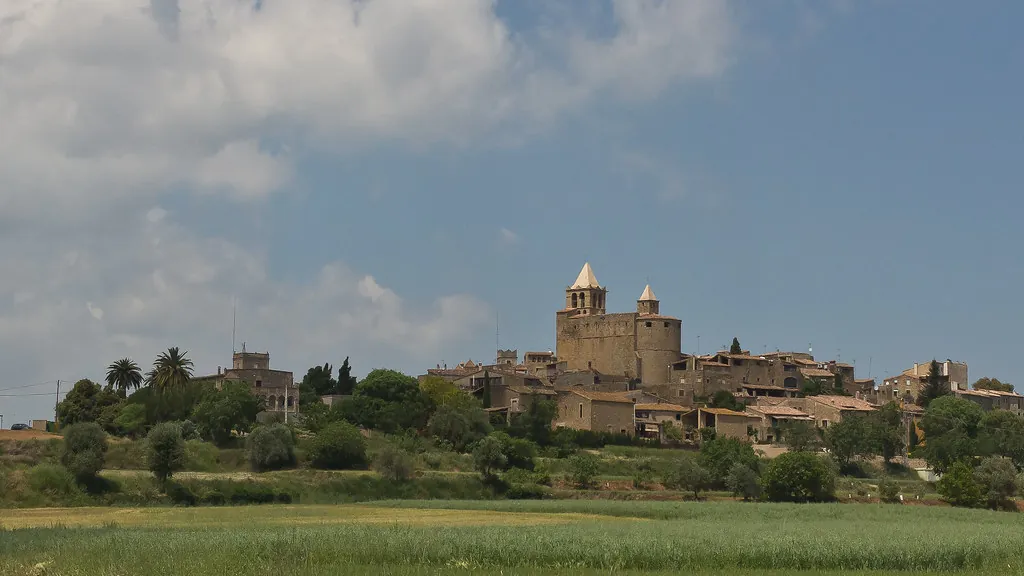
The church of Sant Julià appears between the houses as you approach the centre. Its bell tower can be seen from several points in the old quarter. The present building seems to be the result of different phases and alterations, something common in villages across this part of Catalonia.
Inside, a soft half-light usually fills the space. Pale stone, wooden pews, simple altarpieces. It is not somewhere that invites haste. If the church is open, it is worth stepping inside and pausing for a while, allowing the quiet to settle.
Around it, the small network of streets takes shape. Some still preserve stretches of cobbles and old doorways. There are narrow windows, balconies with iron railings and walls that reveal layers of change. The centre is compact, easy to cross in a short time, yet full of small details that slow the pace.
Wandering the old streets
In Corçà, the best approach is to walk without too much of a plan. Streets bend at short corners. An inner courtyard might appear unexpectedly, or a wide gateway that once led to a farmyard.
Many of the houses were agricultural in origin. Large entrances and former storage spaces, now converted to other uses, still hint at that past. The masías in the surrounding countryside complete the picture. These traditional Catalan farmhouses, built of stone and set apart from one another, sit among cultivated fields.
By mid-afternoon the light shifts quickly. It enters at an angle, tracing the textures of the walls. At that hour the village grows quieter. Footsteps carry further. The movement of the day slows, and the old quarter feels more introspective.
There is no fixed route to follow. Part of the appeal lies in turning a corner simply to see what is there.
Rural paths and open land
Beyond the built-up area, dirt tracks begin. They are mainly agricultural paths, mostly flat, crossing farmland and small holm oak woods. These routes help explain how the territory is organised: open fields, scattered masías and minor roads that link everything together.
In summer, dry cereal crops reflect a sharp, pale light. Autumn brings darker tones and damp ground. Early in the day, birds are often easier to hear than cars.
Walking or cycling along these paths does not usually present much difficulty. Some tracks connect with other nearby villages in the Baix Empordà, making it possible to extend a route beyond Corçà itself. The setting remains rural and working, rather than decorative. Fields are part of daily life here, not a backdrop created for visitors.
The landscape changes with the seasons, and that shift alters the feel of a walk. The same stretch of track can seem bright and exposed in summer, then enclosed and earthy a few months later.
A practical base for exploring the comarca
Corçà is close to several well-known villages in the comarca. Other historic centres inland can be reached after a short drive. The coast is not far away either, following the road east towards the Costa Brava.
For that reason, many people use the village as a quiet base. Days are spent exploring the surrounding area, then evenings return to the interior calm of the Empordà. When the wind drops, there is barely any sound beyond an occasional distant car.
The contrast between inland and coast is part of the appeal. You can spend time among busier seaside areas and then come back to streets where daily routines continue at an unhurried tempo.
When to come and what to know
Corçà changes noticeably with the seasons. Summer brings more movement, especially at weekends. Those who prefer to walk calmly through the streets will find that the early hours of the day tend to be the most peaceful.
For the rest of the year, the atmosphere feels more everyday. Shops open and close. Neighbours greet one another in the square. Tractors pass through on their way to the fields.
From Girona, the usual way to reach Corçà is by road in the direction of the Costa Brava. The journey is short, and having a car makes it easier to move between the surrounding villages.
Corçà does not operate as a dramatic stage set. It works best when observed slowly: the sound of shutters being raised, the shade of a holm oak beside a track, the toasted colour of stone as evening falls. Life here continues at its own pace, with or without visitors.