Full Article
about Cruïlles Monells i Sant Sadurní de l'Heura
Triple municipality with postcard-perfect medieval villages; Monells is known for its arcaded square.
Hide article Read full article
Three villages, one slow rhythm
Cruïlles, Monells and Sant Sadurní de l’Heura are best explored at an unhurried pace, and mostly on foot once you arrive. The usual approach is to leave the car at the entrance to each village and continue walking through the centre. Monells tends to draw the most visitors, so arriving late at the weekend can mean circling for a space.
These three places form a single municipality in the Baix Empordà, with just over a thousand residents spread across the main villages and a number of scattered farmhouses. They sit close to one another and can be covered in a long half day. Many people come to Monells and leave without seeing the other two, even though they are only a few minutes away by road.
The surrounding landscape is typical of inland Empordà: open fields, narrow rural roads and stone houses still in use. There are no large-scale attractions or elaborate tourist set-ups. The point here is simple, walk for a while and take things in slowly.
Monells and its medieval square
Monells holds most of the attention. Plaça Jaume I is a well-preserved medieval square with arcades. Stone surfaces, uneven arches and covered walkways that once hosted a market still define the space. Today, it is more often used for sitting quietly or passing through on the way to nearby streets.
Some scenes from the film Ocho apellidos catalanes were shot here, which increased its visibility on social media and in quick travel guides. Even so, outside weekends and the summer period, the village remains calm.
Narrow alleys lead off from the square, lined with stone houses that have been carefully maintained. There are no major hidden monuments. Interest lies in the details: arches, slight changes in ground level, and façades that retain medieval elements. Close to the centre there is an old public washhouse that is still easy to recognise.
Cruïlles and Sant Sadurní, quieter corners
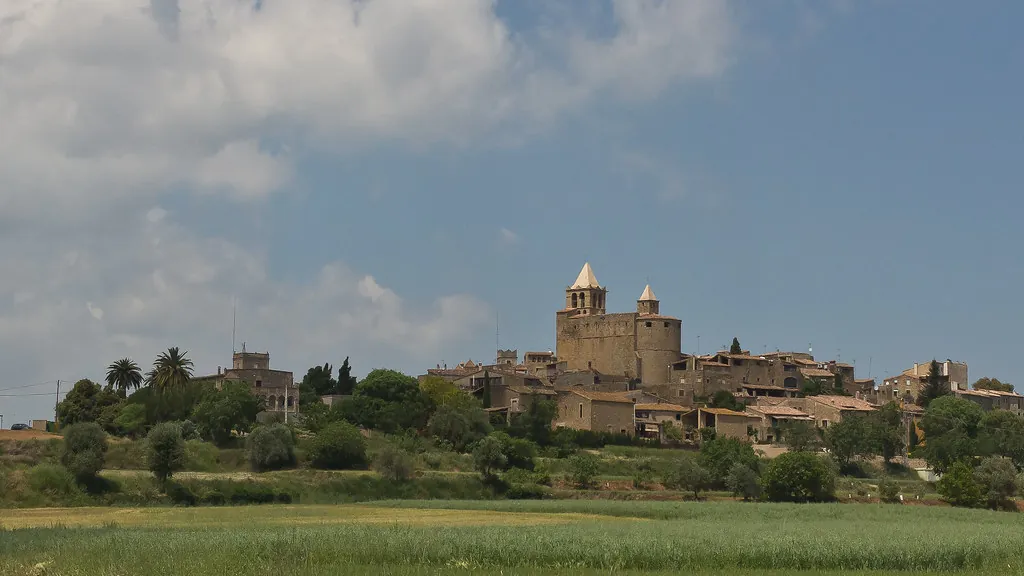
Cruïlles feels different. The most visible landmark is the church of Sant Miquel, alongside the remains of a former Benedictine monastic complex dating back to the 11th century. It has undergone changes over time, but the basic layout of a small monastery can still be understood.
Nearby stands the tower of what was once a castle. It can be seen from several points in the village and from surrounding rural paths. Not all of the structure survives, yet the tower continues to define the outline of the place.
Sant Sadurní de l’Heura is the most understated of the three. It has a Romanesque church that has also been altered over the centuries, and a small cluster of buildings around it. Here, the setting carries more weight than the architecture: open farmland and long views across the interior of the Empordà.
In the surrounding area, old farmhouses appear, some with a defensive look. Many are privately owned and still inhabited or used for agriculture, so they are usually seen from the paths rather than visited directly.
Getting around without overthinking it
The easiest way to move between the villages is by car, then explore each one on foot. Distances are short and the secondary roads tend to be quiet.
There are also rural paths linking the three centres. These are straightforward routes that pass through cultivated fields and small patches of Mediterranean woodland. In hot weather, the middle of the day is best avoided as some stretches offer little shade.
There are no large museums or interpretation centres that require careful planning. It works better to wander for a while without a fixed route, then continue on to the next village.
Local life and seasonal moments
During the summer, each village usually holds its own festa major, the traditional local festival common across Catalonia. These tend to include small concerts, dancing and shared meals. The atmosphere is more about local life than attracting large numbers of visitors.
Throughout the year there are also fairs and gatherings linked to artisan products and the agricultural calendar. Dates vary depending on the year and local organisation, so it is worth checking in advance if you want to coincide with one.
A simple way to plan the visit
A practical approach is to start in Monells early, then move on to Cruïlles or Sant Sadurní once it begins to fill up. Many visitors go no further than the square in Monells and miss the rest of the municipality. That is precisely where things become quieter again.