Full Article
about Garrigoles
Small, quiet rural village; perfect for unwinding in inland Empordà
Hide article Read full article
A small village that keeps its own rhythm
Some places are found almost by accident. You turn off a local road, spot a handful of houses grouped together and wonder who lives there. Tourism in Garrigoles has a bit of that feeling. It is not a village that features on many Baix Empordà routes in Catalonia, and for that very reason it has kept the sense of a place where daily life continues at its own pace.
Garrigoles has around 182 residents. There are stone houses, open fields all around and quiet. Not a postcard version of silence, but the ordinary hush of a place where a tractor passes now and then, or someone walks a dog, and little more disturbs the day.
This is not somewhere that overwhelms with sights. It is somewhere that feels lived in.
The shape of the village
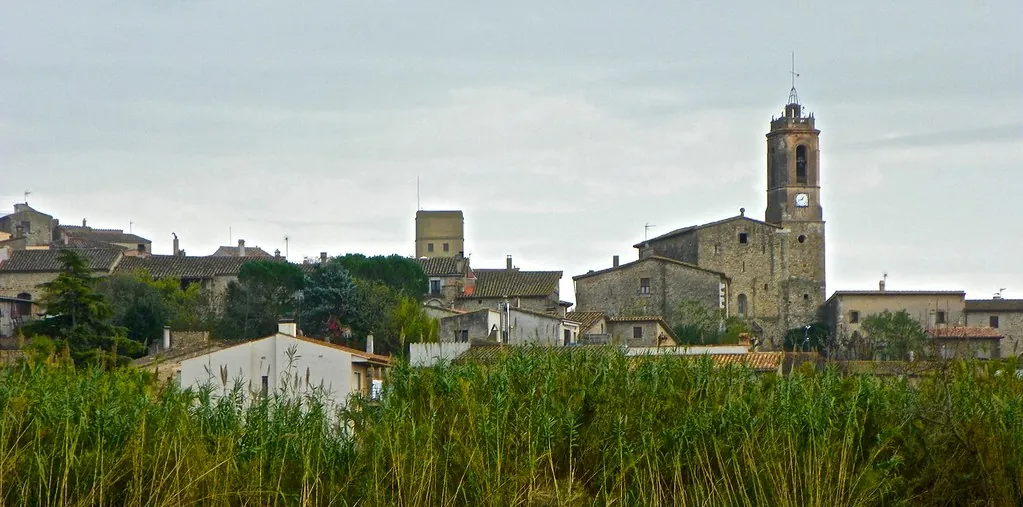
The centre is small. The kind you could cross in ten minutes if in a hurry, although it usually takes longer because details catch the eye: an old doorway, a stretch of dry stone wall, a half-hidden inner courtyard glimpsed through a gate.
The church of Sant Martí stands close to the heart of the village. It is not a spectacular building, but it has the solid, grounded presence of a structure that has watched generations pass without shifting from its place.
The layout of the streets has changed little over time. A short wander without direction quickly brings you back to where you started, much like circling through the neighbourhood of someone who knows every shortcut by heart. There is no grand historic quarter, no monumental ensemble to tick off. What there is instead is continuity, in the paving, in the walls, in the scale of the houses.
Garrigoles is small enough that its limits are clear. Within a few minutes, the built-up area gives way to open countryside.
Walking through the Baix Empordà landscape
Beyond the last houses, the countryside takes over. Agricultural plots stretch outwards, broken up by small patches of Mediterranean woodland and dirt tracks that link Garrigoles to nearby villages.
These are easy routes for walking or cycling. Nothing epic, nothing that demands equipment or planning. They are the sort of paths where you move forward without paying much attention to the clock.
From slightly higher points, the plain of the Empordà opens up. On clear days, the outline of Les Gavarres appears in the distance. There is no prepared viewpoint or marked platform. You simply look up and the landscape is there.
The Baix Empordà is a comarca, or county, in the province of Girona, known for its mix of farmland, small villages and a coastline not far away. Garrigoles sits quietly within this setting. The surroundings define much of the experience here: open horizons, cultivated land, tracks between fields.
There is little separation between village and landscape. Step outside and you are already in it.
Within easy reach of history and coast
One of Garrigoles’ advantages is its location. It lies in the middle of an area with considerable history, all within a short drive.
Heading inland, several well-known medieval villages of the Baix Empordà come into view. They are known for their walls, cobbled streets and squares where the original layout of the settlement is still visible. Garrigoles itself does not have that monumental profile, but it sits within the same wider region.
In the other direction, towards the coast, the scenery shifts quickly. The shoreline is not far away, and with it the maritime side of the Empordà.
Also relatively close are the archaeological remains of Empúries and the ancient Iberian settlement of Ullastret. Both sites help to explain how long this area has been inhabited. They place Garrigoles within a broader historical context that stretches back well before the present village took shape.
Food is another part of the Empordà identity. Rice from the Pals area, olive oil, fish brought in from the coast all form part of the regional cuisine. Garrigoles itself is very small and does not concentrate much in the way of restaurants or services. The usual approach is to head to neighbouring villages for a wider choice.
This makes Garrigoles less of a base for packed itineraries and more of a quiet point within a larger map.
Summer festivities and everyday life
In summer, the village becomes a little livelier. Traditionally, the festa major is held in August. Like many small Catalan villages, this annual festival brings together neighbours who know each other well, people who return for a few days, and simple activities centred around the main square.
Outside this period, life is calm. Very calm. Garrigoles functions more as a place to live or to spend longer stretches of time than as a short break filled with plans and attractions.
There is a clear sense that the village is not trying to reinvent itself as a destination. It continues much as it has, with seasonal rhythms and everyday routines shaping the year.
Getting there and what it is not
Garrigoles is reached by local road from the main routes of the Baix Empordà. The final stretch usually runs along secondary roads between fields, the kind where speed drops almost without noticing.
It helps to be clear about what Garrigoles is, and what it is not. There is no monumental historic centre, no long list of landmarks to mark off on a map.
It is the sort of place found after leaving the main route for a while. You stop briefly, take a short walk, look around, then continue on with a clearer sense of how life unfolds in the small villages of the Empordà.
Garrigoles does not demand much from visitors. It offers space, quiet and a setting shaped by fields and low horizons. For some, that will be enough.