Full Article
about Palamós
Fishing town famous for its red shrimp; commercial port and long beaches
Hide article Read full article
The red prawns arrive while it is still dark. At around five in the morning the first blue plastic crates begin to appear on the quay, still wet, with tentacles moving slowly as if they have not yet understood they are no longer in the water. At that hour tourism in Palamós does not exist. There are only fishermen, hot coffee passed from hand to hand, and the sky lightening behind a forest of masts. The harbour smells of salt and diesel, a mixture that clings to your clothes for hours.
Few words are exchanged. The sound is the dull thud of crates on concrete and the occasional gull arriving before the sun.
The Taste of the Sea
The first time you try a gamba de Palamós, the local red prawn, it becomes clear why seafood is handled with such care here. The flavour is deep and mineral, with the cold character of the seabed. It comes from fishing at considerable depth, where the colour of the water shifts and the nets drag slowly along the bottom.
At the fish market the catch is sorted by size with impressive speed. The largest specimens usually travel far beyond the town. Others remain nearby and end up in home kitchens or in the bars around the harbour, briefly cooked in a pan with olive oil and coarse salt.
The best season generally begins in autumn and runs well into spring. In winter the difference is noticeable: the air feels cleaner, the harbour works to a steadier rhythm, and many bars still cook as they would at home. A hot suquet, the traditional Catalan fish stew, served in a clay dish with bread for dipping into the broth, makes particular sense when rain falls outside and the quay is almost empty.
Walking the Camí de Ronda
The Camí de Ronda begins behind the Museu de la Pesca, between fishing nets hung out to dry and cats sleeping on plastic crates. From there the path follows the coastline towards Calella de Palafrugell. It runs for several kilometres across rock and pine, with short climbs that force a pause now and then.
In some stretches the sea lies so close that the wind carries salt spray across the path. After passing S’Alguer, a small cluster of fishermen’s houses painted white and ochre, the route becomes steeper and thick roots cross the earth underfoot. Sturdy footwear is advisable, particularly if the ground is damp.
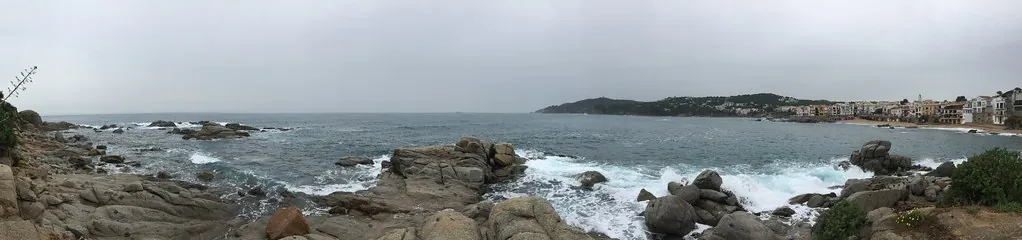
By mid-afternoon the light shifts. The water turns silvery and from certain high points the whole gulf opens up: in one direction the Castell de Sant Esteve de Mar, in the other the cliffs that continue towards Calella. If you descend to Cala del Crit, take water with you. There are no facilities below, only warm rock, leaning pines and the constant sound of the sea folding into the cove.
This stretch of coast rewards a slower pace. The path was originally used to patrol the shoreline, and today it allows walkers to experience the terrain at the same unhurried rhythm as the fishing boats offshore.
What Remains of the Castle
The Castell de Vila-romà lies a couple of kilometres inland from the centre, on the road climbing towards Vall-llobrega. Little remains standing: sections of wall, an arch, and part of the tower that still holds out. The rest has gradually been claimed by tall grasses and nettles.
The fortification suffered damage during the retreat of Napoleonic troops at the beginning of the 19th century. Over time it lost its defensive purpose. What is striking is that later a masia, a traditional Catalan farmhouse, was built within the enclosure, as if the site had shifted from guarding the territory to simply inhabiting it.
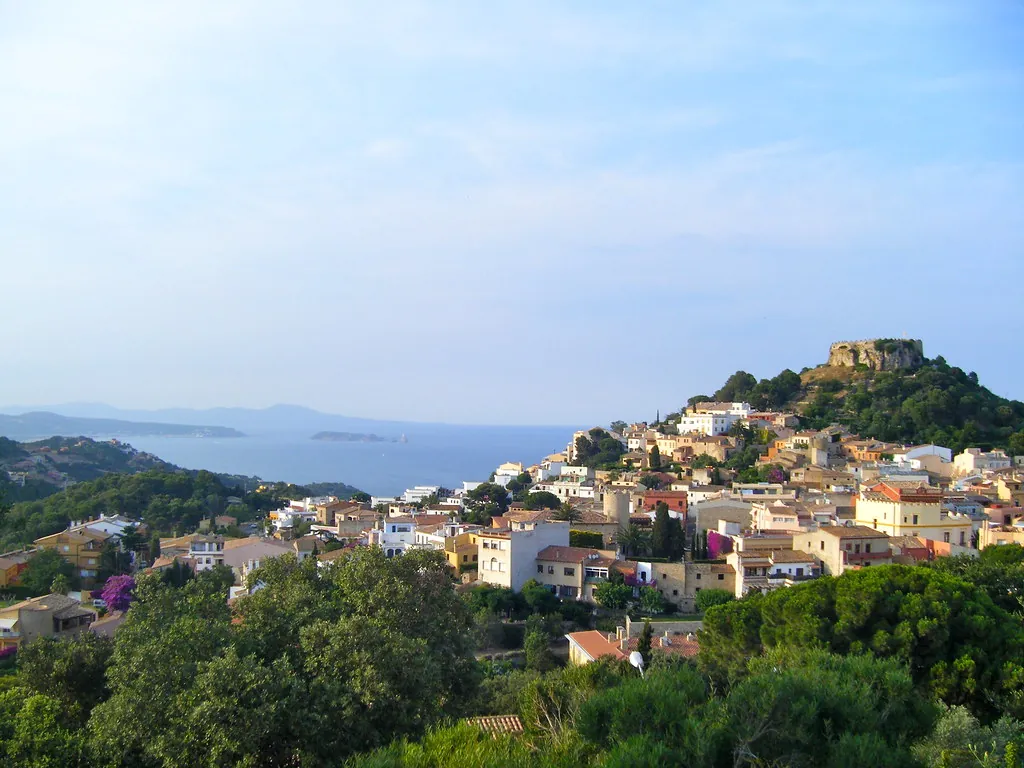
From the highest point the Empordà stretches out towards the Gavarres hills and, between two rises, a strip of blue Mediterranean appears. The wind often blows strongly. At times it carries the scent of cultivated fields, at others the distant murmur of the road.
A Museum That Smells of the Sea
The Museu de la Pesca occupies a former space linked to port activity. The stone slabs on the floor still have the polished sheen left by decades of salt water and crates dragged from one side to another.
On the ground floor there is a reconstruction of the interior of a trawler: thick nets hanging from the ceiling, boxes for ice, notebooks where catches were recorded in tight handwriting. The air carries that mixture of rope, metal and engine oil.
Upstairs the displays explain how trawling works, how catches are classified, and how fish were auctioned according to a traditional system that still sets the tempo of the harbour. One of the videos features an elderly woman recalling how she learned to clean fish as a child: “Three movements and that’s it. If you cut yourself, salt and carry on.”
There is no grand narrative here, just everyday work presented without embellishment.
When to Go, What to Expect
Palamós has life throughout the year, but it changes markedly with the seasons. At the beginning of summer, around Sant Pere, the feast day associated with Saint Peter and closely linked to fishing communities, the harbour fills with activity and celebrations connected to the maritime world. These are lively days, and many people return to spend time here.
In August the atmosphere shifts. The central beaches fill from mid-morning and the seafront promenade grows noisy, with queues to park and crowded terraces.
If there is flexibility, September is often a good moment. The water retains the warmth of summer, yet the pace begins to ease. The port continues its routine, the Camí de Ronda remains open to the same stretches of rock and pine, and the red prawns still arrive before dawn, long before most visitors are awake.
Palamós does not separate its tourism from its working life. The fishing boats leave and return according to their own timetable, indifferent to the season. Walk a little beyond the busiest beach or wake early enough to reach the quay, and the town reveals itself in simple scenes: crates stacked in blue columns, nets drying in the wind, the smell of salt and diesel lingering in the air.