Full Article
about Vilopriu
Hilltop village with a castle-palace; includes the hamlet of Gaüses
Hide article Read full article
Early in the morning, when the sun begins to drop across the stone walls of the church of Sant Miquel, Vilopriu is still half asleep. Light filters in at an angle through the glass and casts pale shapes onto the rough surface inside. A blackbird can be heard, perhaps a door opening in a nearby house, and little else. Tourism in Vilopriu begins with that feeling of having arrived too soon, as if the day itself is still stretching awake.
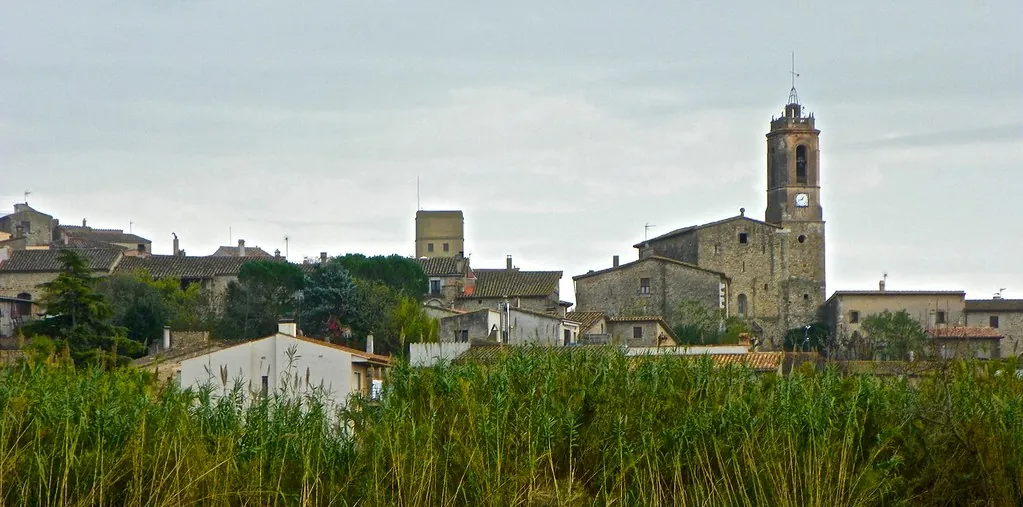
Vilopriu lies inland in the Baix Empordà, surrounded by open fields and secondary roads where most traffic simply passes by. Just over two hundred people live here, and the rhythm of life follows the fields that encircle the village. From its edges the view opens onto cultivated land: in spring the greens are fresh and damp, while in summer the cereals turn yellow, almost white at midday. When the air is clear, the outline of the Montgrí massif can be made out to the north, cut against the horizon.
This is not a place of constant movement. It is somewhere to pause, to notice how the light changes across stone and crops, and to accept that little may happen for long stretches of the day.
Around the Church of Sant Miquel
The centre of Vilopriu can be covered in a matter of minutes. The parish church, dedicated to Sant Miquel, anchors the small cluster of houses that gather around it. Its thick walls and narrow windows allow in a soft light that shifts noticeably as the hours pass.
The surrounding streets are short, with stretches of stone paving and houses that still preserve doorways framed by clearly defined voussoirs. There are no grand buildings or expansive squares. Instead there is a compact group of constructions that reflect centuries of agricultural life. On some façades old roof tiles remain in place, wooden shutters show their age, and small courtyards hold stacks of farming tools.
By mid-afternoon the village becomes almost completely still. The most constant sound is often the wind moving through the trees that stand close to the houses. Without shops or heavy traffic to interrupt the quiet, the atmosphere depends on small details: a conversation drifting from a window, the scrape of a chair on stone, the distant hum of a tractor beyond the last row of homes.
Sant Miquel is both a physical and social centre. Even for visitors simply walking through, it provides a reference point in a village where everything is close at hand and distances are measured in a few dozen steps rather than kilometres.
Paths Through the Fields of the Baix Empordà
The landscape around Vilopriu is typical of the inland Empordà: open farmland, dry stone walls and dirt tracks linking scattered masías, the traditional Catalan farmhouses. These rural paths connect with nearby settlements such as Ullà or Palau-sator. They are not always designed as signposted walking routes. Many are agricultural tracks used daily by local residents.
For that reason, any walk here calls for a degree of attention. Tractors may pass, and some plots are actively cultivated. The sense of sharing working land is part of the experience. There are no dramatic changes in elevation, as the topography is generally gentle, which makes the area suitable for exploring on foot or by bicycle without significant climbs.
In summer it is wise to set out early. Shade is limited and the sun falls hard on the open fields. At midday the heat can linger over the ground, and the pale colour of the crops reflects the light back with intensity. In spring the air tends to feel softer, and the fields are at their greenest.
Walking these tracks gives a clearer sense of how small Vilopriu is within its wider setting. The village sits as one element in a broad agricultural plain, defined less by monuments than by patterns of cultivation and long horizons.
Food from the Fields
The cooking in this part of the Empordà revolves around what comes from the surrounding land and nearby farms: seasonal vegetables, cured meats and straightforward rice dishes. It is food that depends heavily on the quality of the ingredients rather than elaborate preparation.
In larger towns in the comarca, such as La Bisbal d’Empordà or Torroella de Montgrí, markets often display local produce alongside wines from the Empordà denomination of origin. These markets provide a snapshot of the region’s agricultural base, with stalls reflecting what is in season at any given time.
The cuisine here is not complex. It is direct and rooted in availability, shaped by the same fields that frame Vilopriu itself. For visitors staying in or near the village, meals tend to echo that simplicity, whether cooked at home or enjoyed in the surrounding area.
Festivities and Village Life
As in many small villages, the calendar in Vilopriu comes alive above all during the festa major, traditionally held in summer. Over those days the atmosphere shifts. Long tables appear, music fills the air and activities bring together both permanent residents and those who return to the village for a short time.
There are also celebrations linked to the church and the rural calendar. These occasions briefly alter the usual quiet of the streets. Conversations multiply, food is prepared collectively and there is a level of movement that is barely noticeable during the winter months.
For much of the year Vilopriu remains subdued. The contrast between ordinary days and festive ones makes those gatherings more pronounced. They offer a glimpse of the social fabric that sustains a place with a small population and limited commercial activity.
Getting There and Choosing the Moment
Vilopriu is around 35 minutes by car from Girona, following the C‑66 towards La Bisbal d’Empordà and then continuing along local roads. From Barcelona the journey is usually about two hours, depending on traffic conditions.
It is worth arriving with the intention of stopping for a while and walking without haste. The village is small and there is little commercial movement, so not everything will necessarily be open. This is less a destination for ticking off sights and more a setting for slowing down.
The first hours of the morning and the end of the afternoon are when the light in the Empordà falls most gently on the houses and surrounding fields. In the height of summer it is better to avoid the middle of the day. Shade is scarce and the heat clings to the stone.
Vilopriu does not present a long list of attractions. Its appeal lies in its scale, its fields and the steady passage of the day from cool morning to warm afternoon. For those willing to adjust to its pace, that is precisely the point.