

Full Article
about Castelldefels
Coastal resort town with a long sandy beach and a castle on the hilltop
Hide article Read full article
First Things First: The Parking Problem
Arrive before ten or forget about parking. The queue of cars can begin at the second set of traffic lights and stretch all the way to the Can Camins car park. In August, expect it to double. This is the part few people mention about Castelldefels: the beach is vast, the parking is not.
Castelldefels sits just south of Barcelona and has become a go-to stretch of sand for day-trippers. On summer weekends, much of Barcelona seems to head in the same direction. If you time it badly, most of the morning can disappear before you even reach the sea.
Come prepared and it works well. Turn up late and patience is required.
Five Kilometres of Sand
The beach runs for five kilometres, from the Olympic Canal to Gavà. In many sections it is close to one hundred metres wide. In summer, towels spread across almost all of it. There is space, but it fills.
By mid to late afternoon, the wind often arrives from the east. The central stretch becomes dotted with kites as kitesurfers take advantage of the conditions. If swimming is the priority and calmer water is preferred, early morning is the safest bet. The northern end, closer to the canal, is often less affected by the wind.
The sea is typical for this part of the Catalan coast: clean, sandy underfoot and shallow at first. It is neither better nor worse than Sitges or Vilanova. The main difference is the Olympic Canal.
Built for the 1992 Barcelona Olympic Games, the canal is about 1,200 metres long and enclosed by breakwaters. Canoeists train here, and on many weekends families appear with kayaks or paddleboards. It is not especially striking to look at, but the water is usually calmer than on the open beach. On windy days, that makes a difference.
The Castle on the Hill
From the beach, the walk up to the castle takes around ten minutes. The path is steep and there is little shade. At midday, water is essential.
The castle is a restored complex of walls with wide views over the coastline. The oldest part is the keep, dating back to the 10th century. The rest consists of medieval additions and a 16th-century chapel. Inside, there is usually a small exhibition explaining the network of defensive towers built to protect the coast from pirate attacks. Castelldefels once had around a dozen scattered across its territory, and some can still be identified.
From the battlements, the choice of location makes sense. The entire bay is visible, from the Garraf massif to El Prat. Below lies the modern town: five-storey apartment blocks, long avenues and a generous supply of roundabouts.
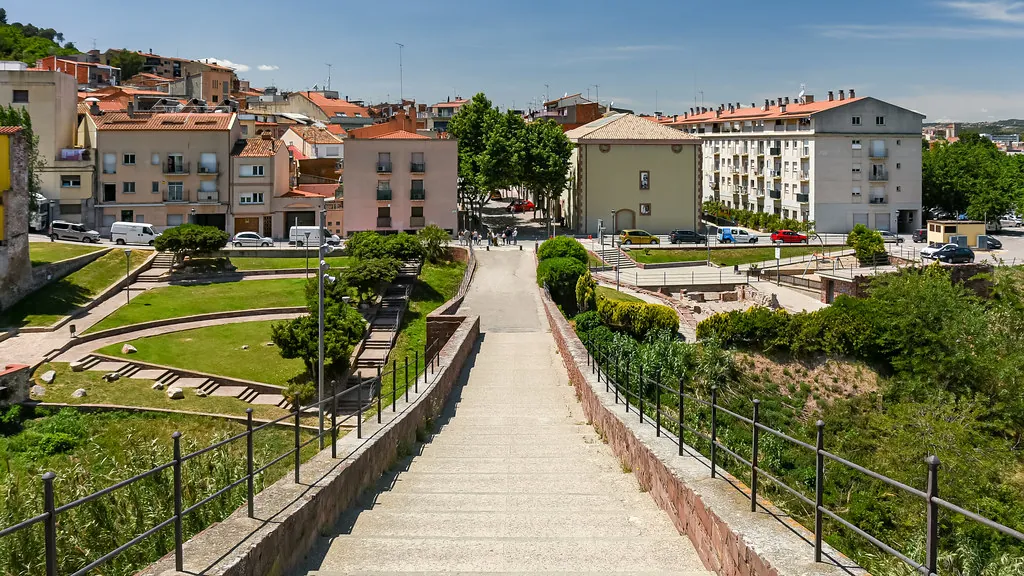
The old quarter is brief. Three streets near the early 20th-century church and little more. It can be covered in a short stroll. Castelldefels does not pretend to be a preserved medieval town. Its appeal lies elsewhere.
Sunset from the castle is short-lived, but the view rewards the climb. Afterwards, it is possible to walk down towards the area near the Ermita de Bruguers, where the atmosphere is usually quieter than along the seafront promenade.
Eating Without Overthinking It
There is no old fishermen’s quarter by the sea. Restaurants and bars are scattered along the promenade without much pattern. Menus tend to repeat the same staples: rice dishes, fideuà and grilled fish.
Xató sometimes appears. This is a local salad made with curly endive, salt cod and anchovies, dressed with a romesco-style sauce based on nuts and peppers. It suits those who enjoy bold, savoury flavours.
For something quick, the beach bars on the sand do the job. Quality is average. Prices are in line with any beach close to Barcelona. If a longer, more relaxed meal is preferred, the area around the church square usually has a few places where a table can still be found without too much waiting.
This is not a destination for culinary revelations. Nor is it prone to major disappointments. It functions, which for many visitors is enough.
A Short Escape into the Garraf
About three kilometres from the promenade begins the Garraf massif. The Parc Natural del Garraf covers thousands of hectares of limestone rock and low scrub. The landscape changes quickly from beach to dry hills.
A footpath starts behind the castle and descends towards the Ermita de Bruguers before climbing again towards La Mola. It is a short walk but exposed, with little shade. A hat and water are sensible precautions.
For flatter ground, the coastal path connects Castelldefels with Gavà in roughly an hour on foot. It is a wide walkway running alongside the coast. When the afternoon wind picks up, kitesurfers are clearly visible from here. Navigation is simple: sea on one side, road on the other.
These options offer a break from the busiest stretches of sand without needing to travel far.
Practical Notes for a Smoother Day
Can Camins is usually the first parking option near the beach, and it fills quickly in summer. The Olympic Canal car park is also widely used, and those who arrive early tend to find a space there.
If arriving by train, the station is about a ten-minute walk from the sand. Exit and head straight down towards the sea.
Weekends in July and August bring the heaviest traffic from Barcelona. When that happens, the more manageable area is often the northern end of the beach, near the canal, where there tends to be slightly more space.
Castelldefels is not Sitges or Cadaqués. There are no modernist houses and no large historic centre. It is a long beach with a castle on top, pressed up against Barcelona, designed for a day out and a return home. Approached with that expectation, it works.
Anyone searching for an old fishing village will need to continue further along the coast.