Full Article
about Sant Just Desvern
Quality residential town next to Collserola, home to the Walden 7 building
Hide article Read full article
From scattered farms to shifting horizons
The earliest written reference to Sant Just Desvern dates back to 965, in a document linked to the monastery of Sant Cugat. At that time, it was little more than a small agricultural settlement set between streams flowing down from Collserola. Vineyards dominated the land, with olives and cereal fields filling the rest. It was a rural landscape shaped by water and seasonal work.
That setting feels distant today. Sant Just Desvern sits only a few kilometres from Barcelona, yet its identity still reflects that long agricultural past. What makes it distinctive is how that past sits alongside unexpected architectural experiments from the twentieth century. A former cement factory turned into an architecture studio and a dense, almost maze-like housing complex stand as reminders of a very different phase in the town’s development.
Industry arrives, the town expands
Well into the twentieth century, Sant Just remained largely a village of farmers, known locally as payeses. Much of the cultivable land was devoted to vines. The rest supported olives, almond trees and small cereal plots that made use of water from Collserola’s streams.
Change came in the 1920s with the installation of a large cement factory in a quarry on the Serra de Sant Ramon. Industry reshaped both the landscape and the rhythm of daily life. Workers arrived from other areas, and the population began to grow quickly. Over a few decades, the town expanded towards the Llobregat plain.
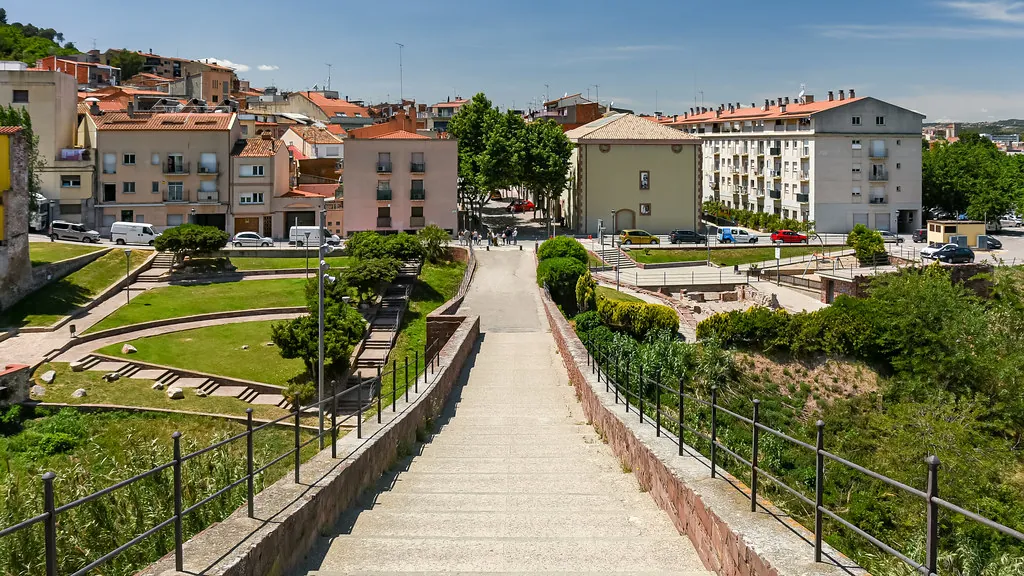
From that point on, two realities coexisted. There was the older agricultural core, still visible in parts of the town, and a more industrial environment that introduced new forms of construction and, later, space for architectural experimentation.
“Grafted” architecture in everyday spaces
The local council uses the expression “arquitectura empeltada”, meaning grafted architecture, to describe a series of interventions where modern design elements were inserted into traditional buildings. The result is not a clean break with the past but a layering of styles that reflects different moments in the town’s evolution.
One of the clearest examples is Can Ginestar. This seventeenth-century farmhouse was remodelled in the early twentieth century by an architect connected to Gaudí’s circle. The renovation introduced concrete elements, worked iron and wooden bay windows that echo late modernisme. Today, the building serves as a library and cultural centre. When open, its interior courtyard offers a quiet glimpse into this blend of old and new.
Nearby stands the house known as Bonavista, built in the late 1920s. Its design combines features of noucentisme, a movement associated with order and classical balance in Catalonia, with touches that lean towards art deco. The mix is subtle rather than showy, but it adds another layer to the town’s architectural variety.
Closer to the historic road leading to Barcelona is the former Hostal de la Creu, dating from 1930. Its design explores a Mediterranean style, with overhangs, ceramic details and sloping roofs. It reflects a moment when architects were searching for a modern language rooted in local traditions.
The route through these buildings often ends at the Hostal Vell. Remodelled in the late 1950s, it features exposed brick and beam structures. It is not a monumental building, yet it helps explain how modern architectural ideas gradually entered domestic spaces in Sant Just Desvern.
Walden‑7 and La Fábrica
The most widely known chapter in the town’s architectural story arrived in the 1970s. On the grounds of the former cement factory, the residential complex Walden‑7 was built, designed by Ricardo Bofill and his Taller de Arquitectura.
Walden‑7 is made up of hundreds of homes arranged in interlocking blocks around internal courtyards. Walkways, staircases and galleries, painted in strong colours, create a space that feels closer to an imagined city than a conventional residential building. Its layout encourages movement through shared spaces and constantly shifting perspectives.
A short distance away stands the old cement factory itself, transformed by Bofill into his studio, known as La Fábrica. Industrial structures such as silos were reused as offices, workspaces and cultural areas, all surrounded by vegetation. It is not a regular visitor site, as it continues to function as a working space, though it does open occasionally.
Together, Walden‑7 and La Fábrica capture a moment when industrial remnants became the foundation for new architectural ideas, linking Sant Just Desvern’s industrial phase with its creative reinvention.
Collserola within reach
The northern edge of Sant Just Desvern meets the Parc Natural de Collserola, a large protected area that stretches behind Barcelona. From the town centre, several paths lead up into the hills.
One of the most common routes climbs towards Sant Ramon. From there, the view takes in Barcelona, the Llobregat delta and, on clear days, mountains further inland. The proximity of these paths means that access to open countryside is immediate, without needing to leave the municipality.
The network of trails includes narrow paths known locally as corriols, used by runners and cyclists, which connect to wider forest tracks deeper into the park. Carrying water is advisable, as fountains are not always available along the initial stretches.
For a gentler walk, the route along the torrent de la Guinardera follows the valley floor through riverside vegetation. Along the way, there are remains of older hydraulic infrastructure. Medieval documents already mention flour mills in this area, indicating how long water has shaped activity here.
Festivals and local rhythms
Sant Just Desvern maintains a calendar of local celebrations that reflect traditions shared across many Catalan towns. The Festa Major takes place in mid-August, with a programme that includes sardanas, a traditional Catalan dance performed in circles, as well as community activities and concerts in the main square.
In autumn, the Festes de Tardor bring a different atmosphere. During these days, the town centre fills with stalls and neighbourhood initiatives as part of Sant Just al Carrer. Associations and residents set up stands offering handmade or second-hand goods, turning public space into a place of exchange and participation.
One of the most anticipated moments is the cursa de karts de coixinets, a race using small, homemade carts. It reflects a playful side of local culture, rooted in creativity and community involvement.
Sant Just Desvern does not present itself through a single defining landmark. Its character comes from the coexistence of elements that might seem unrelated at first glance: farmland and industry, traditional buildings and experimental design, quiet streets and access to the hills of Collserola. That mix gives the town its particular rhythm, shaped over centuries but still evolving.